Building effective teams
Teams in early childhood settings work together to promote the learning and wellbeing of children as well as their own professional knowledge and understanding.
Definition
In the context of early childhood education a team can be broadly defined as a group of people working together to advance their professional knowledge and skills in order to achieve an agreed-upon set of goals. This group may include teachers as well as professionals from outside agencies in an early childhood setting. The New Zealand early childhood curriculum, Te Whāriki, also envisages early childhood teachers working in teams with parents and communities to support children as competent and confident learners.
Relevance
Teamwork in early childhood settings is vital as it involves everyone contributing to achieving the overall mission of their community. Effective teamwork is essential for the development of professional knowledge and skills through engagement with research and professional learning and the collaborative sharing and questioning of practice. Its emphasis on open, trusting relationships supports wellbeing among teachers, children and the wider early childhood community.
State of the evidence
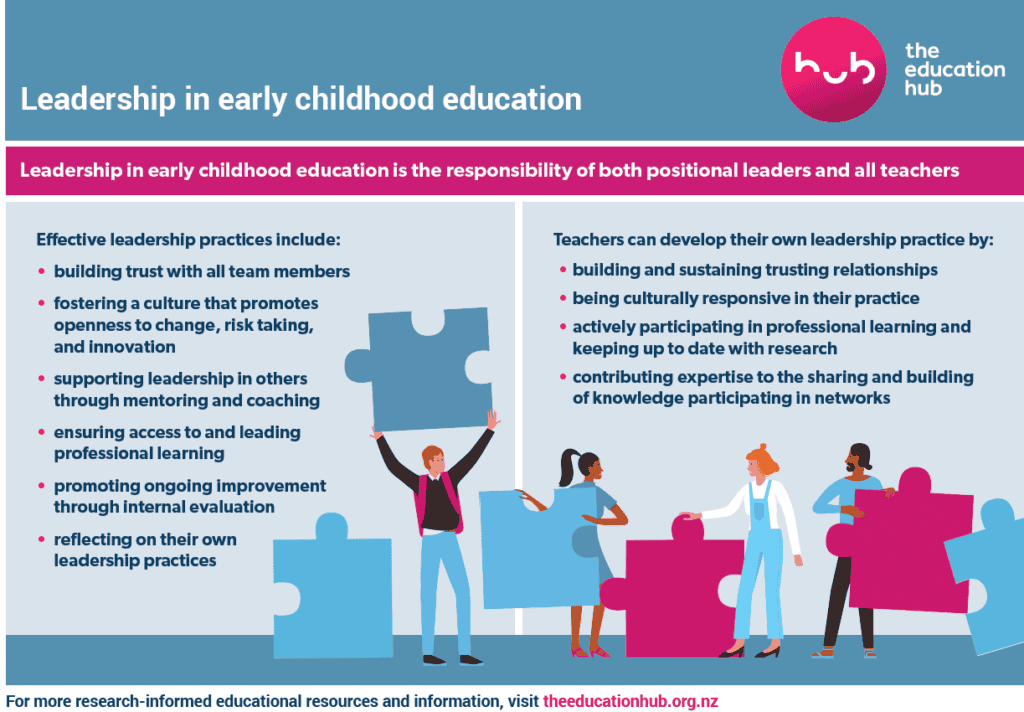
The evidence on the importance of relationships in teaching and learning is unequivocal. There is a wealth of evidence on the importance of teamwork in school settings, although the body of research examining teams and teamwork in early childhood settings is less comprehensive. Early childhood education education researchers have suggested that the characteristics of effective teams identified by research in school settings are also applicable to the early childhood sector. These characteristics include collective learning, mutual responsibility, trusting relationships, shared and supportive leadership and having a shared vision and values.
In practice
Effective teams are built on respectful relationships. This requires everyone in the team to listen to others, appreciate divergent ideas and value others’ input. It is also important that everyone feels confident to offer alternative viewpoints and freely disclose their personal concerns and weaknesses. Other strategies such as developing shared goals, deprivatising one’s own practice, establishing supportive systems, helping teachers to see each other’s strengths, and sharing leadership contribute to the establishment and maintenance of effective teams.
Guiding questions
- Does everyone in our team listen to others and respect and value different ideas and viewpoints?
- Does everyone in our team feel comfortable and confident to share their thoughts and concerns?
- Does the team have a common understanding of our shared goals and work together to achieve them?
- Do we engage in collective learning by observing each other’s teaching, offering and accepting feedback, and sharing and evaluating new approaches?
- Is leadership shared within our team and does it work effectively to support teachers in their learning and practice?

Supporting neurodivergent teachers in schools and early childhood settings
What the research says about supporting neurodivergent teachers in the workplace.

Teacher wellbeing in early years contexts
The crucial importance of teacher wellbeing and how early childhood settings can protect and enhance it.

Professional learning communities in early childhood education
An introduction to the research on PLCs in early childhood education.

Promoting leaderful practice in team-oriented settings
An approach to team-work and leadership that emphasises concurrence, collectivity, collaboration and compassion, with strategies to promote leaderful practices among team members.
Belonging, equity, and teacher identity in early childhood education
Dr Kiri Gould of the University of Auckland explores teacher identity in early childhood education, and how it intersects with discourses of equity, belonging, and inclusion

Building resilience to support teacher wellbeing
Dr Sarah Ferguson shares her extensive knowledge about how to promote workplace wellbeing, including providing educators with tools and strategies that help them to build their resilience and improve their wellbeing.

Appreciative inquiry for effective team-building
Dr Chris Jenkin (AUT) discusses the benefits and growth that come from approaching team-building from an appreciative inquiry perspective.

Bicultural leadership and practice in early childhood education
This session with Deanna Niha, from an early childhood centre in Whangarei, discusses how her centre approaches bilingual and bicultural education and leadership.

Exploring relationships, collaboration, and participation in diverse teaching teams
This webinar explores ways teachers might come together to harness the opportunities of diversity and relationships for the benefit of children and families.

Building trustful relationships and promoting centre wellbeing
This webinar explores the importance of teachers’ relationships with each other in early childhood settings.

Leadership 5: Leading Improvement
This course offers a unique exploration of models for improvement, focusing on leading inquiry and building professional learning communities.

Leadership 4: Leading Curriculum, Pedagogy, & Innovation
This course explores what it means to be the leader of curriculum and pedagogy in your centre, and helps you build the knowledge and practical skillset to be able to do this effectively.

Leadership 3: Leading Partnerships & Collaborations
This course explores the range of collaborations and partnerships in which early childhood leaders are engaged and how these can be strengthened and supported to enhance teaching and leadership practice.

Leadership 2: Leading People & Teams
This course explores a range of techniques that leaders can use to grow excellence in people and teams, including how to productively approach conflict and engage in challenging conversations.

Leadership 1: Leading Authentically
This course focuses on leaders as individuals and helps you to learn about a repertoire of leadership styles identified in research to creatively tailor a leadership style for your own contexts, people, and purposes.

Supporting positive, equitable, and culturally responsive relationships between teachers
Key insights from a webinar with Dr Kiri Gould from The University of Auckland Waipapa Taumata Rau.

Tips and tools for building teacher resilience and wellbeing
Insights from a webinar with Dr Sarah Ferguson.

The benefits of Appreciative Inquiry for team-led review and action-planning
The key insights from our webinar with Chris Jenkin on Appreciative Inquiry.

Mana-inspired leadership for bicultural teaching and learning in early childhood education
Key insights from ECE leader Deanna Niha on bicultural practice and leadership

Relationships, collaboration, and participation in diverse teaching teams
How teachers can build trusting relationships in diverse teaching teams in ECE

Building trustful relationships in early childhood settings
Important ideas for building trustful relationships among teachers in ECE settings