
Assessment
Assessment in early childhood education supports positive outcomes for children by informing the programme and teaching practices of the setting.
Definition
Assessment in early childhood education is most often formative and used to plan interactions with children, activities and programmes in the immediate future. Formative assessment can be formal, involving reflection and analysis in relation to documented observations, or informal, occurring in the moment as teachers observe, listen to and participate in children’s activities. Summative assessment is focused on informing others about children’s learning and achievement over time.
Relevance
Assessment enables teachers to give feedback to children and families, and extend children’s knowledge, skills and achievements. Assessment can also be used to evaluate and improve pedagogies, environments and teaching interactions. Documentation of children’s learning can be used to encourage family participation in assessment, invite a range of perspectives and interpretations, and effectively communicate the complex and holistic nature of children’s learning in the early years.
State of the evidence
Case studies indicate the transformative power of learning stories in terms of their positive effect on children’s reflection on themselves as learners and on family involvement in assessment practices. Research in New Zealand and internationally shows that the sharing and use of assessment information that highlights learning and progress over time helps children see themselves as competent, confident learners, and makes transition to school more likely to be successful.
In practice
- Make assessment holistic by including skills, knowledge and dispositions as well as children’s interests and their family’s culture, activities and aspirations for their child
- Focus on strengthening the dispositions associated with the five strands of the curriculum, and on identifying and developing children’s working theories
- Go deeper into children’s interests to find out what they are thinking about those interests, and consider how interests can support valued learning outcomes
- Make learning, rather than activity, visible, and focus on what children have learned in terms of what has changed in their behaviours, language and action
- Take stock of ongoing assessment and track individual children’s learning over time to explore the continuity of each child’s learning
Guiding questions
- Do you use assessment to notice, recognise and respond to children’s working theories and development of learning dispositions?
- Do your learning stories for an individual child encompass the richness and breadth of a range of learning outcomes?
- Do you go beyond description of activities and interests to analyse continuity and change in children’s learning over time?
- How often do you invite families to interpret and plan next steps for children’s learning?
- Do you encourage children to contribute to assessment?
Features of high quality assessment
An overview of the key features of assessment that promotes learning and enhanced wellbeing in early childhood education.
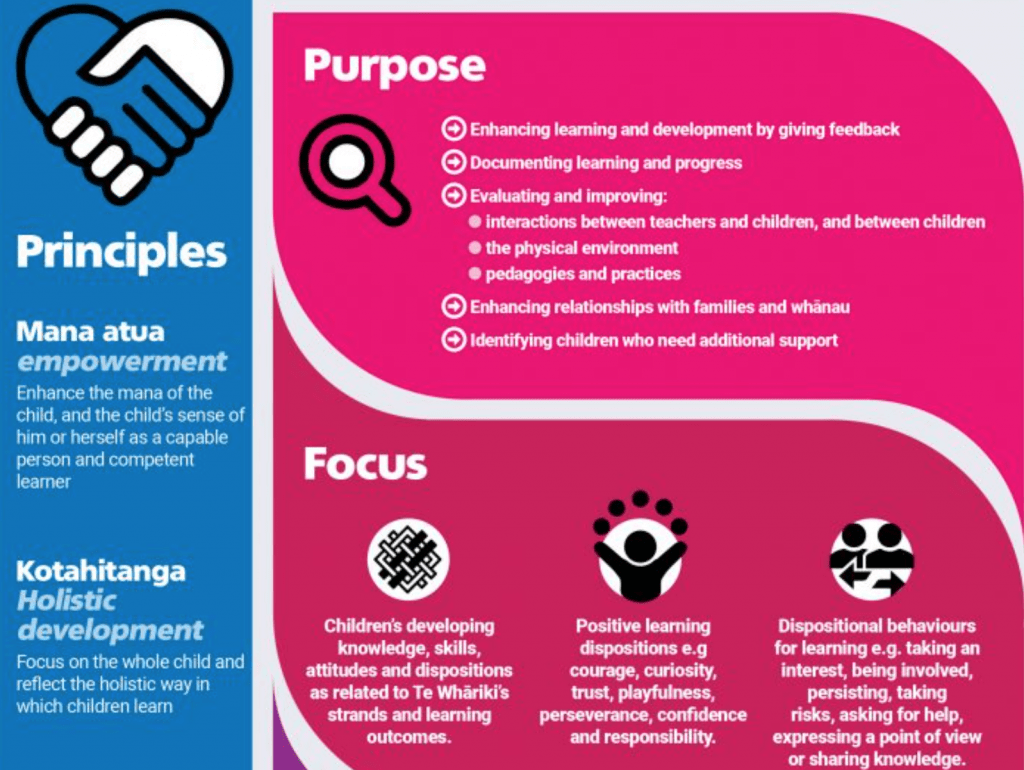
What is assessment in early childhood education?
The principles, purpose, focus and different forms of assessment in early childhood education at a glance.

Culturally responsive assessment based on Kaupapa Māori
A brief overview of assessment practices for early childhood settings that are grounded in the principles of kaupapa Māori.

Pillars of sound educational assessment
An overview of the principles of validity, reliability and fairness that should underpin all educational assessment.
Principles of assessment
An introduction to the principles of assessment that underlie a ‘system that learns’, encompassing early childhood education, primary school and secondary school.
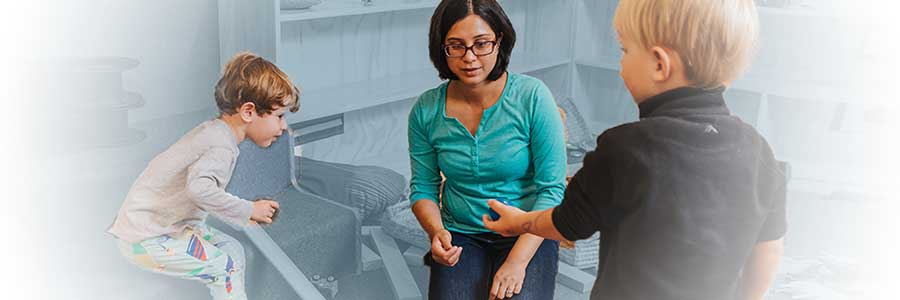
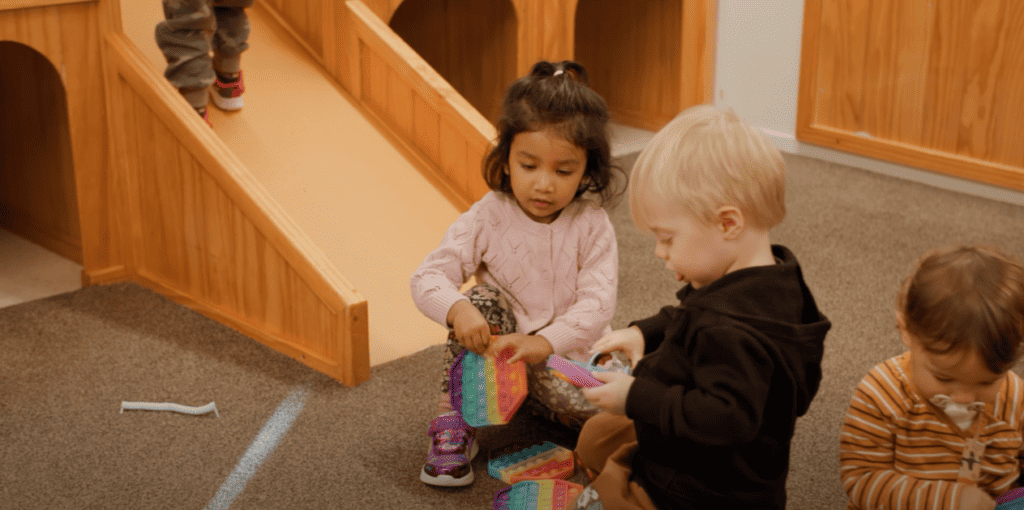
The role of documentation at Kids’ Domain
How one team approaches the documentation of children’s learning.
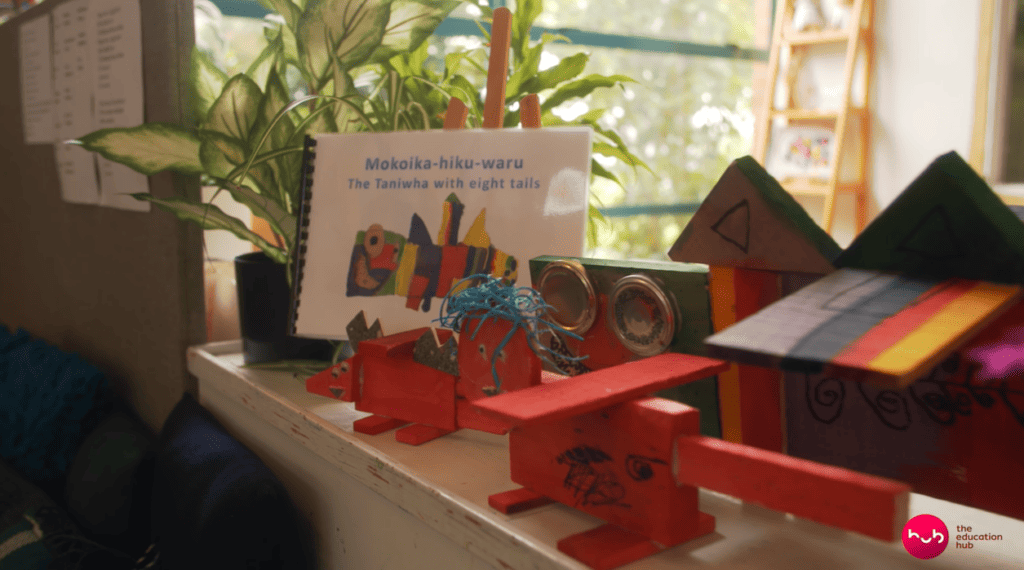
Documentation that captures and communicates learning
How respectful documentation can lead to the development of a meaningful and authentic curriculum.
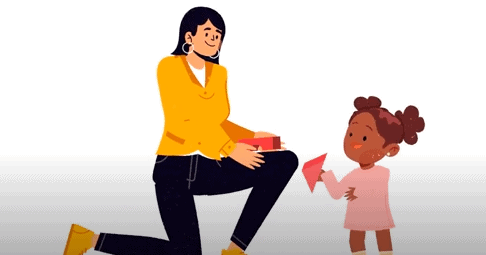
Early childhood assessment principles
An animation outlining principles that should guide effective assessment in ECE