
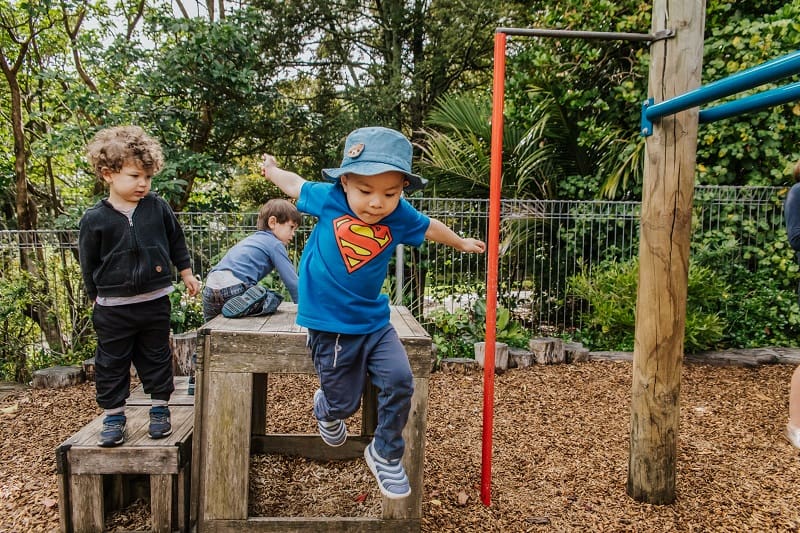
Key insights: Q&A with Gill Connell
In our sequel to Gill Connell’s popular 2021 webinar, Gill responded to teachers’ questions about the role of movement in children’s learning and development, and how best to support children to develop the range of gross and fine motor skills they need for a lifetime of learning. Gill is a globally recognised child development expert, specialising in the foundations of learning through movement and play. She is the co-author of the popular books A Moving Child is a Learning Child (2013) and Move Play and Learn with Smart Steps (2016).
The questions included:
What environments and resources can I provide to support children’s physical development?
You can use the movement ‘nutrition’ groups described on the kinetic scale (view this in Move Play and Learn with Smart Steps or on Gill’s first webinar slides here) as an organising principle for a well-balanced diet of movement experiences that support the brain to grow and develop. Have this poster on the equipment shed door, so that as you prepare spaces for children you can be thinking what you might provide for sensory experiences, balance, intuition, power, coordination, and control.
- For sensory experiences, remember to include eye development, and activities to support children’s visual tracking, such as feathers and bubbles. Visual tracking is an important foundation for reading.
- For balance, look to provide equipment for movement patterns like rolling, spinning slowly, and hanging upside down.
- For intuition, or spatial and bodily awareness, aim to provide opportunities for fitting into spaces (under, over, through, and between things), as well as encouraging children to manoeuvre through spaces by putting their bodies into different positions. This movement group also includes learning about muscle strength, which involves providing children with lifting, carrying, pulling, and pushing opportunities to discover how much force they need to use.
- For power, provide experiences that help children with stamina, flexibility, and agility. Choose activities that will raise their heart rate and encourage them to explore the different ways their bodies can move, for example, by mimicking the movements of different animals.
- For coordination, look at encouraging complex movements, including opposition movements such as marching, climbing, hopping, and skipping.
- For control, you might provide equipment or verbal challenges that enable children to practise doing things in different directions and at different speeds.
How can I adapt physical activities to meet the needs of all children?
It is important to individualise activities so that you make the activity fit the child rather than making the child fit the activity. This means observing the child and making adjustments to increase challenge, or providing some physical support such as holding their hands or clothing (note that it is important to support children’s bodies on both sides, so hold both their hands rather than one). Think about the 5Ds to adjust activities, offering variation in:
- Dynamics, by challenging children to go fast, slow, or freeze. Performing movements slowly is more difficult than doing them at speed.
- Distance, by shifting targets further away or bringing them closer.
- Direction, by suggesting children try performing movements going forwards, backwards, or sideways, or in the style of an animal.
- Duration, by extending the amount of time children perform movements, or challenging them to be faster. Children can explore their personal bests with timers.
- Difficulty, by adjusting the terrain (wrapping a plank in bubble wrap), altering the gradient (increasing the angle of the plank), or adding obstacles or manipulatives (such as placing beanbags on the plank and offering children tongs to use to drop them into a bucket).
How do requirements for physical experiences vary with different age groups?
As children progress along the sequence of movement development (which can be found in A Moving Child is a Learning Child, or in Gill’s first webinar slides here), their needs for different movement nutrition groups change. In the earliest years, infants need a lot of sensory play and exploration including balance (rolling, rocking), and intuition (particularly strength and force) experiences. When children first start to rock, crawl, and push themselves into position, intuition experiences become more important as children explore getting their bodies into different spaces. When children start walking, power becomes important. When they start running, jumping, and learning midline and more complex movement, the emphasis is on power, coordination and control.
What should I do if I have concerns about children’s physical development?
It is important to be aware that age is not an accurate measurement of milestones, but children should be making progress along the sequence illustrated in A Moving Child is a Learning Child or in Gill’s first webinar slides here. This sequence provides a useful tool for profiling children’s development. For example, you might have a child who is sitting but does not appear to be putting their hands down or getting into a crawling position. You can use the sequence of movement development as a guideline to revisit different movement patterns that might assist the child. It is helpful to collect information about the child’s physical development and to gain a bit of history about the child’s birth (assisted births reduce opportunities for infants to use and inhibit primitive reflexes), and about their milestone history. You should also assess the child’s muscle tone, by checking that they don’t go floppy when you pick them up but can hold their own bodyweight. You can find out about the impact of the child’s home environment on their physical development, and ask parents and colleagues about their concerns.
Are there any practices which can negatively impact children’s physical development?
The floor is the best place for a young infant to practise movements. Containers such as car seats, push chairs, and bouncers limit opportunities for children’s physical exploration and movement practice. Supporting infant posture can also be unhelpful, and infants should not be put in positions that they cannot get into or out of by themselves. For example, children should push into a sitting position when they are ready, once they have developed particular reflexes such as the head-righting reflex to keep their head central. Similarly, children will pull themselves up to a table when they are developmentally ready, and holding their hands may interfere with their learning to hold their own bodyweight.
What balance of teacher-planned and supported to child-led free play do you recommend?
The most important consideration here is to provide children with a well-balanced diet of movement experiences, and not every child is going to be attracted to everything you put out for child-led play. Some children may avoid certain things (which can be a sign that they are lacking in that particular movement nutrition group), so you may need to gently guide them. It may be that you sit and play, and do physical activities in the space yourself, to encourage children.
How should I incorporate language learning into physical activities?
Language acquisition is supported by the physical experience that goes alongside it. Children need real experience alongside language in order to develop understanding. You can extend children’s vocabulary while they are having physical experiences by using words like ‘ascending’ and ‘descending’. Experience also helps children understand the different meanings of words in different contexts. Positional language can be particularly important, as words like ‘over’, ‘in front’, and ‘under’ are used in different ways, and poor directional understanding has an impact on the concepts of print that children need for reading and writing.
Should we teach children to write letters and numbers in early childhood?
If children are keen to experiment with writing letters and numbers, it is good to support them, but stay at the child’s level and pace. There is no rush to be writing letters and numbers so instead give children the freedom to explore putting marks on paper. Likewise, there is no need to correct children’s pencil grip, because many physical skills and experiences are needed as the foundation of handwriting. Big muscle movements are required before fine motor skills develop, and tactile messy play, finger play, and rhymes and other activities are needed to help children move and manipulate their fingers. Similarly, there is no need for concern if children have not yet developed hand dominance, as this can occur any time between 4 and 7 years old.
Further reading
Connell, G., & McCarthy, C. (2013). A Moving Child is a Learning Child: How the Body Teaches the Brain to Think. Free Spirit Publishing.
Connell, G., McCarthy, C., & Pirie, W. (2016).Move, Play and Learn with Smart Steps. Free Spirit Publishing.
By Dr Vicki Hargraves