
Leadership
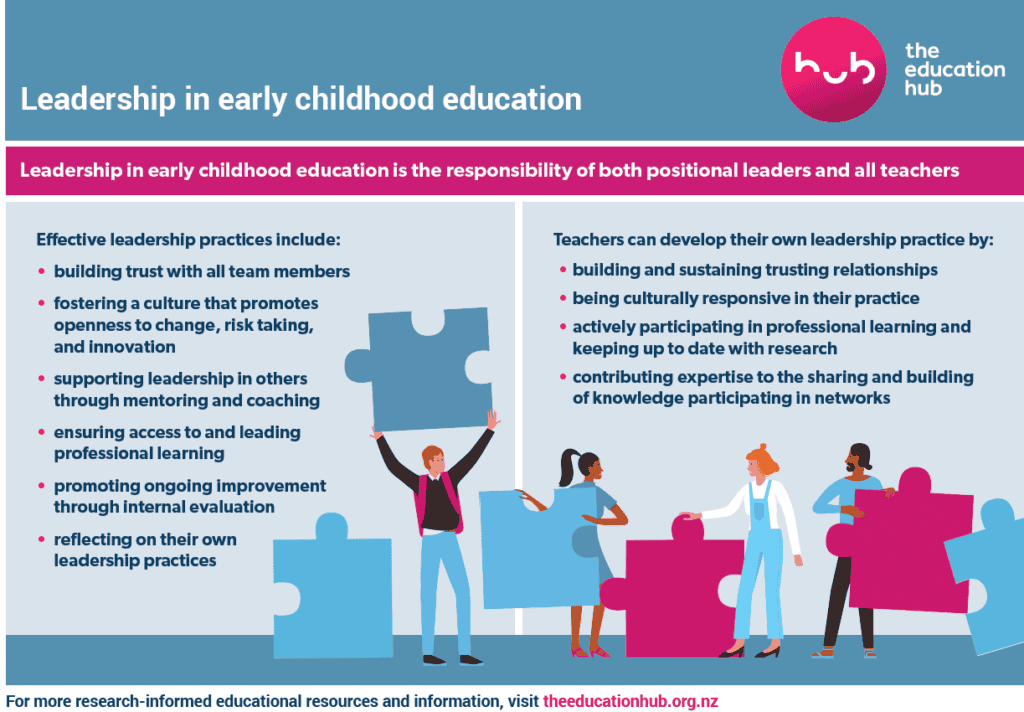
Leadership supports the development of effective teaching and learning in early childhood education by promoting trusting, supportive relationships and prioritising professional learning.
Definition
Leaders should focus on building effective relationships and on supporting effective teaching and learning by encouraging and enabling teachers to grow in their teaching practice through professional learning. Leaders should promote intellectually rigorous programmes, inquiry and research in their centres, and create a rich culture of professional learning activity.
Relevance
Leadership in the early childhood sector in New Zealand has historically had a low profile, although recent documents and guidelines have started to recognise its importance. New Zealand’s early childhood curriculum document, Te Whāriki, explains that leadership is not just the responsibility of centre leaders and other positional leaders, but is expected of all teachers.
State of the evidence
While there is clear evidence of the value of leadership in the school sector as well as in the organisational literature more broadly, there is a relative paucity of research on leadership in early childhood education. However, there is evidence of the importance of leaders in early childhood education leading professional learning, and researchers argue that mentoring and coaching are important leadership strategies for supporting the professional learning of both individuals and teams.
In practice
Positional leaders play a crucial role in creating a collaborative organisational culture focused on improvement. It is important that positional leaders in early childood education provide support and encouragement as well as professional learning opportunities for the teachers they lead, and also that they enable teachers to develop their own leadership capabilities. Effective practice in early childhood education involves leaders and teachers working collaboratively to positively impact children’s learning. However, leaders should also model effective practices and expect accountability.
Guiding questions
- How do we build and sustain trusting relationships in our centre?
- How can we support leadership in others through mentoring and coaching?
- How can we ensure access to and lead professional learning in our centre?
- How can we reflect on and develop our own leadership practices?

Strategy in early childhood education
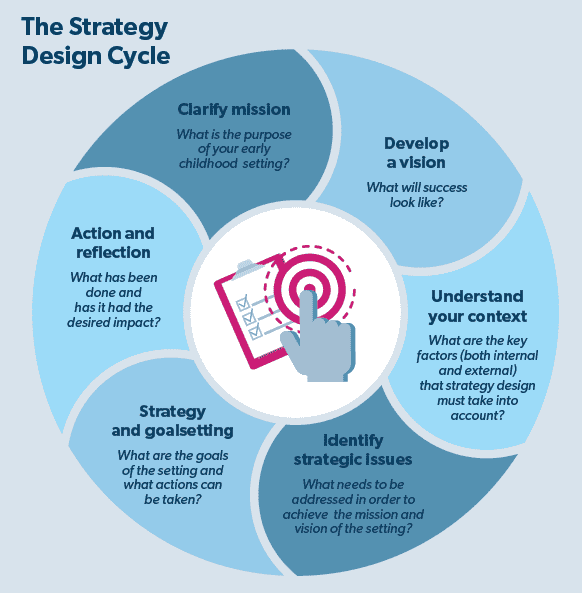
An introduction to the purposes and processes of strategic planning.

The Strategy Design Cycle in an early childhood setting
A step-by-step guide to strategy design for early childhood settings

Ideas for writing strategic documents
Some examples of early childhood strategic plans.

Exercises to support the strategy design cycle
A series of practical exercises that can be used as part of the strategic planning process.

Trouble-shooting common problems in the strategy design process
How to respond to common issues during the strategic planning process.

Strategy design in complex systems
An introduction to complexity theory in strategy design.



Relational leadership and teacher wellbeing in early childhood education
Tuesday 15 September 2026, 7.30pm
In this live webinar, experienced early childhood teacher and leader Alistair Gibbs will explore the reciprocal relationship between leadership and wellbeing, and how relational approaches can strengthen both.

Mātauranga Māori principles from a Kaupapa Māori perspective
Dr Tui Summers talks about some of the key principles that underpin kaupapa Māori leadership

Getting ‘Beyond Quality’ to politics and democracy in (early childhood) education
A special presentation from Emeritus Professor Peter Moss.

Professional learning communities
Sue Cherrington, Kate Thornton, and Rachel Denee explore recent research into the role of professional learning communities (PLCs) in early childhood education and discuss the role of both within-centre and network PLCs.

Leadership in early childhood education
Celeste Harrington (AUT) and Lorraine Manuela (Director at Tots Corner) explore what leadership means in early childhood education.

Leadership 5: Leading Improvement
This course offers a unique exploration of models for improvement, focusing on leading inquiry and building professional learning communities.

Leadership 4: Leading Curriculum, Pedagogy, & Innovation
This course explores what it means to be the leader of curriculum and pedagogy in your centre, and helps you build the knowledge and practical skillset to be able to do this effectively.

Leadership 3: Leading Partnerships & Collaborations
This course explores the range of collaborations and partnerships in which early childhood leaders are engaged and how these can be strengthened and supported to enhance teaching and leadership practice.

Leadership 2: Leading People & Teams
This course explores a range of techniques that leaders can use to grow excellence in people and teams, including how to productively approach conflict and engage in challenging conversations.

Leadership 1: Leading Authentically
This course focuses on leaders as individuals and helps you to learn about a repertoire of leadership styles identified in research to creatively tailor a leadership style for your own contexts, people, and purposes.
Mātauranga Māori principles from a Kaupapa Māori perspective
Key insights from a webinar with Dr Tui Summers from Te Rito Maioha.

Professional Learning Communities: Teachers collaborating for professional learning and improvement
Key insights from our webinar with Sue Cherrington, Kate Thornton, and Rachel Denee on the role of PLCs in teacher professional learning.
The limited research on pedagogical leadership in early childhood education
A brief account of the limited research base on pedagogical or educational leadership in early childhood education.