
The physical sciences: Learning about physical objects and processes in early childhood
In contrast to the natural sciences, the physical sciences investigate the non-living aspects of our world. Physical science involves the study of the nature of materials, physical and chemical changes, energy, and forces[1], and offers explanations for physical phenomena such as forces, motion, light, sound, heat, electricity, magnetism, and waves. These phenomena are all linked to the broader concept of energy, and the way in which energy is transformed from one form to another. The physical sciences are often divided into four branches: physics, chemistry, earth and space science, and astrology. In early childhood settings, physical science learning might include exploring forces and motion in manipulating toys and using equipment, exploring light, sound, magnetism, physical changes such as melting, and chemical changes such as those involved in cooking.
Key questions children might explore in the physical sciences include:
- How does this move?
- What can this material do?
- How does this work?
- Can these substances mix?
- Can this material change shape?
- How does this material behave in water?
Key understandings that children might develop include:
- Water is hard when it freezes
- Some things melt when they get warm
- Cooking changes food mixtures
- Mixing colours makes new colours
- Burning wood makes charcoal
- Magnets push and pull each other
- Objects fall when dropped
- Objects move when pushed or propelled
- We can make sound in different ways
- Some things go rusty in the rain
- Some objects float in liquid and some objects sink
Possible areas for inquiry and investigation in the physical sciences are:
- How can we make this sound louder or longer?
- What materials float on the water and can be used to make a raft for toys?
- What will happen when this gets very hot or very cold (cooking processes)?
- Which materials are attracted to the magnet?
- What happens when we mix red, yellow, and blue paint? Can we separate the colours out again?
Science process skills that might be used:
- Observing, measuring, asking questions, trial and error, making predictions, and solving problems
Why is learning about the physical sciences important? How can physical science contribute to early childhood curriculum goals?
Te Whāriki views exploration as encompassing all aspects of the environment, including the physical and human-made aspects of the environment. It recognises the diversity of ways in which different groups and whānau make sense of the world. Te Whāriki suggests that it is important for children to draw on and recognise different domains of knowledge for understanding people, places, and things[2]. Science is an important domain here, and can be explored alongside mathematics, engineering, design, and social studies.
Physical materials and their properties can foster children’s curiosity about the world and interest in exploring it. In their interactions with the physical and material world, children can be developing their understanding that exploring, playing, and experimenting, and collaborating are valuable and useful ways of learning. They can use all of their senses and their increasing physical skill to explore this realm of science[3].
Children learn about the physical world by asking questions, discussing ideas with others, devising and testing working theories and solving problems by drawing on understandings about materials, resources, and their properties and uses. This exploration offers children opportunities to puzzle about and make sense of the world, drawing on the range of strategies for exploration that are outlined as evidence of children meeting the goals of the Exploration │Mana Aotūroa strand: setting and solving problems, finding patterns, making guesses, using trial and error, planning, comparing, classifying, and explaining. Children come to understand that science is a process of discovery, and learn to feel comfortable with uncertainty, not knowing, and failure[4].
Environments, resources, and activities for exploring physical science
Important experiences that build the foundations of physical science knowledge include:
- Interesting, sensory rich, open-ended resources and attention to the aesthetic and sensory environment, with pleasing contrasts in colour, design, light, and sound[5].
- Opportunities to actively and creatively explore physical objects and materials, their shapes, colours, textures, patterns, properties, and functions, with support from teachers for children’s unique choices of interactions. Plentiful collections of materials are important to encourage children to collect, sort, and organise materials to develop a sense of order as they see fit. Teachers should support them to build vocabulary, discuss ideas, and develop working theories as they work with the physical properties of diverse resources and materials[6].
- Opportunities to explore how things move through diverse actions, such as pushing ,pulling, throwing, swinging, sinking, blowing, and to explore the movement of technological items such as wheels, pulleys, swings, and magnets[7], accompanied by opportunities to reflect, theorise and make meaning of their discoveries.
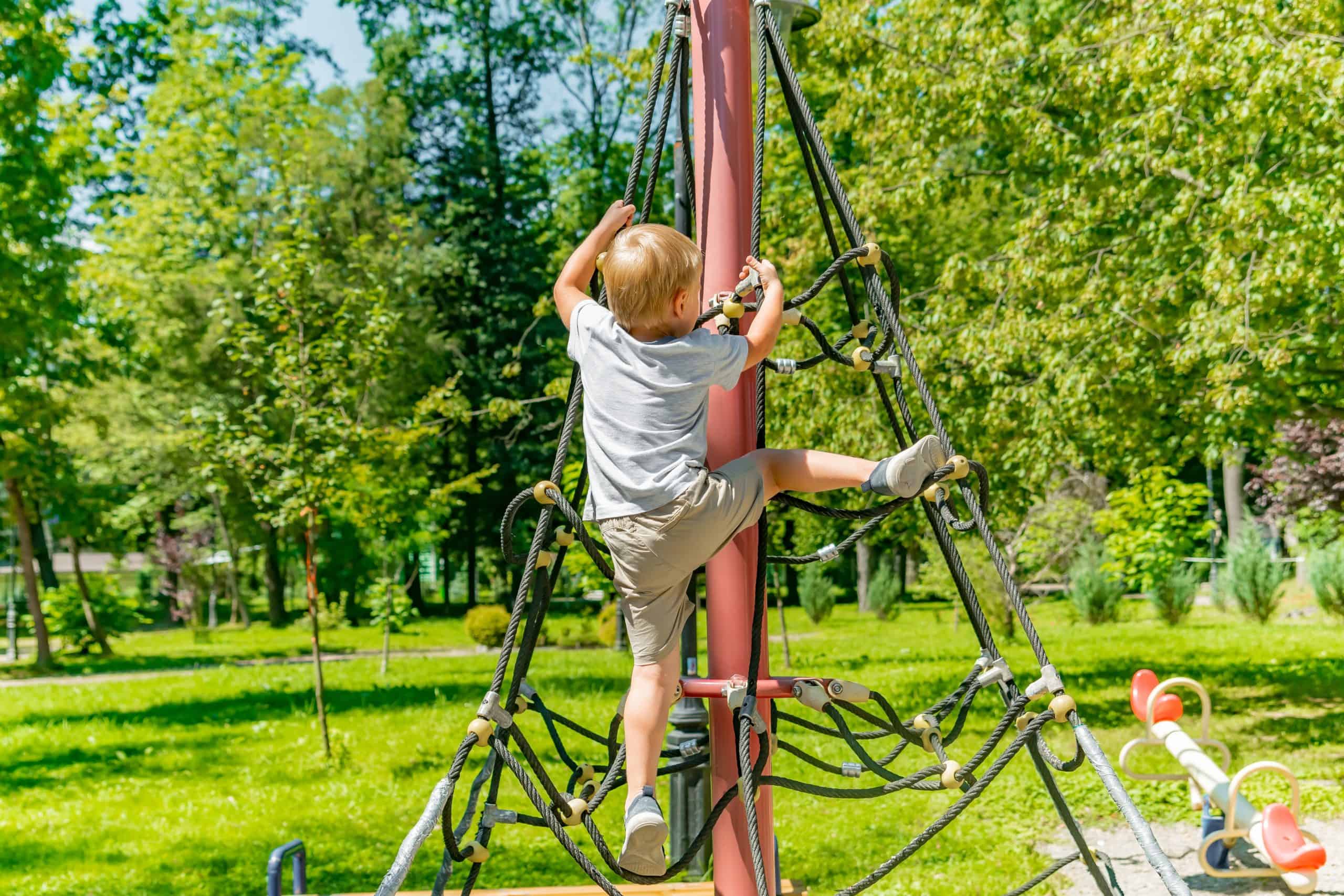
- Talking about the forces acting on children’s bodies as they climb, slide, and spin on playground equipment[8], such as gravity pulling them down the slide, or the friction of particular shoes that slow down the sliding, or the way they have to push or pull using their own bodies to create a force that creates motion[9]. Note that it is important to talk about the range of forces that are acting as a result of the equipment, and to also talk about the operation of force when things are not moving (such as when there are equal forces acting on a see-saw or when a bike comes to a stop). Accurate phraseology around ‘forces acting on objects’, rather than phrases that suggest forces are contained in the object, is crucial to support children’s developing understandings[10].
- Playing with magnets and learning some of their features, such as their two opposite ‘poles’ (a north pole and a south pole). Children can notice how putting two of the same poles repel or push away from each other, and how two opposite poles pull towards each other, and also how magnets can draw objects made of specific materials towards each other. Note that magnetism is caused by the particular arrangement of atoms inside magnets. In most objects, atoms are all mixed up, but in magnets they are lined up in a way to create a magnetic field (invisible to the eye). Some metals have a particular arrangement of atoms that easily line up with the magnetic field of the magnet.
- Experimenting with floating and sinking: observing what happens when children drop solid objects into water (do they float or sink?) and then looking more closely at the objects to find out if they float or sink because of their size or what they are made of. Note that it is important to use solid objects without air inside, so that children can begin to determine the relationship between an object’s mass or density (mass per volume) and whether it floats or sinks (air trapped in an object such as a plastic ball reduces its density). Objects that have more mass per cubic centimetre than water will sink (water has 1g of mass per cubic centimetre). Mass is not the same as weight, which refers to mass being pulled by down by gravity: mass is always the same, but weight can vary depending on the force of gravity[11]. Children can be supported to make links between the material of which an object is made, and its floating or sinking behaviour, rather than its size (facilitate this by offering large polystyrene balls or similar, alongside small, dense, rocks).
- Creating and exploring conditions for making shadows, using a light source such as a torch or overhead projector, and toys that will block out the light. With experience of placing the light source and toys in different positions, children can then be encouraged to predict when a shadow will form, its shape, and how large it will be. Here children can learn that objects must block light from the torch for a shadow to form. It can be helpful to have transparent items (the light travels through and no shadow is formed), translucent materials (some light passes through so a faint or coloured shadow is formed), as well as opaque materials that do not let the light through. By placing the light source and objects in different places, children may be able to observe that light travels in straight lines (the opaque object must be in the direct pathway of the light source to form a shadow). Children might also notice that placing the object nearer the light source blocks more of the light and therefore creates a bigger shadow[12]. Children might also explore how shadows are formed outside on a sunny day: what is the light source here? Note that when talking to children about light, it is important to describe the movement of light (light ‘arriving’ or ‘passing’), rather than terms that suggest it is static (‘light exists’, ‘light is visible’)[13].
- Cooking activities in which children can explore concepts of change in materials as a result of heating, as well as the continuum of heating and cooling (waiting for, or perhaps assisting, food items to cool), and force (actions to change the shape or texture of the mixture – pressing, rolling)[14].
- Playing with ice and observing the changes that occur as ice warms, encouraging children to use all their senses (tasting, smelling, listening, touching, and observing the ice), and introducing ideas of solids and liquids as two states of matter, and the material changes that occur with melting and freezing water. Offering children ice cubes that are in different stages of the melting process can help children notice change and make comparisons. Children could also explore their ideas about how long it takes an ice-cube to fully melt, and how they might make the ice-cubes melt faster or which materials are best to wrap an ice cube in to stop it from melting.
- Mixing oil and water and observing what happens, trying out different actions and ideas to see if the two liquids can be made to mix. Note that oil and water will not mix, because the molecules of water are much more attracted to other water molecules, while the molecules of oil are much more attracted to other oil molecules. They are immiscible, whereas substances that do mix (like cordial and water) are miscible. Children might shake the mixture, but then observe that the oil and water molecules separate out again. Adding food colouring can lead to interesting effects. Adding detergent, which helps to create very small oil droplets that are covered in a layer of detergent, makes it much easier to mix them with water – this is how washing-up works![15]
- Baking soda and vinegar experiments, which are common in early childhood settings, and can promote scientific investigation of the science of chemical reactions. When baking soda and vinegar are mixed they get used up making a new substance, carbon dioxide. This is the magic of chemical reactions! This experiment can be used to show children the three different states of matter (solid baking soda, liquid vinegar, and the resulting bubbles – the gas carbon dioxide).
- Playing with colour and colour mixing with food dye and water, and learning how colours combine to make new colours.
- Using prisms to view light rays ‘bend’ or refract to make a rainbow, comparing this to a rainbow produced by the refraction of light through raindrops on a sunny day, and creating the same effect with water droplets from a hose or spray in the light.
- Exploring sound through body percussion, singing, shouting, whispering, and simple musical instruments. Younger children can experiment with how to make sounds longer, shorter, louder, and quieter. Older children can learn that sound is created by a vibration. Placing some tiny objects on the top of a drum skin and then humming near the drum skin will show children how sound is causing vibrations. Making rubber band guitars also enables children to view and feel the vibrating rubber bands as the source of sound.
- Opportunities and a variety of resources to set and solve problems, and to initiate and implement purposeful activities, with encouragement to experiment, use trial and error, and reflect on prior experience as a basis for devising alternative strategies[16].
- Access to books, images, posters, maps, and reference materials to support children’s interests and thinking about physical process and changes[17].
Books to support physical science learning
A Look at Magnets by Barbara Alpert explains how magnets work, and is a good example of a non-fiction book with a table of contents, glossary, and index to help navigate the text.
Floating and Sinking by Amy Hansen is a simple introduction to how mass and shape affect which objects float and which sink.
I Fall Down by Vicki Cobb is about the force of gravity acting upon us on Earth, how this acts on objects and things, and how it creates the weight of objects. Children can try out some of the dropping activities described.
Matter: Physical Science for Kids by Andi Diehn explains matter (anything that takes up space and can be weighed), the three states of matter, plus, at the end, what doesn’t count as matter. The melting of ice and evaporation of water are covered. This book is best for older children.
Power Up: Your Incredible, Spectacular, Supercharged Body by Seth Fishman explains how energy is made and stored in our bodies, powering us up to run, leap, and climb. Did you know there is enough energy in your little finger to power an entire city for a whole day? This book is best for older children.

Endnotes
[1] Aitken, J., Hunt, J., Roy, E., & Sajfar, B. (2016). A Sense of Wonder : Science in Early Childhood Education. Teaching Solutions.
[2] Ministry of Education. (2017). Te Whāriki. He whāriki mātauranga mō ngā mokopuna o Aotearoa. Early childhood curriculum. Author. https://tewhariki.tahurangi.education.govt.nz/te-whariki-online/our-curriculum/te-wh-riki/te-wh-riki-early-childhood-curriculum-document/5637184332.p
[3] Ministry of Education (2017).
[4] Ministry of Education (2017).
[5] Ministry of Education (2017).
[6] Ministry of Education (2017).
[7] Ministry of Education (2017).
[8] Fleer, M. (2015). Learning science in everyday life – A cultural-historical framework.In M. Fleer, & N. Pramling (Eds.). A Cultural-Historical Study of Children Learning Science : Foregrounding Affective Imagination in Play-based Settings (pp. 3- 22). Springer.
[9] Sikder, S., & Fleer, M. (2015). Small science: Infants and toddlers experiencing science in everyday family life. Research in Science Education, 45, 445–464. https://doi.org/10.1007/s11165-014-9431-0
[10] Hadzigeorgiou, Y. (2015). Young children’s ideas about physical science concepts. In K. C. Trundle, & M. Saçkes (Eds.). Research in Early Childhood Science Education (pp. 67 – 97). Springer.
[11] Australian Council for Educational Research [ACER] (2020b). Science in the Early Years: Floating or Sinking. https://research.acer.edu.au/cgi/viewcontent.cgi?article=1027&context=early_childhood_misc
[12] ACER (2020c). Science in the Early Years: Light and Shadows. https://research.acer.edu.au/cgi/viewcontent.cgi?article=1028&context=early_childhood_misc
[13] Hadzigeorgiou (2015).
[14] Sikder & Fleer (2015).
[15] ACER (2020a). Science in the Early Years: Exploring Mixtures. hhttps://research.acer.edu.au/cgi/viewcontent.cgi?article=1026&context=early_childhood_misc
[16] Ministry of Education (2017).
[17] Ministry of Education (2017).