
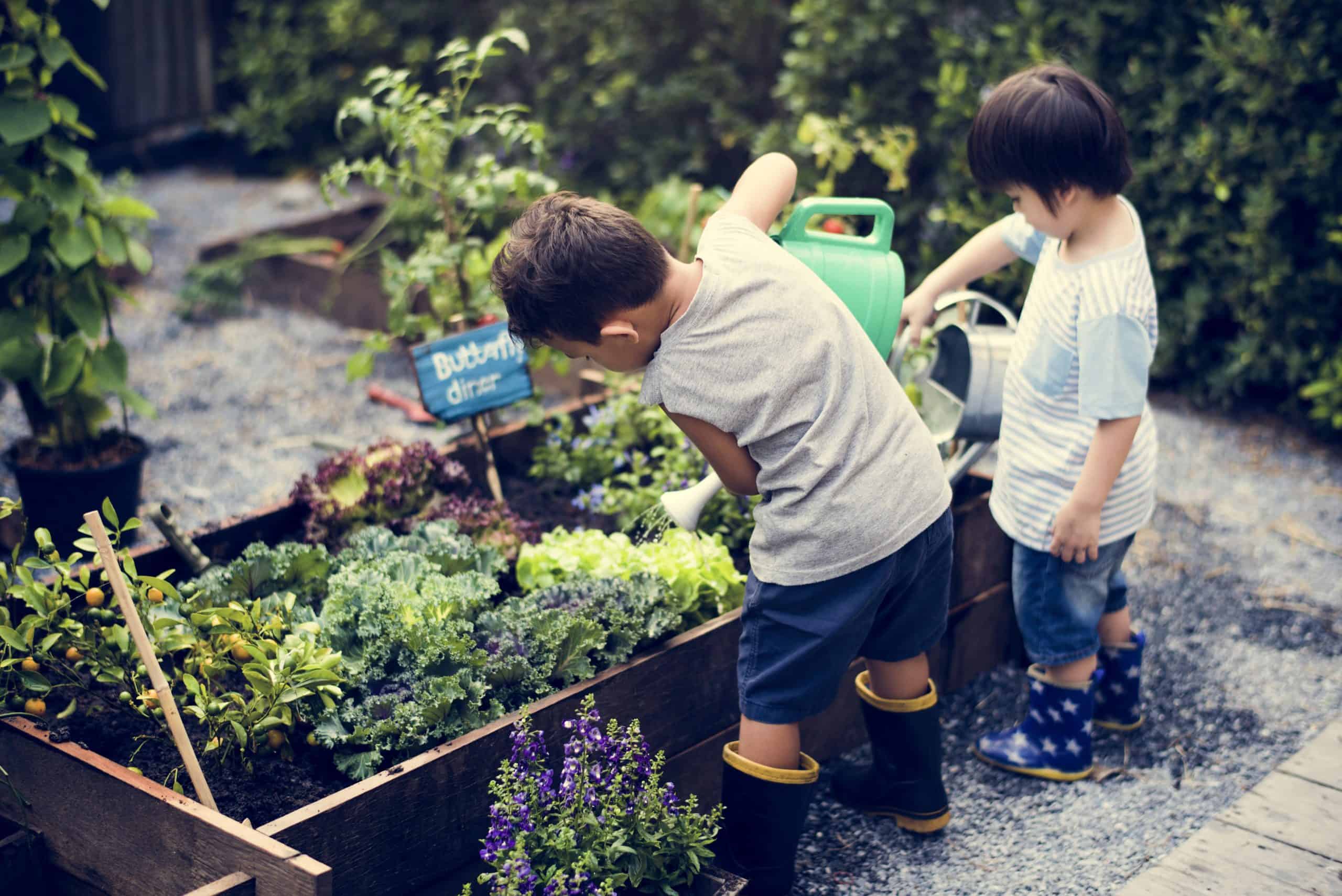
The natural sciences: Learning about the natural world in early childhood
Also described as biology or biological science, the science of the natural world comprises the study of the living things, from small particles to large ecosystems. In early childhood settings, the natural sciences might include investigation into plants, animals, the human body, and practices such as gardening[1].
Key questions children might explore in the natural sciences include:
- What is alive? How do we know that something is alive?
- How do we care for living things?
- What is this creature / plant? What are its special characteristics? Where does it live?
Key understandings that children might develop include:
- Living things share certain characteristics
- Living things have basic needs
- Living things have lifecycles
- Living things have different parts that do different things
- Living things live in a variety of different habitats[2]
- Living things can be classified into different groups according to their shared features[3]
Possible areas for inquiry and investigation in the natural sciences are:
- How can we attract more living things to our outdoor space?
- What does a plant need to grow well?
- Which are the favourite places for insects to hide in our outdoor space?
- What do different animals eat?
Science process skills that might be used in exploring the natural sciences:
- Observing, identifying and classifying, comparing and finding similarities and differences, measuring, asking questions, making predictions, and solving problems
Why is learning about the natural sciences important? How can natural science contribute to early childhood curriculum goals?
The natural or biological sciences help children to understand living things, and how to care for them, including how to care for themselves. Strong natural science knowledge and positive experiences with other living things can cultivate a deep respect for plants, animals, and insects. Connections with nature support children’s wellbeing and sense of belonging[4], and experiences in and with nature can foster children’s curiosity about the world and interest in exploring it. Te Whāriki views exploration as encompassing all aspects of the environment, including the natural environment. The natural world offers a valuable context for children to use all of their senses and their increasing physical skill to explore and to learn by asking questions, discussing ideas with others, devising and testing working theories, and solving problems, the goals for exploration within Te Whāriki. In natural settings, children can be developing their understanding that exploring, playing, and experimenting, and collaborating are valuable and useful ways of learning. Te Whāriki suggests it is important that children appreciate and recognise different domains of knowledge, including the natural sciences, alongside other domains such as mathematics, art, and literature, for understanding people, places, and things[5].
Te Whāriki also recognises the diversity of ways in which different groups and whānau make sense of, respect, and appreciate the natural world. Within the teaching of the natural sciences are important opportunities to develop bicultural understandings, aligning with the intent of Te Whāriki to promote mātauranga Māori. For example, teachers might talk to children about the maramataka Māori used to inform gardening practices, and the tīkanga of tending to a mara, as well as the role of atua Māori in supporting foods to grow to harvest. Respect for nature may be expressed in terms of respect for Papatūānuku, Ranginui, and the atua Māori that take care of different elements of the natural world, with kaitiakitanga being a crucial practice[6].
Environments, resources, and activities for the natural sciences
Important experiences that build the foundations of natural science knowledge:
- Observing and experiencing nature outdoors with all their senses. Important considerations here are to ensure infants and toddlers experience fresh air, real grass, a range of smells, sounds, and temperatures, and contrasts in light, colour, and texture[7]. For young children, this includes unhurried time outside, as well as nature walks, treasure hunts, and scavenger hunts outdoors[8].
- Time under trees, experiencing their calmness, shade, patterns, and tree wildlife[9]. Trips to local parks and natural settings, exploring large spaces and huge trees, having a picnic under a tree, climbing trees[10]. Observing deciduous trees and the changes across the seasons[11].
- Observing, discussing, and reflecting upon the patterns and diversity of the plants and creatures found in nature[12], and (for older children) making comparisons that help them to identify categories and classifications. Supporting children to talk about their play and to reflect and make meaning of their observations.
- Observing and experiencing natural objects within the indoor setting, such as indoor plants, pieces of driftwood, and collections of shells. These can enhance the aesthetic of the space and also be calming[13]. Natural resources invite exploration through all the senses[14].
- Observing and helping to take care of animals and living things[15].
- Planting and growing seeds and plants. Growing beans in glass jars can help children learn about the root systems that support plants[16].
- Using tools to support sensory exploration such as magnifying glasses, cameras, scissors, graters, mortar and pestle, measuring cups and glass jars[17].
- Drawing different plants, seeds, and flowers from observation[18].
- Observing nature in context – for example, you might provide a clod of earthworm-rich soil, so that children can see worms in their natural habitat first, rather than (or as well as) in an artificial worm farm[19].
- Discussing the safety and appropriateness of touching different plants and creatures (without creating biophobic or fear of nature attitudes)[20].
- Planting a variety of herbs in a garden or in small pots. Cress, parsley, oregano, mint, basil, coriander, rosemary, and thyme are good options, offering children a variety of scents, shapes, and textures to explore. Herbs propagate from cuttings easily, so children might like to explore that. They also can be used in cooking or given as gifts[21].
- Enjoyable physical and sensory activity working in a real garden, including digging, planting, harvesting, and watering[22].
- Creating a wildlife-friendly environment within the setting, learning how to attract wildlife and ensure they have everything they need. This might mean learning about important plants, how to make and where to place birdboxes, bird baths, and bird feeders[23], or places for insects and other creatures to hide or feed.
- Time and a variety of resources to explore, set and solve problems, and to initiate and implement purposeful activities, with encouragement to experiment, use trial and error, offer ideas and theories, give reasons for choices, and reflect on prior experience as a basis for devising alternative strategies[24].
- Learning how to use and look after their bodies[25].
- Exploring in highly physical ways – grasping, rolling, running, touching, tasting, and smelling[26].
- Singing songs and practise finger plays to learn the vocabulary of body parts and explore what they can do with each part[27].
- Learning about their senses and explicitly exploring with different senses (for example, jars of items to smell, or scented playdoughs) or activities based on the senses (such as growing, cutting, and drying herbs, making perfumes, perfumed soap, or pot pourri). Sitting quietly, and listeningto what they can hear[28], or playing games of touching objects to explore them without looking.
- Cooking activities in which children get to observe, taste, smell, and feel the different ingredients[29].
- Trying new foods, and having conversations about where different foods come from and how important food is for our bodies[30].
- Observing themselves in mirrors, trying out different expressions, and carefully observing their features to create self-portraits, as well as developing body awareness and body part vocabulary[31].
- Developing understandings of the human body by role playing hospitals and doctor play, with props including x-rays, skeletons, and bones (bones purchased from the butcher can be washed and sterilised with bleach). Measure children’s height and keep growth charts. Sing songs that identify and use different body parts[32].
- Resting and reflecting, and experiencing calmness in their bodies, using lighting, soft spaces, books, music, and flowing fabrics[33].
- Engaging with books, images, posters, maps, and reference materials to support children’s interests and thinking about the natural world[34].
Books that support learning about the natural sciences
All About Me by Debbie MacKinnon is an interactive book focused on identifying and comparing different body parts, and putting them into action!
Broad Bean by Christine Back is a non-fiction, nature study book following the growth of a bean.
Growing Vegetable Soup by Lois Ehlert is a book about growing and then cooking with plants.
Me and My Senses by Joan Sweeney introduces the five senses, and some of the features of the human body that enable sensory perceptions.
Monkey Puzzle by Julia Donaldson plays with the concept of metamorphosis in the life cycle of insects, and the idea that some creatures’ offspring do not look like them.
The Very Hungry Caterpillar and The Tiny Seed by Eric Carle explore life cycles.
The Giving Tree by Shel Silverstein explores ideas about what trees give us.
Titch by Pat Hutchins offers an opportunity to understand that all living things grow.

Endnotes
[1] Aitken, J., Hunt, J., Roy, E., & Sajfar, B. (2016). A Sense of Wonder: Science in Early Childhood Education. Teaching Solutions.
[2] Aitken et al. (2016).
[3] Trundle, K. C. & Saçkes, M. (2012). Science and early education. In Pianta, R., W. Steven Barnett, W. S., Justice, L. M., & Sheridan, S. M. (Eds.) Handbook of Early Childhood Education (pp.240 – 258), Guilford Press.
[4] Aitken et al. (2016).
[5] Ministry of Education. (2017). Te Whāriki. He whāriki mātauranga mō ngā mokopuna o Aotearoa. Early childhood curriculum. Author. https://tewhariki.tahurangi.education.govt.nz/te-whariki-online/our-curriculum/te-wh-riki/te-wh-riki-early-childhood-curriculum-document/5637184332.p
[6] Ministry of Education (2017).
[7] Ministry of Education (2017).
[8] Aitken et al. (2016).
[9] Aitken et al. (2016).
[10] Aitken et al. (2016).
[11] Ministry of Education (2017).
[12] Ministry of Education (2017).
[13] Ministry of Education (2017).
[14] Aitken et al. (2016).
[15] Ministry of Education (2017).
[16] Ministry of Education (2017).
[17] Aitken et al. (2016).
[18] Aitken et al. (2016).
[19] Cutter-Mackenzie, A., Edwards, S., Moore, D., & Boyd, W. (2014). Young Children’s Play and Environmental Education in Early Childhood Education. Springer.
[20] Cutter-Mackenzie et al. (2014).
[21] Aitken et al. (2016).
[22] Aitken et al. (2016).
[23] Ministry of Education (2017).
[24] Ministry of Education (2017).
[25] Aitken et al. (2016).
[26] Aitken et al. (2016).
[27] Aitken et al. (2016).
[28] Aitken et al. (2016).
[29] Aitken et al. (2016).
[30] Aitken et al. (2016).
[31] Aitken et al. (2016).
[32] Aitken et al. (2016).
[33] Aitken et al. (2016).
[34] Ministry of Education (2017).