
Pedagogies for promoting science learning with young children
Teachers’ intentional practices for promoting science understandings and processes of exploration in young children’s play and activity are crucial for the learning of science. Three important dispositions and actions on the part of teachers are highly effective in improving children’s science content knowledge. These are ‘sciencing’, using scientific vocabulary, and using scientific tools and scientific representations. They can be an intentional response to spontaneous events in the early childhood setting as well as to children’s self-initiated play interests.
‘Sciencing’: In ‘sciencing’, teachers intentionally and enthusiastically draw children’s attention to the science that informs everyday activities[i], consciously drawing on and using science to inform the practices and activities of the early childhood setting[ii]. For example, teachers might encourage children to record weather observations, make some simple measurements, or access and use the weather maps on Metservice websites and apps to determine what kind of equipment to put out on the playground. These practices actively orient children to environments and events in a scientific way[iii].
Using scientific vocabulary: Using and modelling scientific language for children as part of science conversations in everyday contexts and during play is really important[iv]. Children need words and concepts to describe what they see and understand about their experiences[v]. For example, when children are playing at rolling hula hoops down a ramp, teachers might use science terms such as ‘inclined plane’ or ‘the slope of the ramp’. However, it is also important to reflect upon when it might be important to stay quiet, supporting children to focus on the experience and use all their senses to absorb the experience[vi]. Strengthening vocabulary in general is useful to support scientific behaviour, as children use language to structure their ideas and guide their actions[vii]. Children with greater language skills also tend to have better experimentation skills and strategies[viii].
Teachers might need to update their own science vocabulary, and take care to use science terms appropriately, so that they don’t support misconceptions. For example, when talking about forces, phrases such as ‘the force of the object’ might suggest to children that there is some kind of internal force within the object. Instead, it would be more accurate to talk about ‘the force acting on the object’[ix].
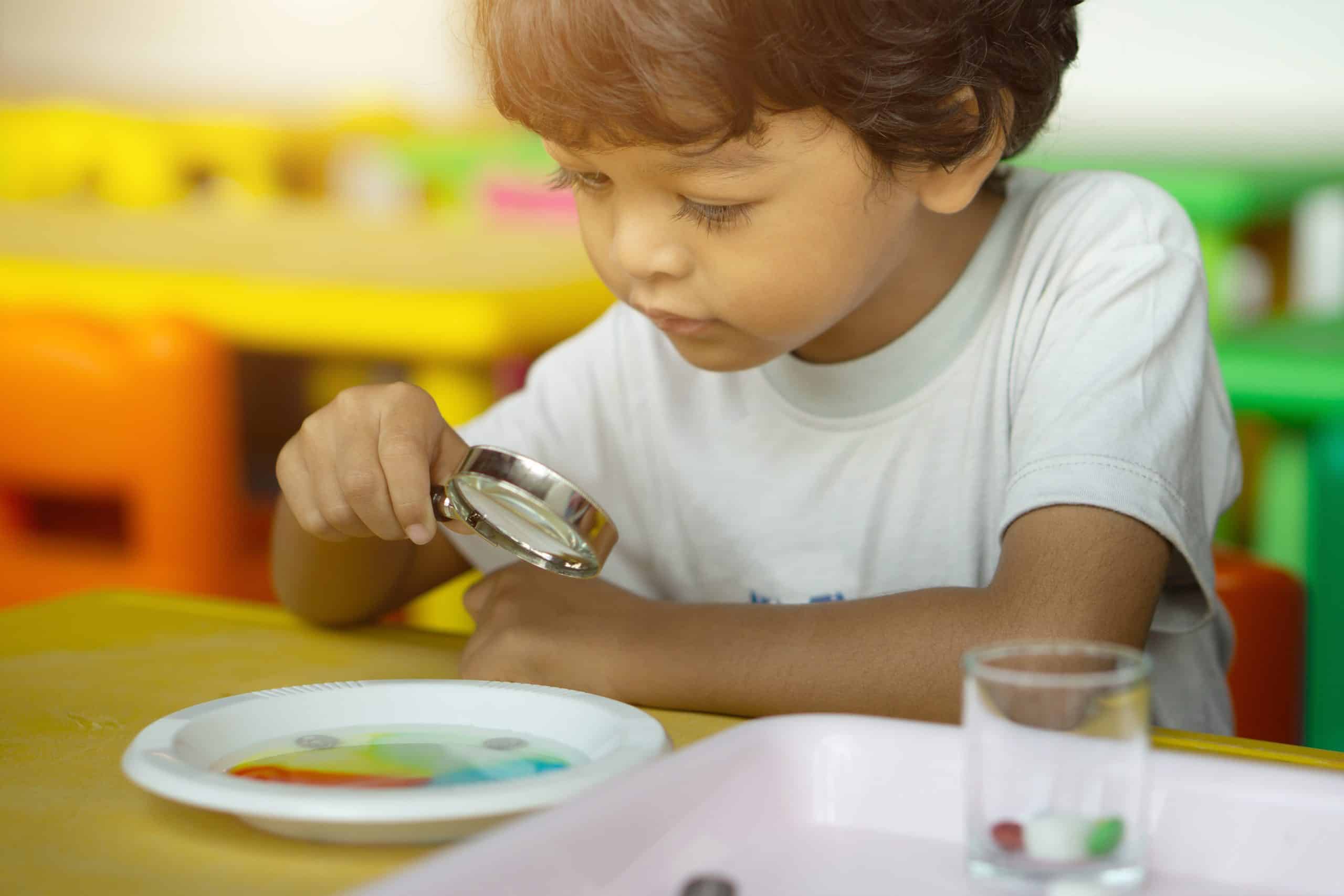
Using scientific tools. As with language and concepts, cultural tools enable children to understand what they observe in more general and theoretical ways[x]. For example, children can come to see weather through a scientific lens by measuring rainfall, noticing wind direction, and analysing cloud formation[xi]. When children are explicitly introduced to science tools such as magnifying glasses or measuring equipment, and how they might be used, they are able to engage in much more productive exploration in their free play[xii].
Offering scientific representations. Many images and models can be found in digital form via the internet, such as visual typologies for identifying clouds. While direct experience is preferable for young children, digital technologies and apps can help children view science phenomena that are not directly accessible[xiii] (such as for tracking moon phases[xiv]) or view them in a different way (as in with the use of a digital microscope). Weather radar pictures and weather maps are some examples of scientific images and models that children can be introduced to and learn to competently use[xv]. Digital images or videos might be projected and shared with children to develop awareness of a science concept, to provoke conversation, or to guide children’s play narratives to include science ideas[xvi]. Many books, both fiction and non-fiction, offer science content to young children, and can authentically support children’s science learning[xvii] (although again are not a substitute for hands-on experience[xviii]).
Scientific concepts, models, and representations are cultural inventions, developed within particular times and contexts in which explanation has been needed[xix]. The knowledge they represent helps children to experience and perceive the world differently, and help children ascribe meaning to their experiences. As scientific terms are used abstractly, in a way that is decontextualized from the context in which they were developed, they cannot be automatically understood and need to be passed to children by more experienced members of the culture. When adults share historically developed knowledge, such as knowledge about rainbows as the refraction of white light (discovered by Isaac Newton in the 1660s), they help orient children to scientific knowledge as a way of explaining everyday experiences[xx].
Another excellent way to intentionally promote science learning in early childhood settings is through the provision of high-quality science texts. Most early childhood settings could do with having more non-fiction books[xxi] which expose children to the explanatory aspects of science texts, improve children’s science vocabulary[xxii] and knowledge, support children’s reasoning skills, and provoke more cognitively-demanding conversation[xxiii]. In addition, fictional narratives and the meaningful context of a story can also facilitate children’s understanding of more difficult science concepts. Narratives can be used to support children to make observations and predictions, ask questions, and draw conclusions, and might inspire science activities or projects[xxiv]. However, some caution should be used. For example, storybooks often use anthropomorphic characteristics to describe plants and animals, assigning them human characteristics and emotions. Here teachers might compare the representation of animals and plants in fiction and non-fiction books, to help children develop appropriate understandings[xxv]. Similarly, both fiction and non-fiction texts about science can include misconceptions or inaccurate illustrations[xxvi], as well as simply fantastical and stereotypical ideas such as the notion of the mad scientist[xxvii], so teachers should review potential texts to ensure that they are accurate and appropriate for children’s level of understanding, and that they represent a range of disciplines and content areas within science (not just biology, which is most common)[xxviii].
More structured intentional activities and experiences can also be provided through the strategies of shared inquiry, co-constructed play, and Conceptual PlayworldsTM (an approach developed by Marilyn Fleer and colleagues), in which teachers carefully plan for structured experience that introduce and reinforce science concepts in a logical progression.
Shared inquiry. Inquiry is another name for research, exploration, inspection, and the examination and study of phenomena[xxix]. It supports deep and sustained engagement with selected science ideas and concepts, rather than simply exposure to many different science ideas[xxx]. Inquiry begins with noticing, wondering, and sharing ideas[xxxi]. Children build their understandings of scientific concepts on the foundation of their existing understandings and funds of knowledge[xxxii], so will learn most effectively when there are opportunities to engage their previous knowledge and preconceptions[xxxiii]. Teachers might pose questions that structure children’s inquiry: ‘what do we see? What do we think? What do we know and what questions do we have? How can we find out?’. For example, discovering a spider web in the playground could lead to discussions about what it is and how it is made, as well as the purpose or funtion of it. Teachers can model curiosity and open-ended thinking (‘I wonder why…, I wonder if…’)[xxxiv]. Listening to children’s questions can help teachers to explore new and emerging interests[xxxv] and to co-construct mutually engaging inquiries and experiences.
Co-constructed play narratives and dramatic play. Some science concepts, because they are invisible or intangible, can be better understood when they are acted out or imagined. For example, teachers might encourage older children to pretend that a hula hoop is a flashlight, and that when they pretend to switch on the flashlight, that they jump through the hula-hoop as photons[xxxvi]. Through play, teachers can highlight or draw attention to ideas by emotionally charging them, perhaps using enthusiasm or exaggeration[xxxvii]. Teachers might also intentionally introduce play in which they and the children act out (or as) science ideas and content, such as by pretending to be ants in the bushes. This supports science learning because science content is needed for such play – children pretending to be an ant cannot act in any way they wish, but have to create and define the role using what they know about how ants look and behave. This can be a great way of determining what children already know[xxxviii], as well as a meaningful reason to explore science content.
Conceptual PlayworldsTM . A Conceptual PlayworldTM is an intentional practice in which teachers create a scientific problem scenario as a play inquiry[xxxix]. They draw on children’s emotions and imagination to collectively develop a narrative which supports children with their awareness of scientific concepts, and intentionally supports them to develop a scientific sense of a situation[xl]. This is an important way in which teachers can generate new, science-related interests for children (rather than simply responding to children’s existing interests), and intentionally plan for the introduction and application of increasingly complex scientific ideas and practices[xli]. In developing a Playworld, the teacher takes the role of narrator, drawing attention to scientific ideas, describing collective scientific thinking, and holding these ideas together for the group[xlii]. Props can also be used, standing in for the scientific meanings that children are beginning to understand, and acting as prompts and pivots on which the narrative can be developed[xliii]. Props are particularly supportive for enabling infants and toddlers to participate and communicate their intentions and ideas[xliv]. Examples of Conceptual PlayworldsTM explored in early childhood settings include: following a tiger into the jungle (with infants and toddlers), navigating different terrain, and searching to find a flamingo (orienting children to the concept of habitat)[xlv]. Another example draws on the story of Goldilocks and the Three Bears, setting up opportunities for older children to cook and cool porridge, using the emotive impact of the story to encourage children to find better ways for cooling porridge more quickly[xlvi] (orienting children to concepts of heat transference).

Endnotes
[i] Fleer, M. (2015c). Imagination and its contributions to learning in science.In M. Fleer, & N. Pramling (Eds.). A Cultural-Historical Study of Children Learning Science : Foregrounding Affective Imagination in Play-based Settings (pp.39 – 58). Springer.
[ii] Fleer, M. (2015b). How preschools environments afford science learning.In M. Fleer, & N. Pramling (Eds.). A Cultural-Historical Study of Children Learning Science : Foregrounding Affective Imagination in Play-based Settings (pp.23 – 37). Springer.
[iii] Fleer (2015b).
[iv] Fleer, M., March, S., & Suryani, A. (2024). A cultural‐historical study of how educators create conditions for infant and toddler learning in science. Science Education, 108, 1495–1518.
[v] Aitken, J., Hunt, J., Roy, E., & Sajfar, B. (2016). A Sense of Wonder: Science in Early Childhood Education. Teaching Solutions
[vi] Aitken et al. (2016).
[vii] van der Graaf, J., Segers, E., & Verhoeven, L. (2018). Individual differences in the development of scientific thinking in kindergarten. Learning and Instruction, 56, 1-9. https://doi.org/10.1016/j.learninstruc.2018.03.005
[viii] van der Graaf et al. (2018).
[ix] Hadzigeorgiou, Y. (2015). Young children’s ideas about physical science concepts. In K. C. Trundle, & M. Saçkes (Eds.). Research in Early Childhood Science Education (pp. 67 – 97). Springer.
[x] Pramling (2015b).
[xi] Fleer (2015b).
[xii] Nayfeld, I., Brenneman, K., & Gelman, R. (2011). Science in the classroom: Finding a balance between autonomous exploration and teacher-led instruction in preschool settings. Early Educational Development, 22, 970–988.
[xiii] Uçar (2015). The use of technology in teaching science to young children. In K. C. Trundle, & M. Saçkes (Eds.). Research in Early Childhood Science Education (pp. 167 – 184). Springer.
[xiv] Uçar (2015).
[xv] Fleer (2015b).
[xvi] Lund et al. (2025a).
[xvii] Smolkin, L. B., & Donovan, C. A. (2015). Science and literacy: Considering the role of texts in early childhood science education. In K. C. Trundle, & M. Saçkes (Eds.). Research in Early Childhood Science Education (pp. 211 – 236). Springer.
[xviii] Trundle, K. C. & Saçkes, M. (2012). Science and early education. In Pianta, R., W. Steven Barnett, W. S., Justice, L. M., & Sheridan, S. M. (Eds.) Handbook of Early Childhood Education (pp.240 – 258), Guilford Press.
[xix] Fleer, M. (2015e). Learning science in everyday life – A cultural-historical framework.In M. Fleer, & N. Pramling (Eds.). A Cultural-Historical Study of Children Learning Science : Foregrounding Affective Imagination in Play-based Settings (pp. 3- 22). Springer.
[xx] Fleer (2015e).
[xxi] Akerson et al. (2015).
[xxii] Alber-Morgan, S. R., Sawyer, M. R., & Miller, H. L. (2015). Teaching science to young children
with special needs.In K. C. Trundle, & M. Saçkes (Eds.). Research in Early Childhood Science Education (pp. 299 – 324). Springer.
[xxiii] Smolkin & Donovan (2015).
[xxiv] Trundle & Saçkes (2012).
[xxv] Akerson et al. (2015).
[xxvi] Trundle & Saçkes (2012).
[xxvii] Patrick, H., & Mantzicopoulos, P. (2015). Young children’s motivation for learning science. In K. C. Trundle, & M. Saçkes (Eds.). Research in Early Childhood Science Education (pp. 7-34). Springer.
[xxviii] Smolkin & Donovan (2015).
[xxix] Aitken et al. (2016).
[xxx] Patrick & Mantzicopoulos (2015).
[xxxi] Aitken et al. (2016).
[xxxii] National Research Council (2000). Eager to Learn: Educating Our Preschoolers. The National Academies Press. https://doi.org/10.17226/9745.
[xxxiii] National Research Council (2000).
[xxxiv] Aitken et al. (2016).
[xxxv] Lund, K., Redfors, A., & Jonsson, A. (2025b). Preschool teachers’ discussions of attempted play-responsive science teaching. International Journal of Science Education, 47 (5), 680-696. https://doi.org/10.1080/09500693.2024.2348187
[xxxvi] Lund et al. (2025b).
[xxxvii] Fleer (2015c).
[xxxviii] Lund et al. (2025b).
[xxxix] Fleer, M. (2019). Scientific Playworlds: A model of teaching science in play-based settings. Research in Science Education, 49(5), 1257-1278. https://doi.org/10.1007/s11165-017-9653-z
[xl] Fleer, M. (2015f). Theoretical and conceptual insights – The young learner in science.In M. Fleer, & N. Pramling (Eds.). A Cultural-Historical Study of Children Learning Science : Foregrounding Affective Imagination in Play-based Settings (pp.59 – 64). Springer.
[xli] Fleer et al. (2024).
[xlii] Fleer, M. (2015a). A cultural-historical model of early childhood science education.In M. Fleer, & N. Pramling (Eds.). A Cultural-Historical Study of Children Learning Science : Foregrounding Affective Imagination in Play-based Settings (pp.199 – 212). Springer.
[xliii] Fleer et al. (2024).
[xliv] Fleer, M. (2024). Conceptual PlayWorld for infant‑toddlers: The unique nature of becoming a science learner in the early years of life. Research in Science Education, 54, 315–338. https://doi.org/10.1007/s11165-023-10145-2
[xlv] Fleer (2024).
[xlvi] Fleer (2015c).