
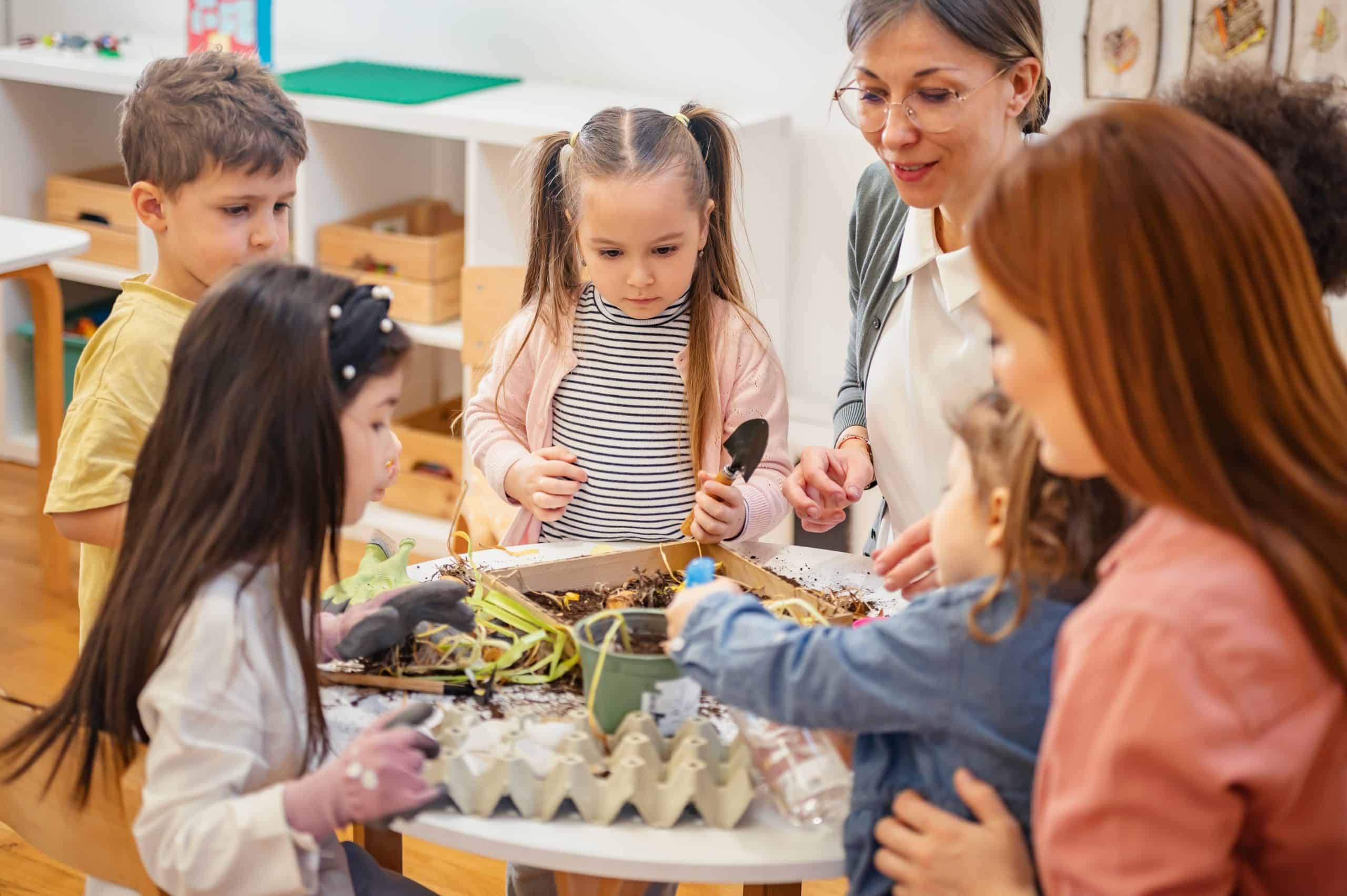
Intentional teaching for science in early childhood settings
While science-like exploration is natural for young children [1], the capacity of children to acquire science knowledge solely through child-centred free play has increasingly come under question[2]. Instead, research advocates for the importance of intentionally planning to introduce specific science concepts and language to children in a structured way that is meaningful to their play and activity. While there are rich possibilities for science learning in the environments of early childhood settings, children may not be consciously aware of the scientific concepts involved in their play[3], and infrequent and fragmented science learning that is not integrated into a cohesive structure is not likely to promote children’s scientific understandings[4].
Intentional teaching is both responsive (to children’s initiatives and interests), and proactive (by deliberately planning and implementing experiences that children may not think up or be able to carry out on their own)[5]. Often, teachers can effectively introduce or reinforce science content within an existing interest or play theme that is meaningful and motivating for children[6]. This requires teachers to be able to ‘see’ the science learning potential in children’s talk and action[7], and draw on a range of pedagogical strategies to facilitate science learning[8], offering information and actively teaching ideas at the same time that they are responsive to children’s perspectives and play interests[9]. Teachers can build on children’s play in ways that challenge children to think or act in new ways, extend their play scripts[10], and apply their developing knowledge in new contexts.
Teachers can demonstrate high expectations for children’s science learning by a more proactive approach in which they intentionally generate children’s interest in diverse scientific concepts (in contrast, teaching that is focused on putting out materials and following children’s interests is indicative of lower expectations for children’s science learning)[11]. While children’s interests have long been an important foundation on which teachers plan for and extend learning, children may not have the experience to know what science-related content they might be interested in[12]. Teachers can assume that young children will enjoy learning about science concepts, especially if they help them see science as relevant and meaningful[13]. Teacher-guided and teacher-initiated activities[14] can be used to help children build on initial discoveries made in play[15], or to introduce particular science content that children might not access through child-centred play alone[16]. Deliberately setting up carefully conceived learning experiences to support science learning[17] is crucial for furthering children’s learning about specific concepts in a structured way that enables them to build increasingly accurate and complex concepts. Teachers should engage children in their teaching, while remaining open to the children initiating different ideas or directions for a science activity[18].
Science-rich environments
Positive environments for science exploration are especially valuable during the early years, where play provides an important foundation for developing basic scientific practices and conceptual understandings[19]. Rich environments can facilitate natural processes of discovery[20], often informal and incidental, such as observing changes in the weather or a special insect in the garden[21], which provide authentic contexts for providing children with scientific explanations[22].
Some early childhood settings may choose to have a designated science area. This can be supportive of science learning, although it is dependent on how it is used: without teachers being actively involved in demonstrating and using the resources in the science area, research finds that children rarely spend time in designated science areas[23]. To promote science learning, science areas need to be attractive to children (often the presence of a teacher serves this function), the area needs to feel appropriate and interesting to children, and children need to be able to recognise the tools and materials and know how they might be used[24].
Science equipment might include observation and measuring equipment, such as magnifying glasses, mirrors, light boxes, tape measures, weighing scales, timers, thermometers, and rain gauges. Tools need to be fit for purpose: for example, metal spades that can cut through the soil, and magnifying glasses that satisfactorily magnify for children to see finer details[25] (otherwise, they may frustrate exploration). It is also important to have resources ready for recording findings, such as a range of visual arts materials, and reference materials such as books, posters, and websites. Other things that can be useful are a range of loose parts made of different materials (not always plastic). Finally, children can also explore and represent scientific ideas through realistic props, including animal and people figures, figurines of a life cycle, soft toys, and finger and hand puppets.
How materials are placed, and how open-ended they are for children’s exploration, will affect the quality of children’s inquiry and exploration[26]. Teachers should ensure that children are able to observe and manipulate resources in a way that will enable them to reflect upon scientific concepts. For example, to explore and begin to conceptualise the science within the movement of objects, it is important that children can act upon objects to produce movement, observe immediately the way the object reacts, and vary their actions on objects to observe different effects[27]. Teachers should also be available and actively promoting children’s construction of understanding about what they are doing and observing, and using resources to directly teach science concepts. Some resources and materials can help to make hard-to-grasp concepts such as force and air tangible to children. For example, children can collect air and wind in plastic bags, which helps them to understand that air can take up space (and therefore is a form of matter) even though it can’t be seen[28].
How does play support science learning?
As a medium through which children find things out through physical exploration, imagination, and experimentation, play can support science learning[29]. In play, children are often highly engaged and paying attention to what they are seeing, hearing, touching, and tasting, which supports them in acquiring, storing, organising, and applying concepts and information[30]. Play also offers a context in which children can repeat and practise skills and test scientific ideas[31]. Schema play, in which children engage in dedicated and repeated exploration of a concept such as trajectory (the patterns of movement of moving objects) or envelopment (covering things and oneself) involves scientific concept formation about the properties of materials (which objects roll or propel, which wrappings are flexible or transparent/opaque) and with the consequences of actions (applying force to propel objects in the air, layering fabrics or paint).
Play offers opportunities to move from thinking and talking about the world ‘as is’ to talking about ‘as if’, which helps children engage in different reasoning and ways of thinking, including those of imagining and anticipating possibilities (‘what if we did this? what might happen then?’), which are crucial to science[32]. In addition, role play and narrative play help children think metacognitively (as they think about and explicitly discuss rules for playing particular roles), which is a kind of conscious reflection that is important for increasing awareness of science concepts[33]. The imaginative aspects of play can also imbue science learning with a heightened emotional investment on the part of children, and help create a positive emotional tone around science experiences[34]. Teachers can also build powerful emotional responses to science learning by connecting science with meaningful stories and story characters with which children can identify and be motivated to engage in scientific problem-solving[35].
While much science content knowledge is embedded into play experiences, this does not necessarily mean that children are making meaningful connections with science knowledge, and acquiring, testing, refining, and reflecting on their knowledge and skills[36]. In fact, several studies demonstrate children enjoying imaginative play with resources planned for science learning, while not engaging fully, or at all, with scientific ideas[37]. Examples include children connecting a tray of seaweeds and sponges in the water tray to SpongeBob SquarePantsTM and enacting some of the narratives they know from that television programme[38]. In other words, resources cannot do science teaching for teachers[39]. Often children need the support of teachers to connect their play activities to particular scientific concepts and content[40]. It is important for teachers to build on the experiences children are having, and draw attention to the science content within them, by putting words to what is happening, sharing experiences[41]. For example, playing with sand, water, mud, and natural materials like straw and jute can help children learn the properties of materials. Yet the possibilities for science learning in play are strengthened if teachers are primed and ready to introduce science vocabulary related to concepts such as flexibility, elasticity, and strength. Appropriate structuring, rather than simply giving children information or leaving them to discover it for themselves, is important for young children to develop conceptual understandings in science[42]. In particular, children from disadvantaged backgrounds (who may lack the cultural capital needed to navigate discovery-based learning approaches)[43], and neurodivergent children[44], benefit hugely from activity-based inquiry in which teachers provide appropriate levels of guidance and explicit instruction.
This means that employing a range of play types is important for science education[45]. Play types might include open-ended play, but also types of play in which more teacher involvement is promoted, such as modelled play (in which teachers illustrate, explain, and demonstrate scientific ideas and activities)[46]. The use of different play types should be seen as pedagogical[47], which means intentionally thinking about and planning how to use play, and different pedagogical strategies within play, to enable children to learn specific science content[48]. For example, one possible sequence of play types might begin with open-ended play, so that children become engaged, notice things, ask questions, and wonder, followed by the teacher providing modelled or structured play in which children are supported to predict, observe, and make a record of what they discover[49], and then guided sessions in which children reflect on their data, construct explanations and theories, draw conclusions, and develop new questions[50]. It is also possible that modelled play is used to first to orient children to the possibilities for scientific investigation in a particular play activity, with open-ended play offered next to enable children to practise and consolidate their learning[51]. Open-ended play might be important for ascertaining what children already know about a science topic before teacher involvement is planned[52]. The science topic, its complexity and familiarity to children, and knowledge of the children themselves will all be relevant to teachers’ pedagogical decisions about what kind of play and when to offer it.
The role of the teacher
Children construct content knowledge when they work with teachers who already hold some scientific content knowledge themselves and can facilitate children’s understandings, whether this occurs within richly-resourced free play contexts or in more guided science experiences[53]. As the previous sections have emphasised, science-rich, playful environments successfully promote science learning when there is the planned, intentional, and science-focused participation of teachers in children’s activities. Rich and systematic science experiences, in which the learning achieved in one experience is carefully built on in the next, enable children to develop and consolidate increasingly complex skills and concepts over time[54]. The best science experiences for promoting science learning are appropriate pitched for children’s understanding, ongoing, contextualised, and coherent[55]. This requires teacher forethought and planning.
Intentional teachers need to have specific, although relatively open-ended, science learning goals for children, in which there remains a place for children to guide their own inquiry[56]. Specific goals enable teachers to help children pay attention to the important aspects of an experience for science learning[57]. Given the vast amount of sensory information present in early childhood science activities, teachers shouldn’t assume that children will attend to the most relevant features of a phenomenon, but should offer support for them to understand which features matter and which are incidental[58].
Guiding children’s observations and activity by asking questions is more useful for most children to gain new understandings than teachers simply stating science facts[59]. Questions can invite children to connect observations and to develop theories, and support them to focus their thinking in ways that can help them unpack key scientific ideas and make sense of complex phenomena[60]. Questions that support children to notice patterns, similarities, and differences in the events they observe[61], and that invite comparison, measuring and counting, and problem-posing are all useful[62]. Teachers’ questions might engage children’s imagination: ‘How does a rainbow happen? What does it feel like? Could you stand on it? Slide on it? Where did the rainbow go?’[63]. As children ask and answer questions, they are constructing their own science knowledge. When questions are asked, teachers should offer plenty of time for children to think, and not expect immediate answers (nor keep up an incessant string of questioning). Some children may need to demonstrate their thinking and ideas through other means, such as drawing or acting them out.
Discussion with teachers and peers is really important for enabling children to make explicit (verbally or visually) their expectations about science phenomena, and this can facilitate them to develop their theories more readily[64]. Good science-based discussions depend on pedagogical practices such as sustained shared thinking and intersubjectivity[65]. Sustained shared thinking occurs in conversations in which teachers and children listen deeply to one another, and build a back-and-forth dialogue in which they build on what the other has to say. Intersubjectivity (shared understandings, interests, and meanings) are crucial for sustained shared thinking to occur. Without intersubjectivity, teachers will not know what will hold a child’s attention, what they will find interesting and meaningful, or what they will be able to make good sense of[66]. Explanations are likely to be more effective when children and adults share joint attention and achieve intersubjectivity[67].
Intentionally providing children with scientific content knowledge is found to be important because this knowledge can filter and focus children’s observations[68]. Children often need the support of teachers to help them look scientifically at their finds and discoveries, relating and building their understanding of these in relation to the formal knowledge system around this phenomenon[69]. Research shows that without support to focus and connect their observations, even school-aged children’s learning is limited as they fail to notice important and relevant things[70]. For example, understanding that the number of legs is a distinguishing feature of the class of creatures known as ‘insects’, children will be more alert to observing the number of legs on the creatures they find in the garden. Knowledge from science teaching therefore changes how children think about and explore their environment[71]. Children need to be shown, and specifically discuss, many examples which demonstrate the essential features of a category or concept: for example, learning the concept of mammal by comparing whales and fish, bats and birds[72] (you might have noticed how very young children tend to overextend concepts, such as applying ‘dog’ to every animal with four legs). In addition, research suggests that as children gain knowledge and competence, they are more likely to sustain interest in a science topic[73].
While it is useful for teachers to ask questions to support children to think scientifically and use their emerging scientific knowledge in constructing models and theories about how the world works, it is also important to provide opportunities to listen to children’s developing theories and questions. Teachers can turn children’s questions back to them[74], perhaps developing these into the focus of shared inquiries. Children’s use of language and expression of ideas can reveal their current thinking[75], and help teachers identify which science concepts and questions are appropriate for children’s current level of understanding. Children also need support from teachers with building on their understanding from past experiences and ongoing conversations related to a topic, linking their ideas and extending on their thinking from day to day. Teachers can help children here by encouraging them to create models and representations of their growing understanding of science ideas, and then using these as a reminder of their previous thinking and as a tool to support them to build on this thinking [76].

Endnotes
[1] Gopnik, A. (2012). Scientific thinking in young children: Theoretical advances, empirical research, and policy implications. Science, 337(6102), 1623–1627.
[2] Edwards, S., & Cutter-Mackenzie, A. (2011). Environmentalising early childhood education curriculum through pedagogies of play. Australasian Journal of Early Childhood, 36 (1), 51 – 59.
[3] Sikder, S., & Fleer, M. (2015). Small science: Infants and toddlers experiencing science in everyday family life. Research in Science Education, 45, 445–464. https://doi.org/10.1007/s11165-014-9431-0
[4] Patrick, H., & Mantzicopoulos, P. (2015). Young children’s motivation for learning science. In K. C. Trundle, & M. Saçkes (Eds.). Research in Early Childhood Science Education (pp. 7-34). Springer..
[5] Lund, K., Redfors, A. & Jonsson, A. (2025b). Preschool teachers’ discussions of attempted play-responsive science teaching. International Journal of Science Education, 47 (5), 680-696. https://doi.org/10.1080/09500693.2024.2348187
[6] Lund, K., Redfors, A., & Jonsson, A. (2025a). Can we play with science? Preschool teachers’ discussion about play-responsive teaching and how science content can be introduced into play with support of digital tools. Early Years, 45 (3-4), 426-440.https://doi.org/10.1080/09575146.2024.2365182
[7] Samarapungavan, A., Tippins, D., & Bryan, L. (2015). A modeling-based inquiry framework for early childhood science learning. In K. C. Trundle, & M. Saçkes (Eds.). Research in Early Childhood Science Education (pp. 259-277). Springer.
[8] Samarapungavan et al. (2015).
[9] Lund et al. (2025b).
[10] Lund et al. (2025b).
[11] Fleer, M., March, S., & Suryani, A. (2024). A cultural‐historical study of how educators create conditions for infant and toddler learning in science. Science Education, 108, 1495–1518.
[12] Patrick & Mantzicopoulos (2015).
[13] Patrick & Mantzicopoulos (2015).
[14] Aitken, J., Hunt, J., Roy, E., & Sajfar, B. (2016). A Sense of Wonder: Science in Early Childhood Education. Teaching Solutions.
[15] Aitken et al. (2016).
[16] Cutter-Mackenzie, A. & Edwards, S. (2013). Toward a model for early childhood environmental education: Foregrounding, developing, and connecting knowledge through play-based learning. The Journal of Environmental Education, 44 (3), 195-213. https://doi.org/10.1080/00958964.2012.751892
[17] Aitken et al. (2016).
[18] Lund et al. (2025b).
[19] National Association for the Education of Young Children (2020). Developmentally appropriate practices: A position statement of the National Association for the Development of Young Children.
[20] Uçar (2015). The use of technology in teaching science to young children. In K. C. Trundle, & M. Saçkes (Eds.). Research in Early Childhood Science Education (pp. 167 – 184). Springer.
[21] Fleer, M. (2015b). How preschools environments afford science learning.In M. Fleer, & N. Pramling (Eds.). A Cultural-Historical Study of Children Learning Science : Foregrounding Affective Imagination in Play-based Settings (pp.23 – 37). Springer.
[22] Fleer (2015b).
[23] Nayfeld, I., Brenneman, K., & Gelman, R. (2011). Science in the classroom: Finding a balance between autonomous exploration and teacher-led instruction in preschool settings. Early Educational Development, 22, 970–988.
[24] Patrick & Mantzicopoulos (2015).
[25] Aitken et al. (2016).
[26] Aitken et al. (2016).
[27] Kamii, C. (2015). Physical-knowledge activities for the development of logico-mathematical knowledge. In K. C. Trundle, & M. Saçkes (Eds.). Research in Early Childhood Science Education (pp. 185 – 208). Springer.
[28] Lund et al. (2025b).
[29] Akman, B., & Özgül, S. G. (2015). Role of play in teaching science in the early childhood years.In K. C. Trundle, & M. Saçkes (Eds.). Research in Early Childhood Science Education (pp. 237 – 257). Springer.
[30] Aitken et al. (2016); Akman & Özgül (2015).
[31] Aitken et al. (2016).
[32] Lund et al. (2025b).
[33] Fleer, M. (2011). ‘Conceptual play’: Foregrounding imagination and cognition during concept formation in early years education Contemporary Issues in Early Childhood, 12 (3) 224-240. http://dx.doi.org/10.2304/ciec.2011.12.3.224
[34] Fleer (2015c).
[35] Fleer (2015c).
[36] Edwards & Cutter-Mackenzie (2011).
[37] Fleer, M. (2015d). Knowledge construction is culturally situated: The human invention of empirical, narrative and theoretical knowledges.In M. Fleer, & N. Pramling (Eds.). A Cultural-Historical Study of Children Learning Science : Foregrounding Affective Imagination in Play-based Settings (pp.95-112). Springer.
[38] Cutter-Mackenzie, A., Edwards, S., Moore, D., & Boyd, W. (2014). Young Children’s Play and Environmental Education in Early Childhood Education. Springer.
[39] Fleer (2015d).
[40] Edwards & Cutter-Mackenzie (2011).
[41] Lund et al. (2025a).
[42] Trundle, K. C. & Saçkes, M. (2012). Science and early education. In Pianta, R., W. Steven Barnett, W. S., Justice, L. M., & Sheridan, S. M. (Eds.) Handbook of early childhood education (pp.240 – 258), Guilford Press.
[43] Hendrix, C. (2025, Jun 08). Defending the Science of Learning. The Learning Dispatch.https://carlhendrick.substack.com/p/defending-the-science-of-learning?utm_source=substack&utm_medium=email
[44] Alber-Morgan, S. R., Sawyer, M. R., & Miller, H. L. (2015). Teaching science to young children
with special needs.In K. C. Trundle, & M. Saçkes (Eds.). Research in Early Childhood Science Education (pp. 299 – 324). Springer.
[45] Cutter-Mackenzie, A. & Edwards, S. (2013). Toward a model for early childhood environmental education: Foregrounding, developing, and connecting knowledge through play-based learning. The Journal of Environmental Education, 44 (3), 195-213. https://doi.org/10.1080/00958964.2012.751892
[46] Cutter-Mackenzie & Edwards (2013).
[47] Cutter-Mackenzie et al. (2014).
[48] Cutter-Mackenzie & Edwards (2013).
[49] Cutter-Mackenzie et al. (2014).
[50] Akerson et al. (2015).
[51] Cutter-Mackenzie et al. (2014).
[52] Cutter-Mackenzie et al. (2014).
[53] Cutter-Mackenzie et al. (2014)
[54] National Research Council (2000).
[55] Patrick & Mantzicopoulos (2015).
[56] Aitken et al. (2016).
[57] Fleer (2015f).
[58] Hendrix, C. (2025, Sept 20). 10 rules for designing effective learning. The Learning Dispatch, Substack. https://carlhendrick.substack.com/p/10-rules-for-designing-effective?utm_source=substack&utm_medium=email
[59] Alber-Morgan et al. (2015); Haber, A. S., Puttre, H., Ghossainy, M.E., & Corriveau, K. H. (2021). “How will you construct a pathway system?”: Microanalysis of teacher-child scientific conversations. Journal of Childhood, Education & Society, 2(3), 338 – 364.
[60] Eberbach, C., & Crowley, K. (2009). From everyday to scientific observation: How children learn to observe the biologist’s world. Review of Educational Research, 79, (1), 39–68
http://doi.org/10.3102/0034654308325899
[61] Eberbach & Crowley (2009).
[62] Alber-Morgan et al. (2015)
[63] Fleer (2015b).
[64] Eberbach & Crowley (2009).
[65] Cutter-Mackenzie & Edwards (2013); Fleer (2025a).
[66] Fleer, M. (2015a). A cultural-historical model of early childhood science education.In M. Fleer, & N. Pramling (Eds.). A Cultural-Historical Study of Children Learning Science : Foregrounding Affective Imagination in Play-based Settings (pp.199 – 212). Springer.
[67] Fender, J. G., & Crowley, K. (2007). How parent explanation changes what children learn from everyday scientific thinking. Journal of Applied Developmental Psychology, 28, 189–210
[68] Eberbach & Crowley (2009).
[69] Fleer (2015a).
[70] Eberbach & Crowley (2009).
[71] Fleer, M. (2015f). Theoretical and conceptual insights – The young learner in science.In M. Fleer, & N. Pramling (Eds.). A Cultural-Historical Study of Children Learning Science : Foregrounding Affective Imagination in Play-based Settings (pp.59 – 64). Springer.
[72] Hendrix, C. (2025, Sept 20). 10 rules for designing effective learning. The Learning Dispatch, Substack. https://carlhendrick.substack.com/p/10-rules-for-designing-effective?utm_source=substack&utm_medium=email
[73] Patrick & Mantzicopoulos (2015).
[74] Haber et al. (2021).
[75] Hadzigeorgiou, Y. (2015). Young children’s ideas about physical science concepts. In K. C. Trundle, & M. Saçkes (Eds.). Research in Early Childhood Science Education (pp. 67 – 97). Springer.
[76] Fleer (2015a).