
ADHD
ADHD is a form of neurodiversity that leads to challenges with executive function.
Definition
ADHD stands for attention-deficit/hyperactivity disorder. Students with ADHD display an ongoing pattern of inattention, impulsivity, or hyperactivity that is severe and consistent enough to interfere with everyday functioning. These behaviours are due to the way the student’s brain works, not to a lack of understanding of the content being covered or as a response to a situation or a particular person. Some children only display one of the symptoms of inattention, impulsivity and hyperactivity, but most exhibit a combined type of ADHD with two or more of the above characteristics.
Relevance
Students with ADHD have difficulty with executive function, or managing and regulating their own thoughts. They have a harder time controlling their impulses, thinking before acting, making a plan and sticking to it, telling their brain when to be active and when to be still, controlling emotional responses, and staying focused when they are not especially interested. As a result, they may find a number of aspects of school life more challenging than their neurotypical peers.
State of the evidence
ADHD is the most common childhood neurodevelopmental disorder, and, while a number of misunderstandings persist, there is a growing body of research to support our knowledge and understanding of ADHD. There are a number of evidence-based strategies that can be used to support students with ADHD in the classroom.
In practice
- Students with ADHD are at a higher risk for low academic achievement: they are frequently recommended for special education programmes and experience more discipline problems. While educators often focus exclusively on behavioural interventions, it is crucially important also to target missed academic skills. In order to help students with ADHD, teachers must remember to address gaps in foundational knowledge, behavioural and study skills, and organisational or executive functioning interventions. Students with ADHD are often creative and innovative thinkers, talented in the arts, imaginative, curious, and willing to take risks. Teachers who focus on student strengths can help to create learners who are more engaged and thus more likely to improve.
Guiding questions
- Do I know which of my students have ADHD?
- Have I asked the students what would help them to learn and be successful in my class?
- Have I engaged with parents and whanau to better understand the needs of my students?
- Have I set up my classroom environment to best support the needs of my students?
- Have I considered how to help my students with ADHD to focus on and pursue their strengths?
- Do I know where to go if I need more support?

Developing the components of executive function in the primary school classroom
An exploration of the different skills that make up executive function, and how to develop them in primary school classrooms.

Strategies for promoting executive function in secondary school
Approaches for supporting secondary school students to consciously build and hone their executive function skills.

Supporting self-regulation through self-instruction and self-monitoring
The importance of self-regulation to learning and how students can be supported to become self-regulated learners.

An introduction to ADHD
A brief introduction to ADHD and a set of strategies to help support students with ADHD in the classroom.

Understanding emotional regulation and dysregulation
Dr Tracy Stewart explores what is meant by emotional regulation and discuss practical strategies that teachers can use to support emotion regulation skills in the classroom. She will also discuss her new, not yet published, research, in which she is working together with teachers to co-develop emotion regulation skills that are embedded directly into classroom practice.

Supporting neurodivergent students in the classroom
Dr Emily McDougal shares insights from her work into supporting neurodivergent students in schools and classrooms.

Understanding ADHD
Dr Dione Healey shares insights from her extensive research into ADHD, much of which is concerned with supporting children with ADHD through cognitive training.

Neurodiversity in education
This webinar explores the challenges that neurodiverse students face in schools and as they move on to tertiary education, as well as how teachers and schools can help to ameliorate these challenges.


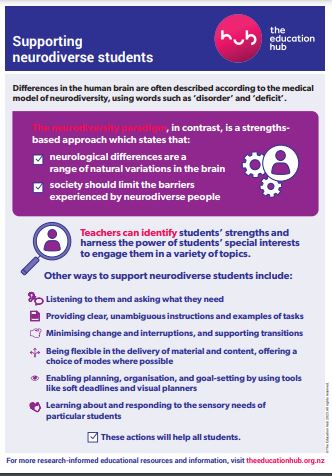

How to support effective emotion regulation in schools and classrooms
Key insights from the webinar with Dr Tracy Stewart.

Key challenges for neurodivergent students in school settings and how to help
Insights from the webinar with Emily McDougal on supporting neurodivergent students in schools and classrooms.

Understanding ADHD
The key insights from our webinar with Associate Professor Dione Healey on understanding ADHD.
Removing barriers to success for neurodivergent students
Dr Chiara Horlin offeres practical ways that teachers and schools can help to ameliorate these challenges and support neurodivergent students to celebrate and use their strengths in the classroom.