
Principles of assessment
The key principles underlying a system that learns in order to provide the best possible learning opportunities and outcomes for students.
Definition
Assessment describes a broad range of practices from informal evaluations of student learning and progress to formal summative examinations for the attainment of recognised qualifications such as NCEA. Assessment can be both formative, which means that it is used to inform ongoing teaching and learning, and summative, which is used to provide a measure of learning and progress. However, this is not a fixed distinction, as summative measures can also be used to inform the focus and direction of future teaching and learning. Sound educational assessment is characterised by validity, reliability and fairness in all assessment practices.
Relevance
Assessment is crucial to learning and is an integral part of the learning process. It also serves as a tool for summative measures that may be used for reporting and certification purposes. Effective assessment practices are fundamental to an education system that learns.
State of the evidence
Advances in educational assessment globally continue to influence thinking about assessment for and of meaningful outcomes for today’s students, as do considerations of how technology can be used for assessment to inform teaching and learning. There is a growing body of convincing evidence regarding the impact of effective formative assessment, although some aspects of assessment, such as self and peer assessment, remain under-researched.
In practice
Effective assessment practices:
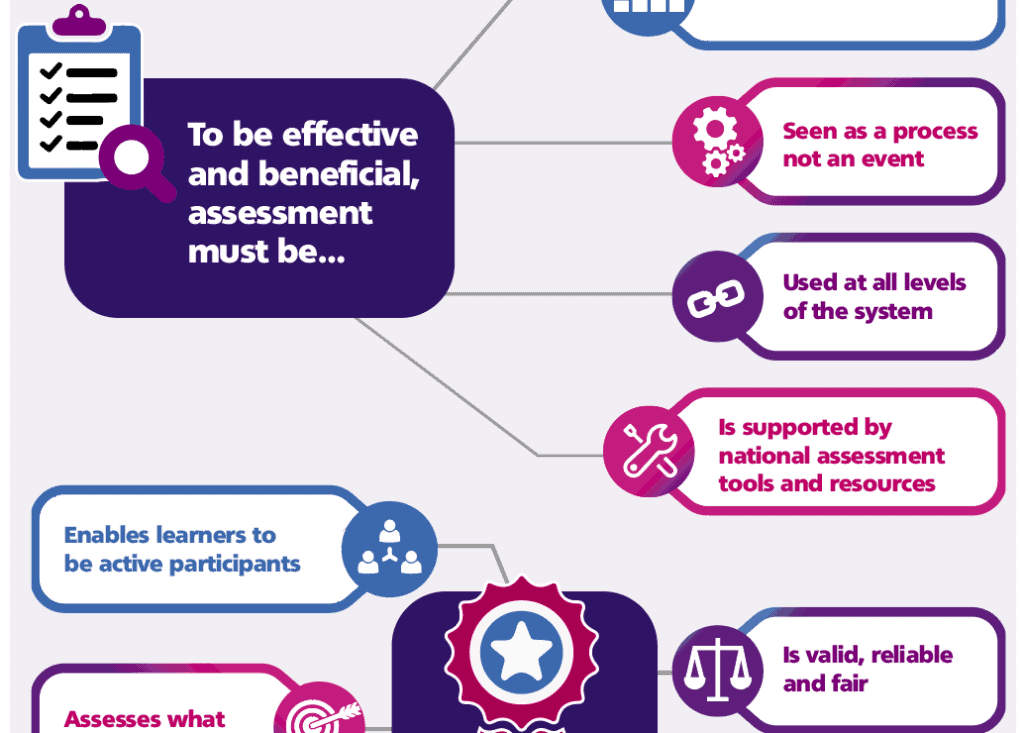
- Assess what is valued, not simply what can be measured
- Enable students to be active participants in assessment
- Develop the assessment capability of all stakeholders
- Gather and employ a broad range of assessment information
- Pay attention to and promote learner wellbeing
- Consider the potential consequences of assessment
Guiding questions
- How do we think about assessment practices as being part of and contributing to a learning system?
- How do we ensure that our assessment practices are valid, reliable and fair?
- Do we assess the knowledge, skills and competencies that are valued in our school?
- How do we work to develop the assessment capability of students, teachers and leaders?
- Do our assessment practices take place in a trusting environment in which the mana and wellbeing of students, teachers and leaders are protected and enhanced?

Pillars of sound educational assessment
An overview of the principles of validity, reliability and fairness that should underpin all educational assessment.
Principles of assessment
An introduction to the principles of assessment that underlie a ‘system that learns’, encompassing early childhood education, primary school and secondary school.

Using assessment to create an education system that learns
Renowned assessment expert Michael Absolum (ONZM) explores the central role assessment should play in driving learning throughout the education system and how schools and teachers can adopt these ideas into their practice

In consideration of educational tests: evil, necessary, or beneficial?
Professor Gavin Brown takes a balanced perspective, suggesting that despite unwelcome side effects, schools and teachers need tests to know what students can or cannot do.

Harnessing and enhancing assessment in schools
Professor Stuart Kime discusses the role of assessment in teaching and learning with a particular focus on practical strategies for how teachers can enhance their assessment practice and embed effective assessment into their day-to-day teaching.

The role of assessment in an education system that learns
Key insights from a webinar with Michael Absolum.

The value of educational tests
Key ideas from the webinar with Professor Gavin Brown on how teachers can use tests to inform teaching and learning.

Harnessing and enhancing assessment in schools: key ideas from Professor Stuart Kime’s webinar
Key ideas on effective assessment practice in schools from Stuart Kime's webinar