
Motivation
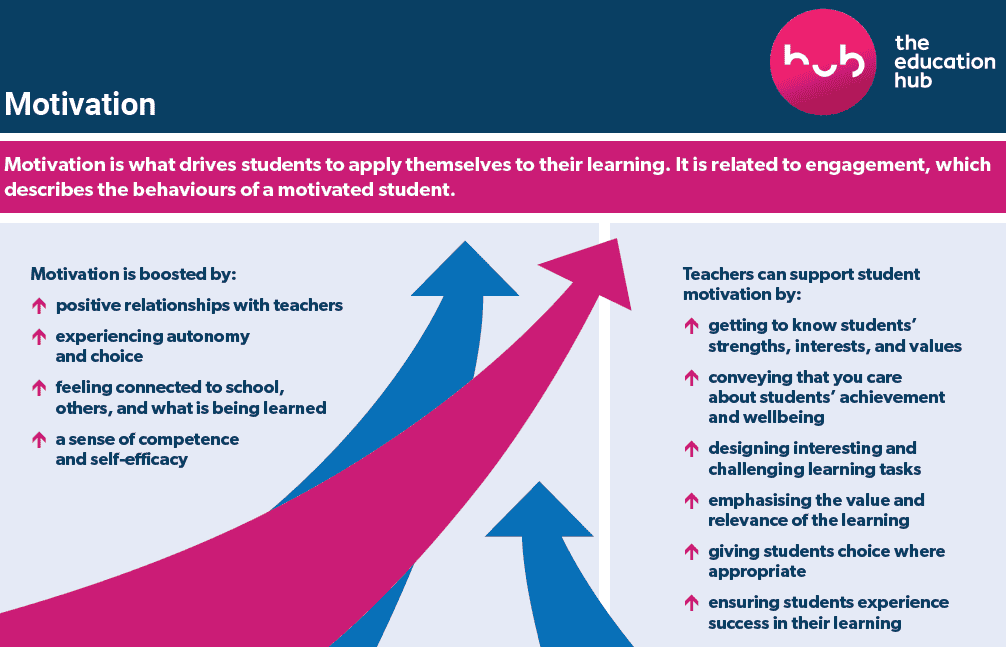
Motivation refers to the thoughts, beliefs, and assumptions that encompass a student’s drive to apply themselves to learning, and is related to engagement, which describes the observable behaviours that arise from that drive.
Definition
Motivation is what makes a person move toward a goal. It is common in education to distinguish between intrinsic motivation (being motivated by the task itself and its perceived value), and extrinsic motivation (being motivated by external factors, such as rewards or the threat of punishment). However, this distinction can be an oversimplification, and it is more helpful to focus on the factors that enhance students’ motivation. It is also often assumed that motivation causes learning, but in fact motivation is just as often the outcome of learning, as students are motivated by their own success in mastering new learning.
Relevance
There is a great deal of research which demonstrates strong links between levels of motivation in students and their learning outcomes. Motivation is positively correlated with academic achievement, positive behaviour, and factors such as wellbeing, self-esteem, and a sense of purpose. Positive motivation and engagement support academic progress and outcomes, but are also a valuable end in themselves.
State of the evidence
There is a considerable body of research evidence on motivation in education. Much of the psychological research is in the form of lab-based quantitative studies. However, there have been a growing number of studies recently that have studied motivation in the school context. Within these studies, there also is a growing evidence base identifying the factors, including practical steps teachers can take, that support students’ motivation in school. Self-determination theory summarises the key factors that research has shown to contribute to student motivation: autonomy (a sense of control and choice), belonging (a sense of connectedness), and competence (a sense of self-efficacy).
In practice
One of the most important factors influencing student motivation is the relationship they have with their teachers, and positive teacher-student relationships serve to boost student motivation. It is also important to keep a focus on motivating students in relation to what is to be learned, rather than on trying to engage students’ interest with fun but potentially distracting activities. Teachers can also attend to the factors of self-determination theory by:
- Providing opportunities for student autonomy and choice
- Enhancing students’ sense of membership of the class and building strong connections with teachers, peers, and the school
- Connecting learning with students’ goals, values, and identities
- Designing learning tasks with an appropriate level of challenge, to develop students’ self-efficacy and sense of competence
- Supporting students to set appropriate goals, and providing feedback to help them track their progress towards achieving those goals
Guiding questions
- What steps do you take to ensure that all students feel like they belong in your class?
- How do you develop tasks with the right level of challenge to keep students engaged?
- How do you communicate the purpose, structure, and value of learning in your classroom?
- How do you work with students to create learning goals and provide feedback on their progress towards these goals?

Motivation for struggling students
A set of strategies specifically geared towards motivating students who are struggling academically or grappling with new challenges.

How to support student autonomy and enhance motivation
An approach to enhancing student autonomy in order to boost their motivation and increase their engagement.

10 strategies that promote motivation
A set of practical strategies and instructional approaches to help motivate your students.

The role of motivation in learning
The different types of motivation, their importance for learning, and strategies designed to boost student motivation.

What switches students on and off?
Professor Andrew Martin presents a guide to the good, the bad, and the ugly of student motivation.

Increasing Year 9 and 10 students’ engagement and motivation in STEM
Discover how two teachers used real-world problems drawn from their local community to engage students in collaborative problem-solving.

Student motivation and engagement when learning from home
Harry Fletcher-Wood discusses the research on motivation and engagement as well as practical techniques teachers and school leaders can use to increase student engagement.

Social-emotional learning – what schools need to know
Dr Claire Han explores the different mindsets, skills, and competencies that SEL incorporates and how they can be integrated into teaching and learning.

The good, the bad, and the ugly of student motivation
Key insights from the highly practical and informative webinar with Professor Andrew Martin on student motivation and engagement

The role of social connection, self-regulation and motivation in student achievement and wellbeing
Key insights from Claire Chuter on how to support and promote students’ social emotional learning.