Engagement
Engagement is a prerequisite for learning, although it is important to bear in mind that engagement does not necessarily equal learning.
Definition
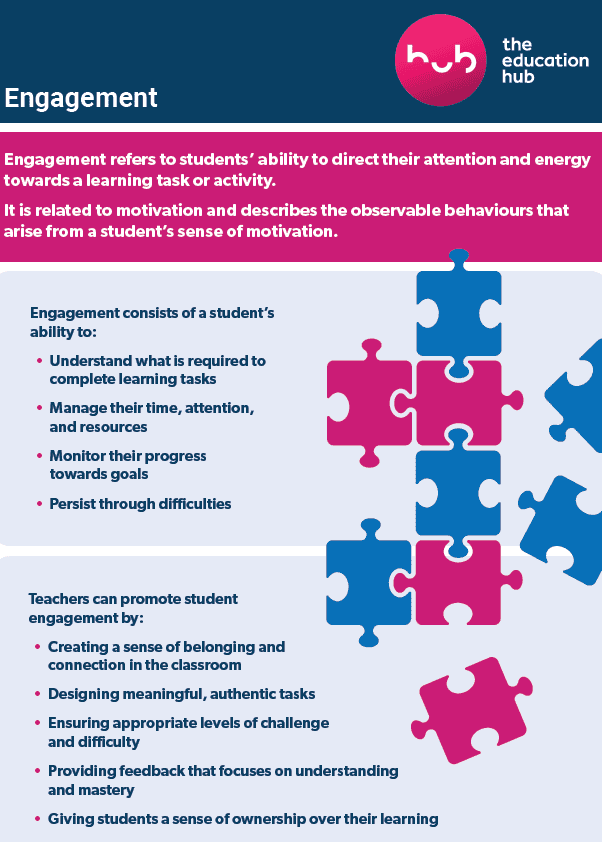
Engagement means students directing their attention and energy ‘in the moment’ towards a particular task or activity. It describes the observable student behaviours, such as planning, task management, and persistence, that arise from their feelings of motivation.
Relevance
Engagement with learning is essential to academic progress. It is most likely to occur when students are motivated, interested, and socially interactive. It is also most often associated with other characteristics in students, such as self-regulation or self-directedness, conscientiousness, and drive. Student outcomes are affected by the extent to which they exert effort, demonstrate enthusiasm, think strategically, and constructively contribute to learning plans.
State of the evidence
There is a considerable body of evidence on engagement in education, including quantitative evidence determining the link between student engagement and learning. The evidence base is complicated as engagement is a multi-faceted concept, which is not only connected to a number of other aspects of students and learning but also impacted by context.
In practice
High levels of engagement are supported by:
- Students’ interest in a task or in a particular subject
- Meaningful, authentic, challenging (yet achievable) tasks
- A classroom context where individual students’ needs are catered for
- Providing opportunities to learn using a variety of techniques
- Actively involving students in the teaching and learning process
- Providing feedback that focuses on comprehension, mastery, and strategies, rather than feedback which defines competence in comparison to class performance
Providing opportunities for groupwork in which students can work with their peers
Guiding questions
- How do you create conditions in your classroom to promote high levels of engagement?
- How do you ensure that students who are highly engaged in a task are actually learning what you are intending for them to learn?
- How do you respond when you recognise that students in your class have disengaged?


What switches students on and off?
Professor Andrew Martin presents a guide to the good, the bad, and the ugly of student motivation.

Increasing Year 9 and 10 students’ engagement and motivation in STEM
Discover how two teachers used real-world problems drawn from their local community to engage students in collaborative problem-solving.

Student motivation and engagement when learning from home
Harry Fletcher-Wood discusses the research on motivation and engagement as well as practical techniques teachers and school leaders can use to increase student engagement.