
theteam@theeducationhub.org.nz
Postal Address
The Education Hub
110 Carlton Gore Road,
Newmarket,
Auckland 1023
The relationships between teachers, students and their families have the potential to have a positive impact on students’ wellbeing and academic success.
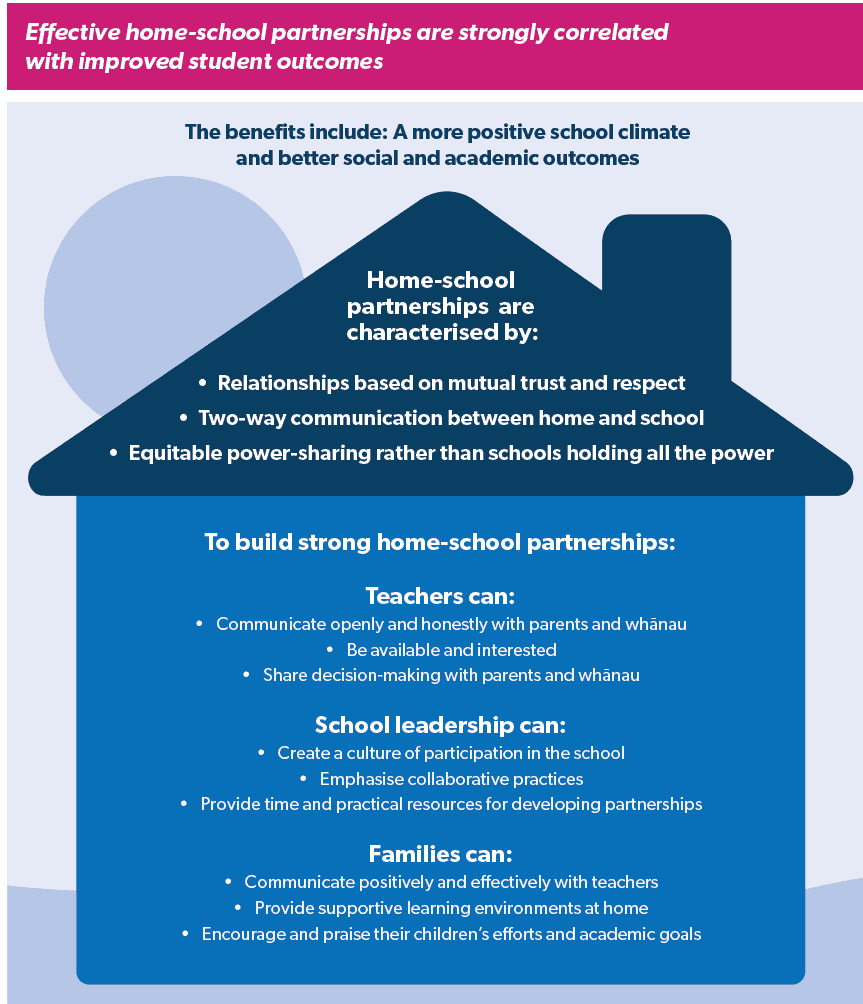
Family involvement in schools has traditionally been conceptualised to include a range of activities that engage families and whānau in their child’s schooling, such as attending parent-teacher conferences and educational workshops, volunteering for field trips, or guiding home-learning activities. Many involvement activities are primarily focused on whānau support for the school, or they may put families in a passive role as recipients of knowledge. Home-school partnerships, on the other hand, are mutually determined, balancing the traditional power dynamic between teachers and whānau. They have benefits for all partners – students, whānau, and teachers. While increased family involvement is a consequence of effective partnerships, effective partnerships do not automatically arise from involvement activities. Teachers can influence partnerships by:
Both family involvement and home-school partnerships have been correlated with a range of benefits for students, teachers, and whānau. Indeed, a comprehensive meta-analysis comparing a wide range of educational interventions found that parent involvement was more positively correlated with student academic achievement than most other interventions. Home-school partnerships include all the benefits of family involvement and additionally have a positive impact on students’ motivation, engagement, behaviour, and social outcomes.
While research has found correlation between family involvement in school activities and improved outcomes for students, it is unable to establish a clear causative relationship. This uncertainty arises primarily because school and home contexts are complex, and a myriad of factors impact on student achievement.
A home-school partnership involves genuine collaboration and coordination between whānau and schools on key issues relevant to both partners’ goals. It involves two-way systems of support that cross home and school settings. Examples include:

A summary on the research behind family involvement and home-school partnership.

The key contributions that families make to home-school partnerships.

What leaders can do to positively impact the relationship between school and students' parents and whanau.

Tips and suggestions for improving partnership with culturally diverse families.

An overview of the research on the role of teachers in creating effective home-school partnerships.

Building supportive partnerships with families of neurodivergent students.

Janelle Riki-Waaka returns to help educators to positively challenge their existing beliefs and perceptions about te ao Māori, and to build deeper understanding of the best ways to work alongside Māori and enact our
responsibilities to te Tiriti o Waitangi.

Janelle Riki-Waaka explores what Māori achieving success as Māori means from a Māori worldview, and how teachers and schools can consider how well their environments and practices support ākonga Māori to succeed and thrive.
Professor Carol Mutch (University of Auckland) shares her research from over 12 years of supporting schools through different disasters and crises both in Aotearoa and the wider Asia-Pacific region.

Authors of the report School-led learning at home: The voices of parents of Māori and Pasifika students, discuss the value of parent voice and some of the key findings of their recent research.

Key insights from our second webinar with Janelle Riki-Waaka.
Key insights from the webinar with Janelle Riki-Waaka on supporting ākonga Māori to achieve success as Māori in schools.

The key insights from our webinar with Carol Mutch on schools' responses to disasters and traumatic events.

The key ideas from our webinar discussing the recent report 'School-led learning at home: The voices of parents of Māori and Pasifika students'.