
Neurodiversity
Neurodiversity is an umbrella term for a range of neurological differences that aims to reframe them as natural variations rather than disorders.
Definition
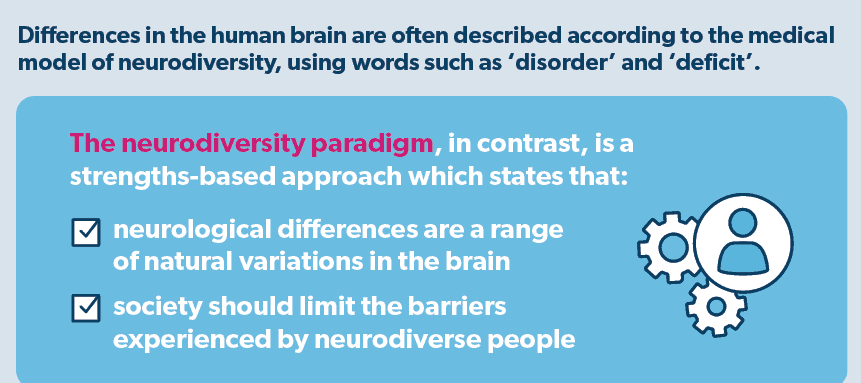
Neurodiversity is a term used to describe neurological differences in the human brain. It sees the diverse spectrum of neurological difference as a range of natural variations in the human brain rather than as a deficit in individuals. It is an umbrella term that includes both conditions that are life-long and those that can develop throughout life, including acquired illness or brain injury, Autism Spectrum Disorder (ASD), Attention Deficit Hyperactivity Disorder (ADHD), dyscalculia, dyslexia, dyspraxia, intellectual disability, mental health, and Tourette syndrome. Neurodiversity deliberately rejects the medical model of diversity that frames human differences as disorders that need to be cured in favour of a more social model of diversity as a natural occurrence.
Relevance
Neurodiversity is extremely common and all teachers are likely to work with a number of neurodiverse children in the course of their careers. The strengths-based approach of neurodiversity has the potential to increase awareness and understanding about neurological difference while also reducing social stigma.
State of the evidence
An increasing number of studies emphasise the importance of taking an additive or strengths-based approach to neurodiversity, rather than characterising the challenges associated with forms of neurodiversity as problems to be fixed.
In practice
- The concept of neurodiversity represents a strengths-based model which acknowledges that, while some children learn and think differently, these are simply differences and not deficits. The neurodiversity model shifts the focus away from the challenges that a neurodiverse individual may experience to the strengths that they possess. Designing activities that allow children to draw on their known strengths can create opportunities for them to learn and develop in ways that suit their individual abilities.
Guiding questions
- How well does your early childhood setting understand the importance of emphasising the strengths as well as the challenges of neurodiverse children?
- How confident do you feel to design activities and learning opportunities that allow your neurodiverse children to use their strengths while also tackling the aspects of learning and early childhood life that they find more challenging?
- How confident do you feel to act as role model for approaches to neurodiversity in your early childhood setting?

Supporting neurodivergent teachers in schools and early childhood settings
What the research says about supporting neurodivergent teachers in the workplace.

Supporting children with sensory processing differences in early childhood
An introduction to understanding sensory processing differences and what they mean for young children.
Supporting social and emotional competence for autistic children
Understanding the social and emotional strengths and needs of autistic children.

Understanding Pathological Demand Avoidance
An introduction to a rare but distinct form of autism.

An introduction to neurodiversity and neurodivergence
An explanation of the concept of neurodiversity as a strengths-based approach to learning differences, and an introduction to some of the different forms of neurodiversity.

An introduction to autism
A brief introduction to autism and what it means for teaching and learning.

Making sense of behaviour: Understanding sensory and neuromotor differences in early childhood
Coming in February 2027
In this webinar, Tahera Afrin will explore the links between neuromotor and sensory processing differences, and why this is important for supporting learning.

Acorns to Oaks: Rewriting the story of inclusive transitions
This webinar with Lisa Winiata and Tara Solomon from Kaitiaki Kindergartens and Tami Harris from Acorn Neurodiversity shares findings from the research partnership between Kaitiaki Kindergartens and Acorn Neurodiversity which investigated how kaiako can support neurodivergent tamariki through the transition to school.

Using trauma-informed practices to support neurodivergent students
Tami Harris of Acorn Neurodiversity explores how using a trauma-informed lens to support neurodivergent students in school settings can help teachers to mitigate challenges

Supporting children with a range of needs in early childhood settings
Dr Vicki Hargraves talks about how teachers can develop supportive, inclusive pedagogies and environments that nurture all learners.
Autism and culturally responsive practice
Dr Jessica Tupou (Victoria University Wellington) shares insights from her ongoing research into supporting autistic children and the importance of taking a culturally responsive approach

Creating a culture of inclusion in early childhood settings
Dr Kate McAnelly shares her research into disability and inclusion, and how early childhood centres can create a culture of inclusion that supports the wellbeing, learning, and engagement of all children


Transitioning neurodiverse tamariki into school: Insights from the Acorns to Oaks project
Key insights from a webinar with Tami Harris from Acorn Neurodiversity and Tara Solomon and Lisa Winiata from Kaitiaki Kindergartens.

How trauma-informed practices can support neurodivergent and trauma-affected children
Key insights from a webinar with Tami Harris from Acorn Neurodiversity.

Supporting children with a range of needs in early childhood settings
Key insights from a webinar with Dr Vicki Hargraves.

Supporting autistic tamariki Māori in early childhood settings
Key insights from a webinar with Dr Jessica Tupou.
Creating and sustaining cultures of inclusion in early childhood settings
Key insights from the webinar with Dr Kate McAnelly.

Key ideas for supporting children with Foetal Alcohol Spectrum Disorder (FASD)
Insights from our webinar with Kim Milne from FASD-CAN.