
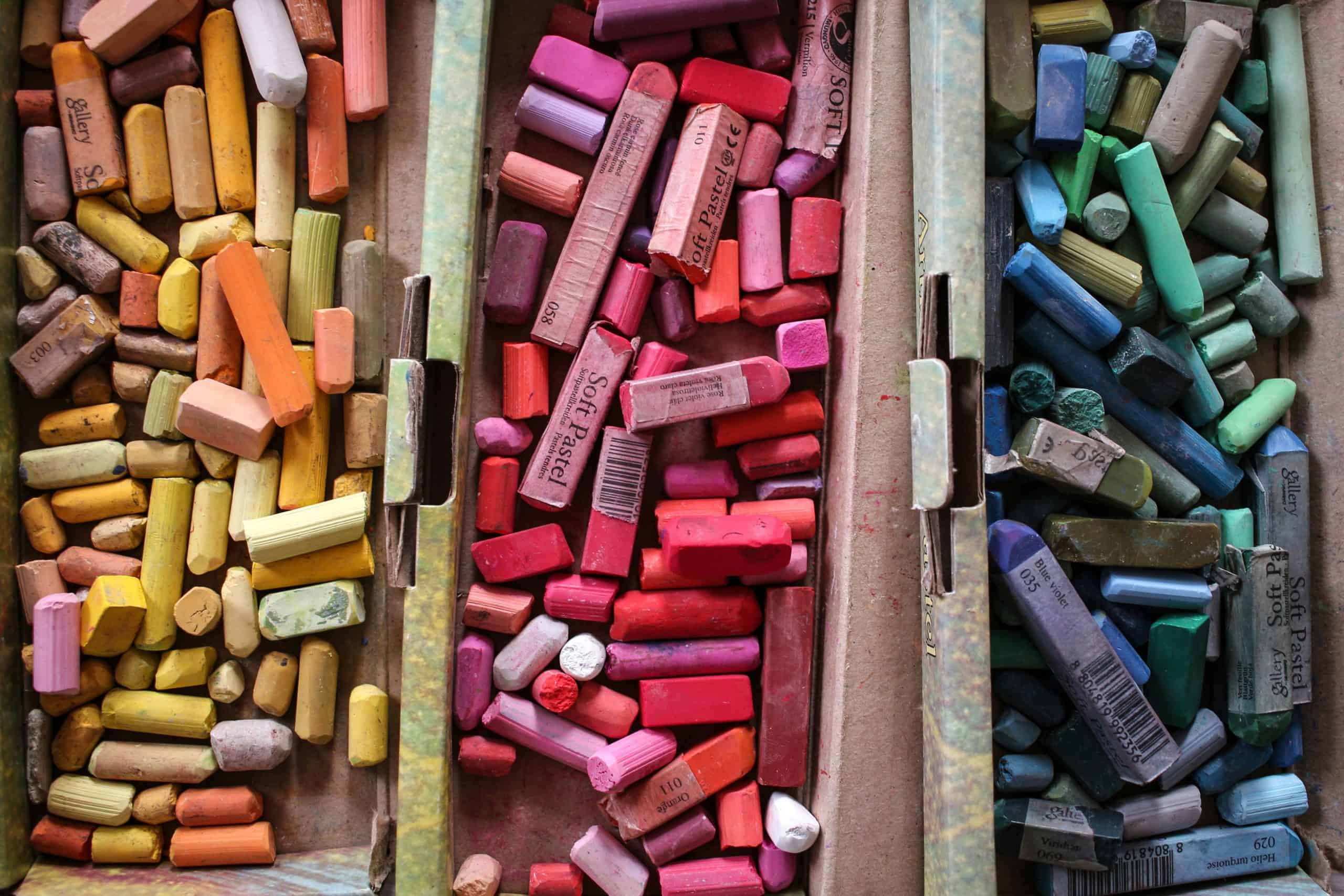
Threads of creativity for structuring visual arts exploration in early childhood
In a webinar, Kelly Goodsir and Kirsty Liljegren, founders of The Creative Collection, shared innovative ways to ignite learning through the visual arts. Drawing on their work exploring creative processes and practices across 15 early childhood settings in Australia and Aotearoa New Zealand, they offered exciting ways to spark creativity and deepen children’s learning experiences. Through stories and metaphors, their discussion reveals how important details and strong practices of listening can unlock creativity and inquiry in early childhood.
The key insights shared in the webinar are:
Visual arts exploration supports children and teachers to develop creativity and to find voice, meaning, and joy in being-with materials. Children’s and adults’ interaction with a diverse range of materials brings many possibilities for creativity, inquiry, and the co-construction of meaning and possibility.
Teachers and educators need to know and understand materials in order to attune to children’s own processes. When teachers and educators experience the properties, possibilities, and joyfulness of materials, it is easier to see how children might come into relationship with a material and they can design really effective contexts for exploration. Staff meetings and hui / gatherings with families can offer teachers and educators space to come to know materials and to know them differently. If teams feel that they have don’t the time to explore materials outside of their time with children, they can be co-investigators alongside children in practice.
Building a relationship with the material is the intention of a creative experience. Getting to know a material is an important phase of learning, in which children develop important dispositions, concepts, and processes. It is important not to rush into making something symbolic because that is what we value. Getting to know a material is learning. It is an important and hugely complex process.
Developing a relationship with materials involves a deep listening, coming into contact with the material with the realisation that the material can provoke questions and ideas, that it speaks back to you, and activates something in you to support your ability to express yourself. It can help to consciously avoid intellectualising the encounter or leaning into learned techniques and assumptions about the use of materials, as this can make teachers immune to discovering new potential. Even naming a process or a way of working with a material can lead to oversimplifying something and shut down possibilities. Teachers and educators should try to avoid making anything symbolic or representative with the material, but instead explore diverse processes for shaping and manipulating the material, and tune into their creative processes.
This means coming to creative art experiences with certain dispositions. For example, teachers and educators might benefit from conceiving of themselves as researchers and inquirers. This means moving out of delivery mode or outcome mode, and welcoming all the ways that children might respond, carefully avoiding being locked into thinking that this is the way that a material or medium is used. One of the most important factors is for teachers and educators to be deeply curious about children’s and their own engagement with materials, to be open to surprise, and interested in the languages and connections that are emerging.
Children can be our guides. Children are adept at understanding and interpreting the agency of materials. They also have a really embodied way of exploring materials which can help adults who tend to come to exploration in a more cognitive way. Therefore, teachers might simply join children in their exploration, honouring that time for experimentation and not jumping too far ahead. This can take bravery and courage! Pausing and listening are also crucial strategies for tuning in. Pausing can offer opportunities that allow the moment to speak, and promote deep thought about introducing other materials, inviting other questions, or sticking with an experience and protecting the time needed to fully explore it.
Documentation can be another way in which teachers and educators might be supported to slow down and explore, to find other ways to perceive what is happening, as well as to engage in open conversations with others about what might be happening. It is important to be curious about how children are responding, the funds of knowledge they are demonstrating, and the questions they are asking. Children will communicate their interests in a really holistic way. This sometimes means we need to linger longer, and give ourselves opportunities to understand what is going on over time.
Materials, environments, and contexts can be consciously designed to support children’s emerging relationships with materials. Environments and contexts are suggestive of the approach children might take in getting to know a material. An environment can evoke experimentation, testing, and investigation, for example. The Creative Collection was created to support teachers and educators with creating environments that promote five threads of creativity.
The five threads of creativity are discovering, enjoying, expressing, thinking, and meaning-making. Discovering occurs when children encounter and have time to ‘be with’ a material or idea, exploring, testing, and manipulating. In the act of developing a relationship with material, materials reveal their possibilities. Similarly enjoyment emerges when there are opportunities to observe a process, and experience surprise, delight, and pleasure. Both discovering and enjoying are important threads not to be rushed through. Expressing ideas and feelings with materials occurs when children use the materials as an extension of themselves (and at the same time, re-create themselves through their expressions). It is important here to be careful not to assume exactly what children are expressing about themselves and their world, but to give time for listening, staying curious to what might be happening. Finally, art materials can support children in thinking and meaning-making about ideas and questions such as ‘do spiders smile?’. The thinking and meaning-making threads invite a time-full approach where teachers and educators encourage coming back to ideas as they relaunch them with new contexts and new materials and media.
The threads of creativity can help teachers and educators to be intentional. Rather than being linear, highly structured, or developmental, or offer finite end points and outcomes, the threads offer launching places in terms of starting points, contexts, and environments. They offer passages for thinking about the visual arts. While each thread is connected to the others in experiences that have many layers, they can be used to spotlight or foreground different aspects of the creative process, particularly for those for whom creativity and the arts are a new terrain. They may also offer a new way of noticing, as well as a new way of declaring the value of the arts and the inquiry process.
It can take a long time to build relationships with materials. A ‘slow pedagogy’ is important in which teachers and educators take time to understand, be mindful, and offer presence to understand what is going on. It is important to maximise uninterrupted time for teachers and children, so that they can be in relationship with ideas and materials for longer. Teachers might allow children to navigate how long is needed. Complexity is supported when materials and their companions are kept in place so that they are not novel. Children benefit from opportunities over time to re-encounter the same material.
There is often a multimodality to children’s creativity, and offering multimodality as a possibility within the contexts offered to children values the multiple avenues (or the hundred languages) that children can use to understand or demonstrate their learning. Therefore, there will not be one material in a context, and materials will be accompanied by other ‘companions’, so that children can develop many modes of discovering, enjoying, expressing, thinking, and meaning-making. For example, clay might be used, with the language of light offering another dimension. Different modalities offer different possibilities and insights, supporting children to make complex connections and build sophisticated meanings. Multimodality helps teachers and educators plan for complexity and expansive inquiry.
To receive the complimentary copy of The Threads of Creativity, sign up for The Creative Collection Newsletter (at the bottom of this page).
Further reading and connections
The Creative Collection on Facebook
The Creative Collection on Instagram
Keyte-Hartland, D., (2019). Intelligent materials: agency and aesthetics. Early Education Journal (89)
Pelo, A. (2017). The Language of Art: Inquiry Based Studio Practices in Early Childhood Settings. Redleaf Press.
Penfold, L. (2019). Material matters in children’s creative learning. Journal of Design and Science.
Scarlet, R. (2018). Becoming with ART in Early Childhood. MultiVerse Publishing.
Vecchi, V. (2010). Art and Creativity in Reggio Emilia: Exploring the Role and Potential of Ateliers in Early Childhood Education. Routledge.