
theteam@theeducationhub.org.nz
Postal Address
The Education Hub
110 Carlton Gore Road,
Newmarket,
Auckland 1023
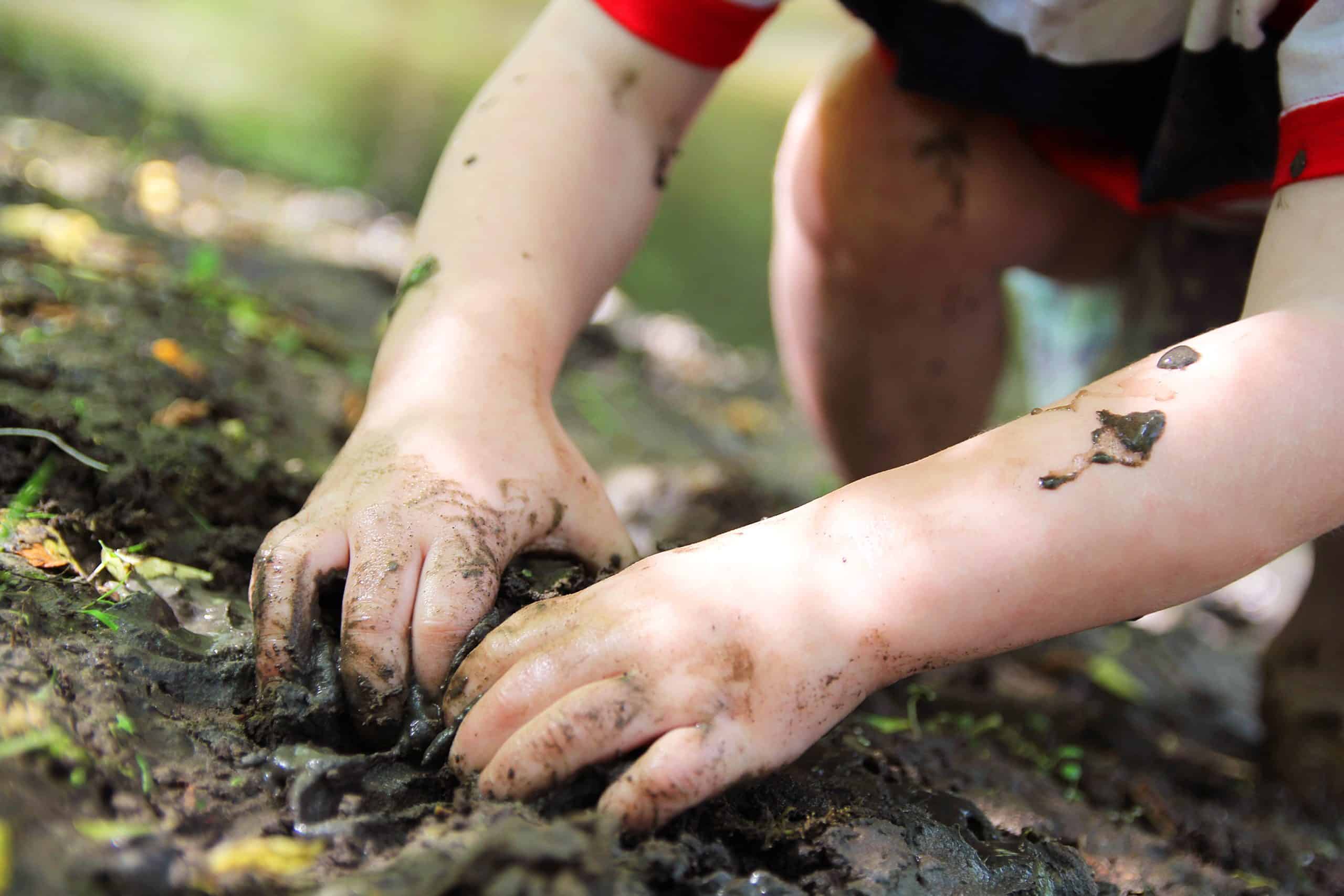
Learning and playing in natural spaces both inside and outside early childhood settings are increasingly promoted as valuable for children’s education. Drawing on opportunities to extend learning outcomes related to STEAM [Science, Technology, Engineering, Arts, and Mathematics] and Exploration by going outdoors, Professor Karen Malone encourages teachers to consider their role in children’s encounters with nature and nature play.
In a webinar, Karen shared stories from her research and recent forays with children into the outdoors. She discussed how pedagogical practices such as ritual and gratitude, paying attention, attuning to nature, and documenting through shared visual diaries, can help teachers notice and respond to the tensions and challenges that sometimes arise as they seek ethical ways to engage with the outdoors.
Opportunities for children to observe and connect to place, in which the focus is on experiencing the outdoors, are extremely important. Nature play builds on experience rather than knowledge, and is most valuable when it is about spontaneous, opportunistic encounters that are responsive to what is being experienced. Rather than seeking for children to come away having learned the names of various plants in the space, fostering children’s connections and building their attunement with nature should be the main purpose of nature play experiences. These engaging experiences help young children to build the foundations for bigger scientific and ecological concepts. While offering a little bit of knowledge, for example, about why a shark egg is shaped so it can be pushed into a rock crevice and stay there, can help to narrate children’s encounters, the most important consideration is to support the excitement and awe associated with children’s first experiences of this object.
Touchstones and provocations are key pedagogical tools that can form a frame for nature play experiences, creating a passage for the adventure to come. Touchstones and provocations support teachers to act as conductors – noting when children get excited and following where that goes, sometimes slowing things down to temper children’s excitement and help them think about what to do with the thing(s) they have found. The encounter may ebb and flow as children get absorbed and linger on things, and then are suddenly ready to move on. Teachers follow children’s curiosity and exploration, their awe and wonder, and foster any emerging questions.
Touchstones are springboards or principles that allow for openings, and that can guide the way you shape experiences or what you choose to respond to. They can help to locate teachers and children in their encounters with nature, and open up our curiosity to what is possible. Some touchstones may be site specific, some may be more relevant for what is going on in a given encounter, or what is important to you. Touchstones include:
Provocations are the artefacts and objects that teachers bring along that may be used to nurture possibilities as they arise. This means that teachers consider potential encounters as they visit the intended site in advance of a trip with children, and find out some of the history and indigenous stories of the place. It can be helpful to see this information as little breadcrumbs that might guide children’s journey through the space. However, there is no set plan and, in being responsive to children and to the encounter, it is not essential that provocations are used. Provocations that Karen has and might provide include a visual journal, containing drawings and images of the things that might be seen for children to add to; chalks, charcoal, clay, plasticine, brushes, watercolours, tracing paper, solar paper, printing tools, and tools for grinding ochre; natural objects for ephemeral artworks; or books about trees, birds, and nature. Karen recommends that teachers do not take too many provocations and do not become attached to any particular one, nor that they hold enlarged expectations about what might happen during encounters. Experiences as simple as lying on the grass looking at the sky should also be valued.
STEAM can be integrated throughout the nature play experience, rather than abstracted from children’s experiences and encounters. Interesting scientific concepts such as the Fibonacci coil of a snail shell, or the size of a cuttlefish bone, are small conceptual science experiences on to which children will later build more formal science knowledge. Karen focuses on noticing children’s explicit and implicit questions, and thinks about how she might help children to answer some of their questions through their own exploration. She keeps mental and physical notes of the things children ask and say so that they can return to them at some point, either during the encounter or back at the setting.
Visual diaries are used for recording children’s inquiries, but also support a range of pedagogical purposes. Visual diaries help children to story their encounters, and are part of the process of their encounters with the natural world as, in Karen’s example, they use ground ochre or watercolours mixed with sand and seawater to document their experiences. Teachers can use the visual diary to gain another insight into children’s thinking and exploring, and to anticipate possibilities and reflect on how they might bring different encounters together.
Rituals for transition into nature spaces can support ethical, respectful encounters with the more-than-human. Rituals might involve giving gratitude, paying respect, and honouring the natural space, and serve to cultivate a particular relation and energy for engaging with the space: for example, ‘we are now here, and this place holds special possibilities. We are respectful and thoughtful. We want to be present and to notice’. Nature play is focused on supporting children’s connections with the more-than-human, encouraging them to be open to and affected by their encounters with nature in ways that emphasise the ideas of gratitude, empathy, and care. Nature play offers opportunities to think about respectful care, seeking to balance the anthropocentrism that has been a characteristic of human engagements with nature, in which nature is seen for what humans can take or get from it. Children and teachers might think how children’s nature play may impact or affect the environment and processes within it, and perhaps aim to leave them better places, by picking up litter, for example.
Further resources
Karen’s presentation
Karen’s instagram page
Learn about Robin Wall Kimmerer’s work.
Lasczik, A., Cutter-Mackenzie-Knowles, A., Osborn, M., Malone, K., & Knight, L. (2024). Engaging visual diaries in early childhood nature play as pedagogical arousal. Australasian Journal of Early Childhood. https://doi.org/10.1177/18369391241276885
Malone, K. & Crinall, S. (2023). Children as worlding but not only: Holding space for unknowing and undoing, unfolding and ongoing. Children’s Geographies. https://doi.org/10.1080/14733285.2023.2219624