
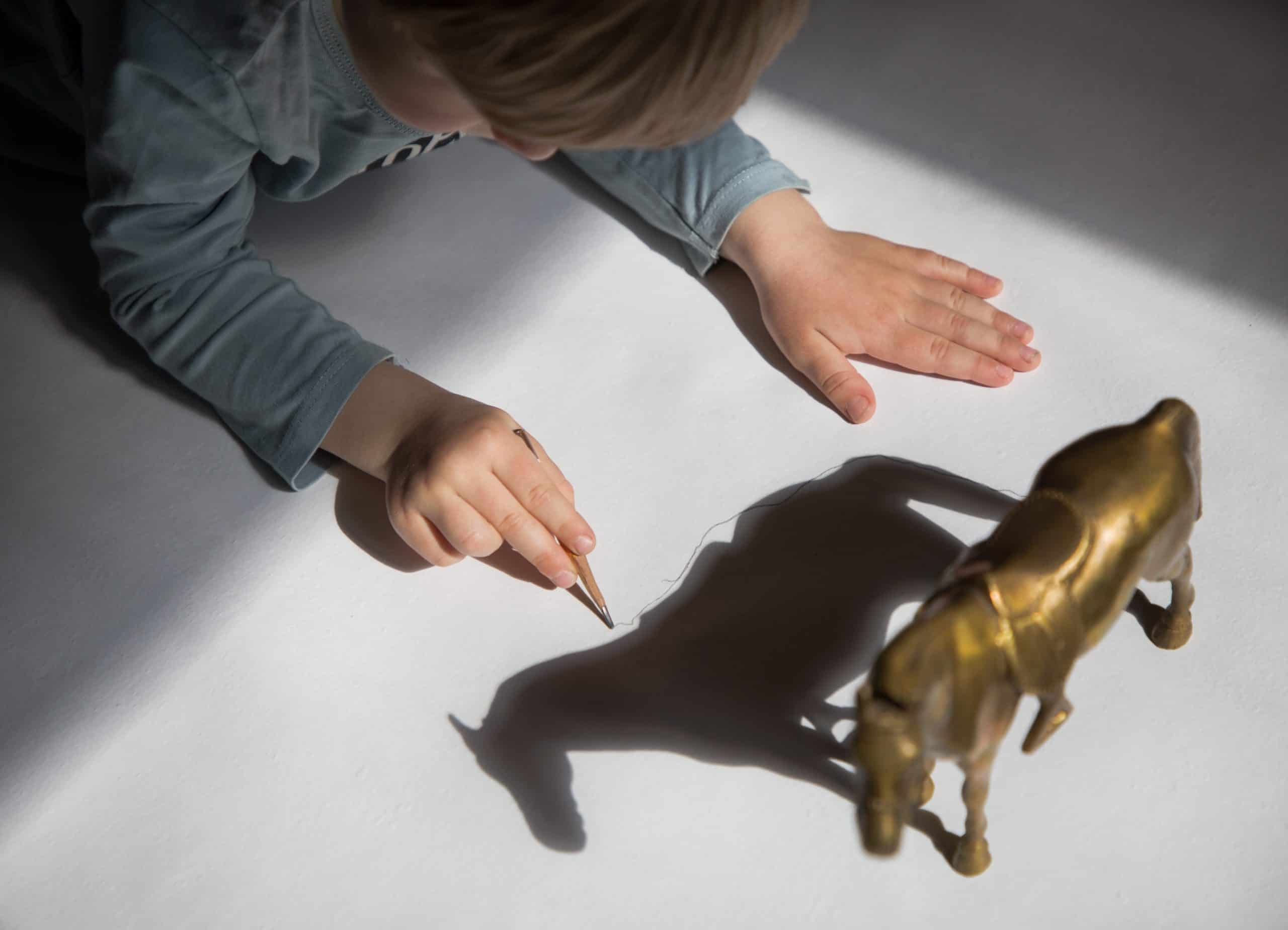
Shadow drawing
Summary: An exciting provocations to get your child drawing, which can tempt even the most reluctant artists
Set-up: 5 mins
Play: 20 mins – 1 hour
Complexity: Suits a variety of abilities
Materials
- Paper
- Drawing tools such as pens and pencils, chalk
- Model animals and dinosaurs (your child’s favourites)
What to do
On a sunny day, set up model animals on a white piece of paper so that their shadow falls onto the paper. Encourage your child to draw round the shadow as a starting point for their picture. There are then all sorts of ways to fill the shadow in. Get younger children to fill in the detail so that the shadow looks like the animal it is of. Then encourage them to draw something nice for the animal to eat, or a cosy home for it. Encourage older children to give the animal shadow a ridiculous pattern, or a funny set of props, to make it humorous. Invite them to imagine and draw a scene around the animal – where is it? What is it doing? Keep drawing fun by focusing on imagining and pretending rather than on realistic depiction of their chosen model. It doesn’t matter what the drawing looks like as long as you’re having fun!
Extensions
Try some more outdoor drawing activities:
Chalk on your trampoline. This is really very simple but very satisfying, and it doesn’t feel like drawing for those reluctant artists! Try it!
Tape pens or chalk to model vehicles, and stick a few pieces of paper together so they can go driving. Afterwards, can you follow the lines your car made?
What learning does this activity promote?
Fine motor skill, creativity, imagination, language, storytelling
By Dr Vicki Hargraves