theteam@theeducationhub.org.nz
Postal Address
The Education Hub
110 Carlton Gore Road,
Newmarket,
Auckland 1023
Relationships and sexuality education in primary school is important and needs to be carefully planned and taught. RSE promotes students’ social emotional skills, builds the foundation of healthy relationships, and develops awareness of broader social, cultural and environmental contexts that influence wellbeing. RSE involves learning about relationships as well as about bodies, gender, and sexualities. RSE is different from what many people remember as ‘sex education’, which focuses on the physical/biological dimension of sex. RSE is shaped by an holistic model of health which includes physical, mental, emotional, spiritual and social dimensions of human sexuality. This research review will help teachers to:
It includes links to the Ministry of Education’s new RSE guide and key resources that can be downloaded to support a whole-school approach to RSE.
Quality RSE in primary schools starts at Year 1. Learning from Year 1 builds the fundamental knowledge and skills needed to develop a positive sense of identity, decision-making skills, healthy relationships, respect for others, and critical thinking. RSE knowledge and skills support the wellbeing of students as they progress through primary school and approach puberty. Many schools have RSE at the senior primary level that explores the physical changes at puberty. Although the physical changes of puberty are important, young people also need the knowledge and skills to navigate the emotional, social, and spiritual aspects of pubertal change and relationships within a digital world.
An extensive literature review of 30 years of data on the effectiveness of comprehensive sex education (CSE) found that CSE can increase knowledge about the body’s changing needs, decrease shame and anxiety about sexuality, improve communication skills, and expand understandings of gender identity and social norms[1]. Furthermore, CSE can develop children’s media literacy skills, promote inclusion and healthy relationships, and improve sexual abuse disclosure rates. Key findings relevant for primary school teachers are that CSE needs to start in junior primary school. It should be based on a holistic and broad definition of sexual health, and be framed within a positive, affirming and inclusive approach to human sexuality.
Children are growing up in a changing world where families are more diverse, information is available at a touch of a button, and social media is part of life. Children and young people are also challenging gender norms and stereotypes and the impact these have on wellbeing. To ensure young people have the knowledge and skills to respond to these societal changes and challenges, RSE needs to draw on students’ voices and be well planned in a consistent manner by trained teachers[2].
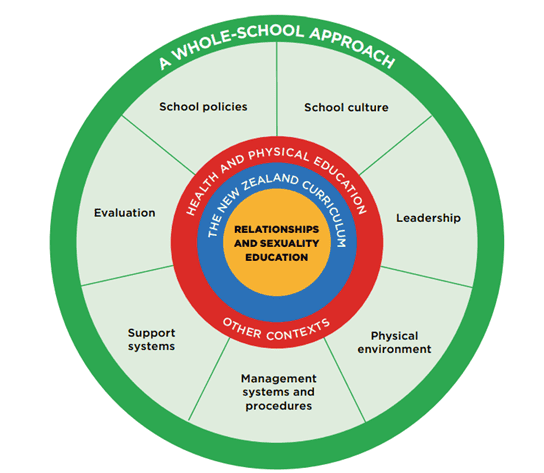
It is beneficial for schools to explore what parts of the whole-school approach support a holistic RSE programme of learning. Quality RSE is based on a whole-school approach to relationships and sexuality. The following diagram from Relationships and sexuality education: A guide for teachers, leaders and boards of trustees[3] can be used to support leaders to discuss the strengths of the school and areas for development in RSE.
An example of a whole-school approach to wellbeing is promoting inclusion and diversity. This approach would include:
A video from New Zealand’s Ministry of Education provides a short practical example of strong leadership and a whole-school approach to relationships and sexuality. The video highlights how RSE promotes inclusion, develops healthy relationships between school members, decreases bullying, and supports teachers to develop and implement RSE across the curriculum.
It is important for schools to reflect on the importance of community consultation to ascertain the needs of their community. Consultation involves more than informing the school community on what will be taught – it should be a transparent and shared process. In New Zealand, it is a requirement that, at least once every two years, school boards consult the school community and adopt a statement on the delivery of the health curriculum, although the board may choose how to consult with the community. The purpose of the consultation is to enact a shared process to create a localised curriculum that meets the needs of students. Effective community consultation involves board members and school leaders working together to consult with the community on how the school plans to deliver sexuality education as part of the health curriculum. It is essential that students and their families are able to have meaningful input into the content and delivery of the sexuality education programme[4].
There are many strategies that schools can use to consult with communities. These include:
Many schools carry out online surveys with their communities, but these surveys often do not have a high return rate and leave little room for collaboration. Māori and Pasifika families prefer to participate through a shared process where relationships are at the heart of the discussion. For more information and great ideas on consultation, see Tūturu’s Community Consultation: Health Education resource, and the Ministry of Education’s video on consultation and teacher resource page.
Planning an RSE programme of learning
Many primary schools have learning programmes connected to wellbeing. However, a whole-school approach to RSE that is deliberately planned and based on progressions across the curriculum levels reflects good practice. The Ministry of Education’s one-page learning programme review and Effective Pedagogy in RSE teacher resource provide a helpful starting place for schools to discuss a localised curriculum. Here are some key first steps:
Programme development: Years 1-8
A minimum of 12-15 hours spent per year on RSE is recommended[6], and the voices of students and their learning needs should guide planning. Below are some guidelines about what effective RSE covers across the primary school years. These are based on Relationships and sexuality education: A guide for teachers, leaders and boards of trustees, Years 1-8. See the Relationships and sexuality progressions for sample lessons.
At level one (ages 5-7)
Students learn about recognising body parts, body safety, hygiene, showing respect for self and others. They learn the skills to develop and maintain friendships, express their feelings and needs, and know who to ask for help. They also learn to stand up for others and understand the relationship between gender, identity, and wellbeing.
At level two (ages 7-9)
Students can explain how bodies change over time. They can give and receive consent, including in online spaces. They continue to develop relationships skills through developing interpersonal skills such as listening, taking turns, recognising the feelings of others, and showing caring and compassion. At level two, students are starting to identify gender stereotypes and diverse gender and sexual identities in society.
At level three (ages 9-11)
Students start to learn about pubertal change from a holistic perspective and recognise that everyone is different. They start to understand that there are different types of relationships and how these can influence wellbeing. They learn skills to enhance relationships, such as giving or withholding consent and strategies to enhance relationships. Students continue to learn about policies and practices that support inclusion and diversity, where they can seek help, and start to critique the impact of social media on wellbeing.
At level four (11-13)
Students learn more about pubertal change and how it relates to social norms around gender and sexuality. They develop an understanding of conception and contraception and how this relates to wellbeing. They further develop their skills to manage relationships and explore topics like love, attraction, consent, communication, and social media effects. By the end of Year 8, students should understand how wider contexts link with people’s gender and sexual identities, take action to be inclusive, know how to seek help, and critique media representations of gender and relationships.
In consultation with the wishes and needs of students and the school community, the above key learning ideas will support schools to develop a comprehensive learning programme. Key resources and lesson plan ideas that support students to develop a strong identity, be inclusive, have healthier relationships, and learn the skills to critique situations that impact wellbeing can be found at the end of this guide.
Answering the tricky questions
Teachers often worry about answering perceived ‘tricky questions’ in RSE. The following guidelines are adapted from the Ministry of Education material written for teachers to develop their comfort and confidence in answering questions. You can be asked any question at any time while teaching, and for many reasons. Sometimes students may be testing you or seeking attention from peers, but more often there will be an actual desire to learn. You need to be prepared for questions on a wide variety of topics. Legally you are entitled to answer any question that students ask you, but before you answer, it is important that you have reflected on the way you will answer these and what messages you may inadvertently send. Here are some guidelines for responding:
Another important way to invite and respond to students’ questions is to use a question box, which is highly recommended for every class. A question box gives you time to consider your response, so this method means you are less likely to be put on the spot. It is important that you feel confident and comfortable with teaching RSE, including responding to questions, so seek support from your colleagues if needed. If you decide that you will not answer a question from the question box, give students a reason. You could say ‘this question asks … but I am not going to answer it because …’, or ‘this question is directed to me personally. I won’t be answering from my own experience. But some people believe … and others feel …’.
For help-seeking and disclosure type questions, ensure you are familiar with your school child protection policy and procedures. One of the best things you can do is talk to your colleagues about how you can support one another to manage disclosures safely and appropriately. Childmatters offers a number of basic guidelines that should be followed to ensure the safe handling of any disclosure. It is recommended that teachers read and discuss these guidelines at the start of the year. Always ensure you talk to other teachers about any concerns and follow school guidelines. You should also be familiar with school and community support services for young people and recommend these to encourage help-seeking behaviour from students.
Key resources to support a whole-school approach to RSE, including lesson plans, can be found below.
Teacher resources
Lesson plan ideas:
New Zealand Ministry of Education resources:
Endnotes
[1] Goldfarb, E. S., & Lieberman, L. D. (2021). Three decades of research: The case for comprehensive sex education. Journal of Adolescent Health, 68(1), 13-27.
[2] Education Review Office (2018). Promoting well-being through sexuality education. Wellington, NZ: ERO.
[3] Ministry of Education (2020). Relationships and sexuality education: A guide for teachers, leaders and boards of trustees. Wellington, NZ: Ministry of Education, p.16.
[4] ERO, 2018, p. 6.
[5] For more information, see pages 8 & 12 of Relationships and sexuality education: A guide for teachers, leaders and boards of trustees.
[6] Education Review Office (2007). The teaching of sexuality education in Years 7 to 13. Wellington: ERO.