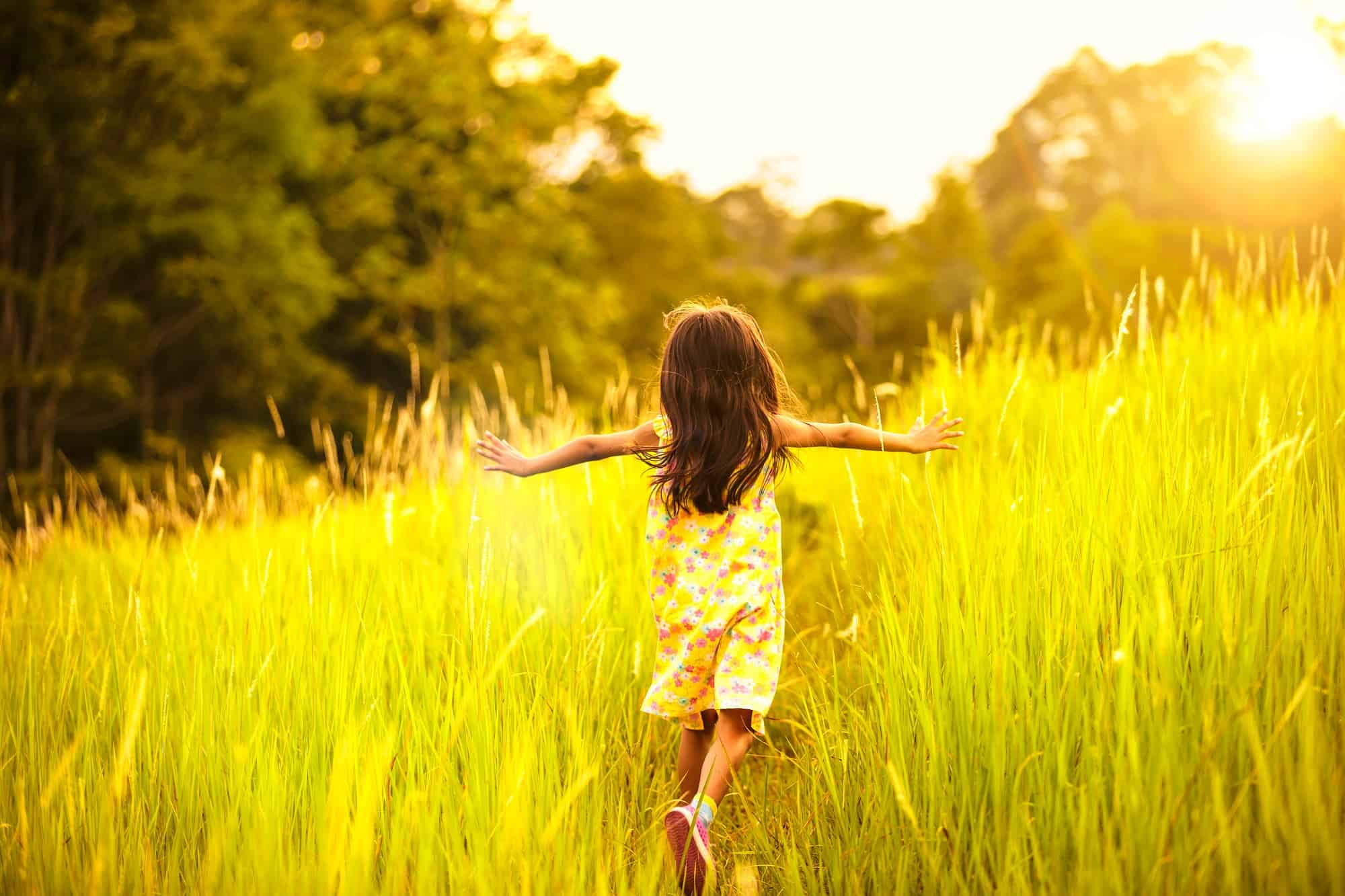
Outdoor play can occur in various contexts, including developed or maintained spaces such as landscaped parks and playgrounds, as well as relatively natural wild spaces such as fields and bush. Forest School is a form of outdoor play provision, influenced by practices in Scandinavia, that involves regular outdoor learning sessions in an area of bush. School and early childhood setting playgrounds form other contexts for outdoor play, and may constitute open spaces of both grass and tarmac, manufactured and/or built equipment, and, increasingly, natural elements, habitats or gardens. Outdoor environments might hold affordances for:
- constructive play such as building shelters, dens and other constructions with loose parts
- symbolic or dramatic play including playing house or pirates
- locomotive play involving gross motor activities and skills, such as running, hide and seek, and chase games which tend to take place where there are large open spaces
Children are spending less time playing outdoors, and particularly in
natural environments, than in previous generations, despite the fact that
outdoor play has a range of developmental benefits beyond physical and social
development and the evidence
base exploring the benefits of outdoor play is extensive. Many findings are
quite robust, holding consistent across age groups, school types and research
methodologies, although there are some issues with a lack of description of
methodological processes and the ways in which children engage with the
environment. There are some inconsistencies in definitions of ‘nature’ and ‘natural
environments’ and their analysis, making it difficult to compare and transfer
findings. There are also difficulties in researching unquantifiable measures
related to the emotional and sensory aspects of being in nature, for example,
or attributes such as resilience. Bias is rarely acknowledged, despite researchers
tending to be advocates of pedagogies related to outdoor and nature play.
Research suggests that outdoor play:
- correlates with higher physical activity
levels, which are
associated with numerous health benefits including physical fitness, metabolic function
and bone health, while children’s lack of access to outdoor play is thought to
be a contributing factor to health issues such as increased levels of
depression and obesity.
- encourages healthy behaviour habits with robust evidence associating physical
and mental health benefits with
outdoor play. Research also demonstrates that activity habits formed during childhood tend to continue into adulthood.
- supports children’s learning, as research shows that children have better opportunities to play without distractions or interruptions outdoors and that there is increased opportunity for making choices and constructing play activities and spaces, leading to more complex play. Children find learning outdoors more motivating, enjoyable and memorable. Exercise improves children’s executive functions, such as the ability to inhibit impulses and the ability to hold information in working memory, and physical activity has been shown to be linked to academic success, particularly in reading and maths, as well as IQ more generally, although research findings in this area are a little inconsistent.
- builds children’s independence and
self-esteem, as outdoor
spaces encourage autonomy, especially when teachers trust children to explore
independently. Children can come to perceive wild outdoor spaces, in
particular, as their own domain and develop feelings of competence and
self-efficacy.
Why are natural outdoor spaces
important?
Outdoor play in natural environments (environments not developed and
maintained by humans) is shown to have a greater impact on children’s learning
and development than outdoor play in designed or manufactured outdoor spaces.
Natural environments are thought to offer a number of benefits for children’s
learning and development.
Research finds that natural environments offer greater affordances or
challenges and loose parts, especially where natural spaces have a
diversity of landscape elements, vegetation and topography (gradients and
textures). This leads to greater inventiveness and creativity, extended
engagement and exploration, more diverse, complex and cognitively demanding
play activities, more complex movement, risk-taking, problem-solving, and social
competencies. Manufactured equipment and fixed structures, on the other hand, support
physical development but are rarely associated with complex dramatic play
scenarios or cognitively demanding play.
Play in natural environments also supports children’s attention
skills and cognitive resources. Research finds that children who spend time
in natural settings demonstrate superior cognitive performance and
effectiveness in terms of attention skills, working memory, self-regulation and
self-discipline. Concentration and
attention require mental effort, and the more effortless form of
attention associated with natural environments offers respite from, and restores, focused attention. Time spent
outdoors in natural settings is associated with lower hyperactivity and
inattention symptoms, while limiting children’s time in outdoor spaces is
linked to attention difficulties. Cognitive ability is also found to be
improved by reduced stress levels and noise.
Natural environments offer greater safety by providing children
opportunities for diverse forms of free play. This can reduce social
hierarchies related to physical competence that occur when physical activity is
the only activity catered for, and increase civil and cooperative behaviours
and decrease confrontation and frustration. Naturalised playgrounds also offer softer
play surfaces and calmer flows of movement. They also offer greater space for
free movement, noisier, messier or more boisterous play, larger scale
constructions, and role plays, as well as direct and sensory-rich experience
of natural phenomena, weather, seasons and shadows. The vegetation and soft
surfaces of natural spaces dampen noise, and enable children to learn in more
kinaesthetic ways and through hands-on involvement.
This means that outdoor play in
nature is found to enhance:
- cognitive
development through unique opportunities for problem-solving, discovery, creativity,
decision-making, mastery and control, and risk-taking. Some research suggests students
in school have higher achievement when they have access to natural outdoor
areas, although data is inconsistent, and there is quite robust evidence that
gardening projects lead to modest gains in science learning. Adults are found
to engage with and support children’s play more in natural spaces, which is
likely to enhance cognitive development.
- positive
learning dispositions as well as motivation, involvement and endurance. The ability to take risks and
successfully overcome challenges develops confidence, self-esteem, and self-efficacy
or feelings of mastery, which are in turn linked to enhanced resilience.
- emotional wellbeing by restoring positive emotions, particularly
for children with behavioural difficulties, and increasing positive feelings such as playfulness and a sense of
freedom. Play in nature-based settings is found to lead to children being
happier, having better emotional adjustment, regulation and mental health, and
experiencing reduced stress, anxiety, depression, anger and aggression. It is
important to note, however, that some children may find outdoor experiences
frightening or unpleasant because of fear of hazards or the handling of natural
materials.
- health
due to increased physical activity, the restorative effects of being in
nature, and the reduction of negative feelings such as anger. Built play
equipment is associated with more vigorous activity but more children are
likely to engage in at least moderate exercise and diverse gross-motor
activities upon playgrounds with natural elements, as these offer better
conditions for children of all abilities. High quality outdoor environments that include trees, shrubs and hills,
for example, are associated with improved cardiorespiratory and musculoskeletal
fitness, lower blood pressure, leaner bodies, longer sleep at night, greater
diversity of skin bacteria and fewer allergies, increased Vitamin D
levels, and better overall wellbeing.
- physical
skills and development, particularly balance and co-ordination,as
well as fitness. Forest School is linked to improved stamina as well.
Engagement with a diversity of equipment and materials positively impacts on
motor skill development, and demanding movement tasks such as those associated
with more rugged, uneven and complex landscapes foster physical learning more
than stereotypic movements.
- linguistic
development, language and communication skills including descriptive
language use, listening skills, sophisticated conversations and
metacommunication or communication about language. This is thought to be due to
the lack of background noise and other constraints upon communication of indoor
settings, as well as the extended vocabulary accompanying the use of unfamiliar
loose parts and diverse play experiences.
- personal
and social skills, such as self-knowledge, learning to take risks and
overcome uncertainty and fear, as well as friendships and social bonds. Children
who have access to nature demonstrate greater prosocial, civil and courteous
behaviours and increased social play
with children of different sexes, ages and other variables, as a result
of natural play spaces being minimally structured to afford co-operative and
complex play and a choice of activities and roles. The use of loose parts is
found to increase negotiation amongst children alongside other positive social
behaviours such as teamwork, turn taking, leadership, the inclusion of others,
and dealing with peer conflicts.
- creativity
and imagination due to the changeable environment and flexible
materials. Children are found to engage in a greater number of fantasy roles
rather than domestic roles in natural environments, and use higher numbers of
imaginative object substitutions and transformations.
- sensory integration processes, in which the senses are activated in
combination, integrating, for example, the visual, vestibular (balance) and
proprioceptive (sensors of muscles, tendons and joints) systems. Children who
have limited outdoor play opportunities are found to have limited sensory
perception.
- connection
with nature and a sense of relationship
and relatedness to the natural world, which are important for helping children
develop respect and care for the environment. Positive experiences of nature in
early childhood are reliably associated with an increase in environmental
behaviours that continue into adulthood, such as environmental stewardship. Children
who have experience of natural settings also have greater environmental
knowledge.
Further Reading
Berman, M. G., Jonides, J. & Kaplan, S. (2008). The cognitive benefits
of interacting with nature. Psychological Science, 19 (12),
1207-1212.
Gill, T. (2014). The benefits of children’s engagement with nature: A
systematic literature review. Children, Youth and Environments, 24 (2),
10-34.
Tremblay, M. S., Gray, C., Babcock, S., Barnes, J., Costas Bradstreet, C., Carr, D., … Brussoni,
M. (2015). Position statement on active outdoor play. International Journal
of Environmental Research and Public Health, 12, 6475-6505. doi:10.3390/ijerph120606475
PREPARED FOR THE EDUCATION HUB BY
Vicky Hargraves
Vicki runs our early childhood education webinar series and also is responsible for the creation of many of our early childhood research reviews. Vicki is a teacher, mother, writer, and researcher living in Marlborough. She recently completed her PhD using philosophy to explore creative approaches to understanding early childhood education. She is inspired by the wealth of educational research that is available and is passionate about making this available and useful for teachers.
spaces such as landscaped parks and playgrounds, as well as relatively natural wild spaces such as fields and bush. Forest School is a form of outdoor play provision, influenced by practices in Scandinavia, that involves regular outdoor learning sessions in an area of bush. School and early childhood setting playgrounds form other contexts for outdoor play, and may constitute open spaces of both grass and tarmac, manufactured and/or built equipment, and, increasingly, natural elements, habitats or gardens. Outdoor environments might hold affordances for:
- constructive play such as building shelters, dens and other constructions with loose parts
- symbolic or dramatic play including playing house or pirates
- locomotive play involving gross motor activities and skills, such as running, hide and seek, and chase games which tend to take place where there are large open spaces
Children are spending less time playing outdoors, and particularly in
natural environments, than in previous generations, despite the fact that
outdoor play has a range of developmental benefits beyond physical and social
development and the evidence
base exploring the benefits of outdoor play is extensive. Many findings are
quite robust, holding consistent across age groups, school types and research
methodologies, although there are some issues with a lack of description of
methodological processes and the ways in which children engage with the
environment. There are some inconsistencies in definitions of ‘nature’ and ‘natural
environments’ and their analysis, making it difficult to compare and transfer
findings. There are also difficulties in researching unquantifiable measures
related to the emotional and sensory aspects of being in nature, for example,
or attributes such as resilience. Bias is rarely acknowledged, despite researchers
tending to be advocates of pedagogies related to outdoor and nature play.
Research suggests that outdoor play:
- correlates with higher physical activity
levels, which are
associated with numerous health benefits including physical fitness, metabolic function
and bone health, while children’s lack of access to outdoor play is thought to
be a contributing factor to health issues such as increased levels of
depression and obesity.
- encourages healthy behaviour habits with robust evidence associating physical
and mental health benefits with
outdoor play. Research also demonstrates that activity habits formed during childhood tend to continue into adulthood.
- supports children’s learning, as research shows that children have better opportunities to play without distractions or interruptions outdoors and that there is increased opportunity for making choices and constructing play activities and spaces, leading to more complex play. Children find learning outdoors more motivating, enjoyable and memorable. Exercise improves children’s executive functions, such as the ability to inhibit impulses and the ability to hold information in working memory, and physical activity has been shown to be linked to academic success, particularly in reading and maths, as well as IQ more generally, although research findings in this area are a little inconsistent.
- builds children’s independence and
self-esteem, as outdoor
spaces encourage autonomy, especially when teachers trust children to explore
independently. Children can come to perceive wild outdoor spaces, in
particular, as their own domain and develop feelings of competence and
self-efficacy.
Why are natural outdoor spaces
important?
Outdoor play in natural environments (environments not developed and
maintained by humans) is shown to have a greater impact on children’s learning
and development than outdoor play in designed or manufactured outdoor spaces.
Natural environments are thought to offer a number of benefits for children’s
learning and development.
Research finds that natural environments offer greater affordances or
challenges and loose parts, especially where natural spaces have a
diversity of landscape elements, vegetation and topography (gradients and
textures). This leads to greater inventiveness and creativity, extended
engagement and exploration, more diverse, complex and cognitively demanding
play activities, more complex movement, risk-taking, problem-solving, and social
competencies. Manufactured equipment and fixed structures, on the other hand, support
physical development but are rarely associated with complex dramatic play
scenarios or cognitively demanding play.
Play in natural environments also supports children’s attention
skills and cognitive resources. Research finds that children who spend time
in natural settings demonstrate superior cognitive performance and
effectiveness in terms of attention skills, working memory, self-regulation and
self-discipline. Concentration and
attention require mental effort, and the more effortless form of
attention associated with natural environments offers respite from, and restores, focused attention. Time spent
outdoors in natural settings is associated with lower hyperactivity and
inattention symptoms, while limiting children’s time in outdoor spaces is
linked to attention difficulties. Cognitive ability is also found to be
improved by reduced stress levels and noise.
Natural environments offer greater safety by providing children
opportunities for diverse forms of free play. This can reduce social
hierarchies related to physical competence that occur when physical activity is
the only activity catered for, and increase civil and cooperative behaviours
and decrease confrontation and frustration. Naturalised playgrounds also offer softer
play surfaces and calmer flows of movement. They also offer greater space for
free movement, noisier, messier or more boisterous play, larger scale
constructions, and role plays, as well as direct and sensory-rich experience
of natural phenomena, weather, seasons and shadows. The vegetation and soft
surfaces of natural spaces dampen noise, and enable children to learn in more
kinaesthetic ways and through hands-on involvement.
This means that outdoor play in
nature is found to enhance:
- cognitive
development through unique opportunities for problem-solving, discovery, creativity,
decision-making, mastery and control, and risk-taking. Some research suggests students
in school have higher achievement when they have access to natural outdoor
areas, although data is inconsistent, and there is quite robust evidence that
gardening projects lead to modest gains in science learning. Adults are found
to engage with and support children’s play more in natural spaces, which is
likely to enhance cognitive development.
- positive
learning dispositions as well as motivation, involvement and endurance. The ability to take risks and
successfully overcome challenges develops confidence, self-esteem, and self-efficacy
or feelings of mastery, which are in turn linked to enhanced resilience.
- emotional wellbeing by restoring positive emotions, particularly
for children with behavioural difficulties, and increasing positive feelings such as playfulness and a sense of
freedom. Play in nature-based settings is found to lead to children being
happier, having better emotional adjustment, regulation and mental health, and
experiencing reduced stress, anxiety, depression, anger and aggression. It is
important to note, however, that some children may find outdoor experiences
frightening or unpleasant because of fear of hazards or the handling of natural
materials.
- health
due to increased physical activity, the restorative effects of being in
nature, and the reduction of negative feelings such as anger. Built play
equipment is associated with more vigorous activity but more children are
likely to engage in at least moderate exercise and diverse gross-motor
activities upon playgrounds with natural elements, as these offer better
conditions for children of all abilities. High quality outdoor environments that include trees, shrubs and hills,
for example, are associated with improved cardiorespiratory and musculoskeletal
fitness, lower blood pressure, leaner bodies, longer sleep at night, greater
diversity of skin bacteria and fewer allergies, increased Vitamin D
levels, and better overall wellbeing.
- physical
skills and development, particularly balance and co-ordination,as
well as fitness. Forest School is linked to improved stamina as well.
Engagement with a diversity of equipment and materials positively impacts on
motor skill development, and demanding movement tasks such as those associated
with more rugged, uneven and complex landscapes foster physical learning more
than stereotypic movements.
- linguistic
development, language and communication skills including descriptive
language use, listening skills, sophisticated conversations and
metacommunication or communication about language. This is thought to be due to
the lack of background noise and other constraints upon communication of indoor
settings, as well as the extended vocabulary accompanying the use of unfamiliar
loose parts and diverse play experiences.
- personal
and social skills, such as self-knowledge, learning to take risks and
overcome uncertainty and fear, as well as friendships and social bonds. Children
who have access to nature demonstrate greater prosocial, civil and courteous
behaviours and increased social play
with children of different sexes, ages and other variables, as a result
of natural play spaces being minimally structured to afford co-operative and
complex play and a choice of activities and roles. The use of loose parts is
found to increase negotiation amongst children alongside other positive social
behaviours such as teamwork, turn taking, leadership, the inclusion of others,
and dealing with peer conflicts.
- creativity
and imagination due to the changeable environment and flexible
materials. Children are found to engage in a greater number of fantasy roles
rather than domestic roles in natural environments, and use higher numbers of
imaginative object substitutions and transformations.
- sensory integration processes, in which the senses are activated in
combination, integrating, for example, the visual, vestibular (balance) and
proprioceptive (sensors of muscles, tendons and joints) systems. Children who
have limited outdoor play opportunities are found to have limited sensory
perception.
- connection
with nature and a sense of relationship
and relatedness to the natural world, which are important for helping children
develop respect and care for the environment. Positive experiences of nature in
early childhood are reliably associated with an increase in environmental
behaviours that continue into adulthood, such as environmental stewardship. Children
who have experience of natural settings also have greater environmental
knowledge.
Further Reading
Berman, M. G., Jonides, J. & Kaplan, S. (2008). The cognitive benefits
of interacting with nature. Psychological Science, 19 (12),
1207-1212.
Gill, T. (2014). The benefits of children’s engagement with nature: A
systematic literature review. Children, Youth and Environments, 24 (2),
10-34.
Tremblay, M. S., Gray, C., Babcock, S., Barnes, J., Costas Bradstreet, C., Carr, D., … Brussoni,
M. (2015). Position statement on active outdoor play. International Journal
of Environmental Research and Public Health, 12, 6475-6505. doi:10.3390/ijerph120606475
PREPARED FOR THE EDUCATION HUB BY
Vicky Hargraves
Vicki runs our early childhood education webinar series and also is responsible for the creation of many of our early childhood research reviews. Vicki is a teacher, mother, writer, and researcher living in Marlborough. She recently completed her PhD using philosophy to explore creative approaches to understanding early childhood education. She is inspired by the wealth of educational research that is available and is passionate about making this available and useful for teachers.
spaces such as landscaped parks and playgrounds, as well as relatively natural wild spaces such as fields and bush. Forest School is a form of outdoor play provision, influenced by practices in Scandinavia, that involves regular outdoor learning sessions in an area of bush. School and early childhood setting playgrounds form other contexts for outdoor play, and may constitute open spaces of both grass and tarmac, manufactured and/or built equipment, and, increasingly, natural elements, habitats or gardens. Outdoor environments might hold affordances for:
- constructive play such as building shelters, dens and other constructions with loose parts
- symbolic or dramatic play including playing house or pirates
- locomotive play involving gross motor activities and skills, such as running, hide and seek, and chase games which tend to take place where there are large open spaces
Children are spending less time playing outdoors, and particularly in
natural environments, than in previous generations, despite the fact that
outdoor play has a range of developmental benefits beyond physical and social
development and the evidence
base exploring the benefits of outdoor play is extensive. Many findings are
quite robust, holding consistent across age groups, school types and research
methodologies, although there are some issues with a lack of description of
methodological processes and the ways in which children engage with the
environment. There are some inconsistencies in definitions of ‘nature’ and ‘natural
environments’ and their analysis, making it difficult to compare and transfer
findings. There are also difficulties in researching unquantifiable measures
related to the emotional and sensory aspects of being in nature, for example,
or attributes such as resilience. Bias is rarely acknowledged, despite researchers
tending to be advocates of pedagogies related to outdoor and nature play.
Research suggests that outdoor play:
- correlates with higher physical activity
levels, which are
associated with numerous health benefits including physical fitness, metabolic function
and bone health, while children’s lack of access to outdoor play is thought to
be a contributing factor to health issues such as increased levels of
depression and obesity.
- encourages healthy behaviour habits with robust evidence associating physical
and mental health benefits with
outdoor play. Research also demonstrates that activity habits formed during childhood tend to continue into adulthood.
- supports children’s learning, as research shows that children have better opportunities to play without distractions or interruptions outdoors and that there is increased opportunity for making choices and constructing play activities and spaces, leading to more complex play. Children find learning outdoors more motivating, enjoyable and memorable. Exercise improves children’s executive functions, such as the ability to inhibit impulses and the ability to hold information in working memory, and physical activity has been shown to be linked to academic success, particularly in reading and maths, as well as IQ more generally, although research findings in this area are a little inconsistent.
- builds children’s independence and
self-esteem, as outdoor
spaces encourage autonomy, especially when teachers trust children to explore
independently. Children can come to perceive wild outdoor spaces, in
particular, as their own domain and develop feelings of competence and
self-efficacy.
Why are natural outdoor spaces
important?
Outdoor play in natural environments (environments not developed and
maintained by humans) is shown to have a greater impact on children’s learning
and development than outdoor play in designed or manufactured outdoor spaces.
Natural environments are thought to offer a number of benefits for children’s
learning and development.
Research finds that natural environments offer greater affordances or
challenges and loose parts, especially where natural spaces have a
diversity of landscape elements, vegetation and topography (gradients and
textures). This leads to greater inventiveness and creativity, extended
engagement and exploration, more diverse, complex and cognitively demanding
play activities, more complex movement, risk-taking, problem-solving, and social
competencies. Manufactured equipment and fixed structures, on the other hand, support
physical development but are rarely associated with complex dramatic play
scenarios or cognitively demanding play.
Play in natural environments also supports children’s attention
skills and cognitive resources. Research finds that children who spend time
in natural settings demonstrate superior cognitive performance and
effectiveness in terms of attention skills, working memory, self-regulation and
self-discipline. Concentration and
attention require mental effort, and the more effortless form of
attention associated with natural environments offers respite from, and restores, focused attention. Time spent
outdoors in natural settings is associated with lower hyperactivity and
inattention symptoms, while limiting children’s time in outdoor spaces is
linked to attention difficulties. Cognitive ability is also found to be
improved by reduced stress levels and noise.
Natural environments offer greater safety by providing children
opportunities for diverse forms of free play. This can reduce social
hierarchies related to physical competence that occur when physical activity is
the only activity catered for, and increase civil and cooperative behaviours
and decrease confrontation and frustration. Naturalised playgrounds also offer softer
play surfaces and calmer flows of movement. They also offer greater space for
free movement, noisier, messier or more boisterous play, larger scale
constructions, and role plays, as well as direct and sensory-rich experience
of natural phenomena, weather, seasons and shadows. The vegetation and soft
surfaces of natural spaces dampen noise, and enable children to learn in more
kinaesthetic ways and through hands-on involvement.
This means that outdoor play in
nature is found to enhance:
- cognitive
development through unique opportunities for problem-solving, discovery, creativity,
decision-making, mastery and control, and risk-taking. Some research suggests students
in school have higher achievement when they have access to natural outdoor
areas, although data is inconsistent, and there is quite robust evidence that
gardening projects lead to modest gains in science learning. Adults are found
to engage with and support children’s play more in natural spaces, which is
likely to enhance cognitive development.
- positive
learning dispositions as well as motivation, involvement and endurance. The ability to take risks and
successfully overcome challenges develops confidence, self-esteem, and self-efficacy
or feelings of mastery, which are in turn linked to enhanced resilience.
- emotional wellbeing by restoring positive emotions, particularly
for children with behavioural difficulties, and increasing positive feelings such as playfulness and a sense of
freedom. Play in nature-based settings is found to lead to children being
happier, having better emotional adjustment, regulation and mental health, and
experiencing reduced stress, anxiety, depression, anger and aggression. It is
important to note, however, that some children may find outdoor experiences
frightening or unpleasant because of fear of hazards or the handling of natural
materials.
- health
due to increased physical activity, the restorative effects of being in
nature, and the reduction of negative feelings such as anger. Built play
equipment is associated with more vigorous activity but more children are
likely to engage in at least moderate exercise and diverse gross-motor
activities upon playgrounds with natural elements, as these offer better
conditions for children of all abilities. High quality outdoor environments that include trees, shrubs and hills,
for example, are associated with improved cardiorespiratory and musculoskeletal
fitness, lower blood pressure, leaner bodies, longer sleep at night, greater
diversity of skin bacteria and fewer allergies, increased Vitamin D
levels, and better overall wellbeing.
- physical
skills and development, particularly balance and co-ordination,as
well as fitness. Forest School is linked to improved stamina as well.
Engagement with a diversity of equipment and materials positively impacts on
motor skill development, and demanding movement tasks such as those associated
with more rugged, uneven and complex landscapes foster physical learning more
than stereotypic movements.
- linguistic
development, language and communication skills including descriptive
language use, listening skills, sophisticated conversations and
metacommunication or communication about language. This is thought to be due to
the lack of background noise and other constraints upon communication of indoor
settings, as well as the extended vocabulary accompanying the use of unfamiliar
loose parts and diverse play experiences.
- personal
and social skills, such as self-knowledge, learning to take risks and
overcome uncertainty and fear, as well as friendships and social bonds. Children
who have access to nature demonstrate greater prosocial, civil and courteous
behaviours and increased social play
with children of different sexes, ages and other variables, as a result
of natural play spaces being minimally structured to afford co-operative and
complex play and a choice of activities and roles. The use of loose parts is
found to increase negotiation amongst children alongside other positive social
behaviours such as teamwork, turn taking, leadership, the inclusion of others,
and dealing with peer conflicts.
- creativity
and imagination due to the changeable environment and flexible
materials. Children are found to engage in a greater number of fantasy roles
rather than domestic roles in natural environments, and use higher numbers of
imaginative object substitutions and transformations.
- sensory integration processes, in which the senses are activated in
combination, integrating, for example, the visual, vestibular (balance) and
proprioceptive (sensors of muscles, tendons and joints) systems. Children who
have limited outdoor play opportunities are found to have limited sensory
perception.
- connection
with nature and a sense of relationship
and relatedness to the natural world, which are important for helping children
develop respect and care for the environment. Positive experiences of nature in
early childhood are reliably associated with an increase in environmental
behaviours that continue into adulthood, such as environmental stewardship. Children
who have experience of natural settings also have greater environmental
knowledge.
Further Reading
Berman, M. G., Jonides, J. & Kaplan, S. (2008). The cognitive benefits
of interacting with nature. Psychological Science, 19 (12),
1207-1212.
Gill, T. (2014). The benefits of children’s engagement with nature: A
systematic literature review. Children, Youth and Environments, 24 (2),
10-34.
Tremblay, M. S., Gray, C., Babcock, S., Barnes, J., Costas Bradstreet, C., Carr, D., … Brussoni,
M. (2015). Position statement on active outdoor play. International Journal
of Environmental Research and Public Health, 12, 6475-6505. doi:10.3390/ijerph120606475
PREPARED FOR THE EDUCATION HUB BY
Vicky Hargraves
Vicki runs our early childhood education webinar series and also is responsible for the creation of many of our early childhood research reviews. Vicki is a teacher, mother, writer, and researcher living in Marlborough. She recently completed her PhD using philosophy to explore creative approaches to understanding early childhood education. She is inspired by the wealth of educational research that is available and is passionate about making this available and useful for teachers.
spaces such as landscaped parks and playgrounds, as well as relatively natural wild spaces such as fields and bush. Forest School is a form of outdoor play provision, influenced by practices in Scandinavia, that involves regular outdoor learning sessions in an area of bush. School and early childhood setting playgrounds form other contexts for outdoor play, and may constitute open spaces of both grass and tarmac, manufactured and/or built equipment, and, increasingly, natural elements, habitats or gardens. Outdoor environments might hold affordances for:
- constructive play such as building shelters, dens and other constructions with loose parts
- symbolic or dramatic play including playing house or pirates
- locomotive play involving gross motor activities and skills, such as running, hide and seek, and chase games which tend to take place where there are large open spaces
Children are spending less time playing outdoors, and particularly in
natural environments, than in previous generations, despite the fact that
outdoor play has a range of developmental benefits beyond physical and social
development and the evidence
base exploring the benefits of outdoor play is extensive. Many findings are
quite robust, holding consistent across age groups, school types and research
methodologies, although there are some issues with a lack of description of
methodological processes and the ways in which children engage with the
environment. There are some inconsistencies in definitions of ‘nature’ and ‘natural
environments’ and their analysis, making it difficult to compare and transfer
findings. There are also difficulties in researching unquantifiable measures
related to the emotional and sensory aspects of being in nature, for example,
or attributes such as resilience. Bias is rarely acknowledged, despite researchers
tending to be advocates of pedagogies related to outdoor and nature play.
Research suggests that outdoor play:
- correlates with higher physical activity
levels, which are
associated with numerous health benefits including physical fitness, metabolic function
and bone health, while children’s lack of access to outdoor play is thought to
be a contributing factor to health issues such as increased levels of
depression and obesity.
- encourages healthy behaviour habits with robust evidence associating physical
and mental health benefits with
outdoor play. Research also demonstrates that activity habits formed during childhood tend to continue into adulthood.
- supports children’s learning, as research shows that children have better opportunities to play without distractions or interruptions outdoors and that there is increased opportunity for making choices and constructing play activities and spaces, leading to more complex play. Children find learning outdoors more motivating, enjoyable and memorable. Exercise improves children’s executive functions, such as the ability to inhibit impulses and the ability to hold information in working memory, and physical activity has been shown to be linked to academic success, particularly in reading and maths, as well as IQ more generally, although research findings in this area are a little inconsistent.
- builds children’s independence and
self-esteem, as outdoor
spaces encourage autonomy, especially when teachers trust children to explore
independently. Children can come to perceive wild outdoor spaces, in
particular, as their own domain and develop feelings of competence and
self-efficacy.
Why are natural outdoor spaces
important?
Outdoor play in natural environments (environments not developed and
maintained by humans) is shown to have a greater impact on children’s learning
and development than outdoor play in designed or manufactured outdoor spaces.
Natural environments are thought to offer a number of benefits for children’s
learning and development.
Research finds that natural environments offer greater affordances or
challenges and loose parts, especially where natural spaces have a
diversity of landscape elements, vegetation and topography (gradients and
textures). This leads to greater inventiveness and creativity, extended
engagement and exploration, more diverse, complex and cognitively demanding
play activities, more complex movement, risk-taking, problem-solving, and social
competencies. Manufactured equipment and fixed structures, on the other hand, support
physical development but are rarely associated with complex dramatic play
scenarios or cognitively demanding play.
Play in natural environments also supports children’s attention
skills and cognitive resources. Research finds that children who spend time
in natural settings demonstrate superior cognitive performance and
effectiveness in terms of attention skills, working memory, self-regulation and
self-discipline. Concentration and
attention require mental effort, and the more effortless form of
attention associated with natural environments offers respite from, and restores, focused attention. Time spent
outdoors in natural settings is associated with lower hyperactivity and
inattention symptoms, while limiting children’s time in outdoor spaces is
linked to attention difficulties. Cognitive ability is also found to be
improved by reduced stress levels and noise.
Natural environments offer greater safety by providing children
opportunities for diverse forms of free play. This can reduce social
hierarchies related to physical competence that occur when physical activity is
the only activity catered for, and increase civil and cooperative behaviours
and decrease confrontation and frustration. Naturalised playgrounds also offer softer
play surfaces and calmer flows of movement. They also offer greater space for
free movement, noisier, messier or more boisterous play, larger scale
constructions, and role plays, as well as direct and sensory-rich experience
of natural phenomena, weather, seasons and shadows. The vegetation and soft
surfaces of natural spaces dampen noise, and enable children to learn in more
kinaesthetic ways and through hands-on involvement.
This means that outdoor play in
nature is found to enhance:
- cognitive
development through unique opportunities for problem-solving, discovery, creativity,
decision-making, mastery and control, and risk-taking. Some research suggests students
in school have higher achievement when they have access to natural outdoor
areas, although data is inconsistent, and there is quite robust evidence that
gardening projects lead to modest gains in science learning. Adults are found
to engage with and support children’s play more in natural spaces, which is
likely to enhance cognitive development.
- positive
learning dispositions as well as motivation, involvement and endurance. The ability to take risks and
successfully overcome challenges develops confidence, self-esteem, and self-efficacy
or feelings of mastery, which are in turn linked to enhanced resilience.
- emotional wellbeing by restoring positive emotions, particularly
for children with behavioural difficulties, and increasing positive feelings such as playfulness and a sense of
freedom. Play in nature-based settings is found to lead to children being
happier, having better emotional adjustment, regulation and mental health, and
experiencing reduced stress, anxiety, depression, anger and aggression. It is
important to note, however, that some children may find outdoor experiences
frightening or unpleasant because of fear of hazards or the handling of natural
materials.
- health
due to increased physical activity, the restorative effects of being in
nature, and the reduction of negative feelings such as anger. Built play
equipment is associated with more vigorous activity but more children are
likely to engage in at least moderate exercise and diverse gross-motor
activities upon playgrounds with natural elements, as these offer better
conditions for children of all abilities. High quality outdoor environments that include trees, shrubs and hills,
for example, are associated with improved cardiorespiratory and musculoskeletal
fitness, lower blood pressure, leaner bodies, longer sleep at night, greater
diversity of skin bacteria and fewer allergies, increased Vitamin D
levels, and better overall wellbeing.
- physical
skills and development, particularly balance and co-ordination,as
well as fitness. Forest School is linked to improved stamina as well.
Engagement with a diversity of equipment and materials positively impacts on
motor skill development, and demanding movement tasks such as those associated
with more rugged, uneven and complex landscapes foster physical learning more
than stereotypic movements.
- linguistic
development, language and communication skills including descriptive
language use, listening skills, sophisticated conversations and
metacommunication or communication about language. This is thought to be due to
the lack of background noise and other constraints upon communication of indoor
settings, as well as the extended vocabulary accompanying the use of unfamiliar
loose parts and diverse play experiences.
- personal
and social skills, such as self-knowledge, learning to take risks and
overcome uncertainty and fear, as well as friendships and social bonds. Children
who have access to nature demonstrate greater prosocial, civil and courteous
behaviours and increased social play
with children of different sexes, ages and other variables, as a result
of natural play spaces being minimally structured to afford co-operative and
complex play and a choice of activities and roles. The use of loose parts is
found to increase negotiation amongst children alongside other positive social
behaviours such as teamwork, turn taking, leadership, the inclusion of others,
and dealing with peer conflicts.
- creativity
and imagination due to the changeable environment and flexible
materials. Children are found to engage in a greater number of fantasy roles
rather than domestic roles in natural environments, and use higher numbers of
imaginative object substitutions and transformations.
- sensory integration processes, in which the senses are activated in
combination, integrating, for example, the visual, vestibular (balance) and
proprioceptive (sensors of muscles, tendons and joints) systems. Children who
have limited outdoor play opportunities are found to have limited sensory
perception.
- connection
with nature and a sense of relationship
and relatedness to the natural world, which are important for helping children
develop respect and care for the environment. Positive experiences of nature in
early childhood are reliably associated with an increase in environmental
behaviours that continue into adulthood, such as environmental stewardship. Children
who have experience of natural settings also have greater environmental
knowledge.
Further Reading
Berman, M. G., Jonides, J. & Kaplan, S. (2008). The cognitive benefits
of interacting with nature. Psychological Science, 19 (12),
1207-1212.
Gill, T. (2014). The benefits of children’s engagement with nature: A
systematic literature review. Children, Youth and Environments, 24 (2),
10-34.
Tremblay, M. S., Gray, C., Babcock, S., Barnes, J., Costas Bradstreet, C., Carr, D., … Brussoni,
M. (2015). Position statement on active outdoor play. International Journal
of Environmental Research and Public Health, 12, 6475-6505. doi:10.3390/ijerph120606475
PREPARED FOR THE EDUCATION HUB BY
Vicky Hargraves
Vicki runs our early childhood education webinar series and also is responsible for the creation of many of our early childhood research reviews. Vicki is a teacher, mother, writer, and researcher living in Marlborough. She recently completed her PhD using philosophy to explore creative approaches to understanding early childhood education. She is inspired by the wealth of educational research that is available and is passionate about making this available and useful for teachers.
spaces such as landscaped parks and playgrounds, as well as relatively natural wild spaces such as fields and bush. Forest School is a form of outdoor play provision, influenced by practices in Scandinavia, that involves regular outdoor learning sessions in an area of bush. School and early childhood setting playgrounds form other contexts for outdoor play, and may constitute open spaces of both grass and tarmac, manufactured and/or built equipment, and, increasingly, natural elements, habitats or gardens. Outdoor environments might hold affordances for:
- constructive play such as building shelters, dens and other constructions with loose parts
- symbolic or dramatic play including playing house or pirates
- locomotive play involving gross motor activities and skills, such as running, hide and seek, and chase games which tend to take place where there are large open spaces
Children are spending less time playing outdoors, and particularly in
natural environments, than in previous generations, despite the fact that
outdoor play has a range of developmental benefits beyond physical and social
development and the evidence
base exploring the benefits of outdoor play is extensive. Many findings are
quite robust, holding consistent across age groups, school types and research
methodologies, although there are some issues with a lack of description of
methodological processes and the ways in which children engage with the
environment. There are some inconsistencies in definitions of ‘nature’ and ‘natural
environments’ and their analysis, making it difficult to compare and transfer
findings. There are also difficulties in researching unquantifiable measures
related to the emotional and sensory aspects of being in nature, for example,
or attributes such as resilience. Bias is rarely acknowledged, despite researchers
tending to be advocates of pedagogies related to outdoor and nature play.
Research suggests that outdoor play:
- correlates with higher physical activity
levels, which are
associated with numerous health benefits including physical fitness, metabolic function
and bone health, while children’s lack of access to outdoor play is thought to
be a contributing factor to health issues such as increased levels of
depression and obesity.
- encourages healthy behaviour habits with robust evidence associating physical
and mental health benefits with
outdoor play. Research also demonstrates that activity habits formed during childhood tend to continue into adulthood.
- supports children’s learning, as research shows that children have better opportunities to play without distractions or interruptions outdoors and that there is increased opportunity for making choices and constructing play activities and spaces, leading to more complex play. Children find learning outdoors more motivating, enjoyable and memorable. Exercise improves children’s executive functions, such as the ability to inhibit impulses and the ability to hold information in working memory, and physical activity has been shown to be linked to academic success, particularly in reading and maths, as well as IQ more generally, although research findings in this area are a little inconsistent.
- builds children’s independence and
self-esteem, as outdoor
spaces encourage autonomy, especially when teachers trust children to explore
independently. Children can come to perceive wild outdoor spaces, in
particular, as their own domain and develop feelings of competence and
self-efficacy.
Why are natural outdoor spaces
important?
Outdoor play in natural environments (environments not developed and
maintained by humans) is shown to have a greater impact on children’s learning
and development than outdoor play in designed or manufactured outdoor spaces.
Natural environments are thought to offer a number of benefits for children’s
learning and development.
Research finds that natural environments offer greater affordances or
challenges and loose parts, especially where natural spaces have a
diversity of landscape elements, vegetation and topography (gradients and
textures). This leads to greater inventiveness and creativity, extended
engagement and exploration, more diverse, complex and cognitively demanding
play activities, more complex movement, risk-taking, problem-solving, and social
competencies. Manufactured equipment and fixed structures, on the other hand, support
physical development but are rarely associated with complex dramatic play
scenarios or cognitively demanding play.
Play in natural environments also supports children’s attention
skills and cognitive resources. Research finds that children who spend time
in natural settings demonstrate superior cognitive performance and
effectiveness in terms of attention skills, working memory, self-regulation and
self-discipline. Concentration and
attention require mental effort, and the more effortless form of
attention associated with natural environments offers respite from, and restores, focused attention. Time spent
outdoors in natural settings is associated with lower hyperactivity and
inattention symptoms, while limiting children’s time in outdoor spaces is
linked to attention difficulties. Cognitive ability is also found to be
improved by reduced stress levels and noise.
Natural environments offer greater safety by providing children
opportunities for diverse forms of free play. This can reduce social
hierarchies related to physical competence that occur when physical activity is
the only activity catered for, and increase civil and cooperative behaviours
and decrease confrontation and frustration. Naturalised playgrounds also offer softer
play surfaces and calmer flows of movement. They also offer greater space for
free movement, noisier, messier or more boisterous play, larger scale
constructions, and role plays, as well as direct and sensory-rich experience
of natural phenomena, weather, seasons and shadows. The vegetation and soft
surfaces of natural spaces dampen noise, and enable children to learn in more
kinaesthetic ways and through hands-on involvement.
This means that outdoor play in
nature is found to enhance:
- cognitive
development through unique opportunities for problem-solving, discovery, creativity,
decision-making, mastery and control, and risk-taking. Some research suggests students
in school have higher achievement when they have access to natural outdoor
areas, although data is inconsistent, and there is quite robust evidence that
gardening projects lead to modest gains in science learning. Adults are found
to engage with and support children’s play more in natural spaces, which is
likely to enhance cognitive development.
- positive
learning dispositions as well as motivation, involvement and endurance. The ability to take risks and
successfully overcome challenges develops confidence, self-esteem, and self-efficacy
or feelings of mastery, which are in turn linked to enhanced resilience.
- emotional wellbeing by restoring positive emotions, particularly
for children with behavioural difficulties, and increasing positive feelings such as playfulness and a sense of
freedom. Play in nature-based settings is found to lead to children being
happier, having better emotional adjustment, regulation and mental health, and
experiencing reduced stress, anxiety, depression, anger and aggression. It is
important to note, however, that some children may find outdoor experiences
frightening or unpleasant because of fear of hazards or the handling of natural
materials.
- health
due to increased physical activity, the restorative effects of being in
nature, and the reduction of negative feelings such as anger. Built play
equipment is associated with more vigorous activity but more children are
likely to engage in at least moderate exercise and diverse gross-motor
activities upon playgrounds with natural elements, as these offer better
conditions for children of all abilities. High quality outdoor environments that include trees, shrubs and hills,
for example, are associated with improved cardiorespiratory and musculoskeletal
fitness, lower blood pressure, leaner bodies, longer sleep at night, greater
diversity of skin bacteria and fewer allergies, increased Vitamin D
levels, and better overall wellbeing.
- physical
skills and development, particularly balance and co-ordination,as
well as fitness. Forest School is linked to improved stamina as well.
Engagement with a diversity of equipment and materials positively impacts on
motor skill development, and demanding movement tasks such as those associated
with more rugged, uneven and complex landscapes foster physical learning more
than stereotypic movements.
- linguistic
development, language and communication skills including descriptive
language use, listening skills, sophisticated conversations and
metacommunication or communication about language. This is thought to be due to
the lack of background noise and other constraints upon communication of indoor
settings, as well as the extended vocabulary accompanying the use of unfamiliar
loose parts and diverse play experiences.
- personal
and social skills, such as self-knowledge, learning to take risks and
overcome uncertainty and fear, as well as friendships and social bonds. Children
who have access to nature demonstrate greater prosocial, civil and courteous
behaviours and increased social play
with children of different sexes, ages and other variables, as a result
of natural play spaces being minimally structured to afford co-operative and
complex play and a choice of activities and roles. The use of loose parts is
found to increase negotiation amongst children alongside other positive social
behaviours such as teamwork, turn taking, leadership, the inclusion of others,
and dealing with peer conflicts.
- creativity
and imagination due to the changeable environment and flexible
materials. Children are found to engage in a greater number of fantasy roles
rather than domestic roles in natural environments, and use higher numbers of
imaginative object substitutions and transformations.
- sensory integration processes, in which the senses are activated in
combination, integrating, for example, the visual, vestibular (balance) and
proprioceptive (sensors of muscles, tendons and joints) systems. Children who
have limited outdoor play opportunities are found to have limited sensory
perception.
- connection
with nature and a sense of relationship
and relatedness to the natural world, which are important for helping children
develop respect and care for the environment. Positive experiences of nature in
early childhood are reliably associated with an increase in environmental
behaviours that continue into adulthood, such as environmental stewardship. Children
who have experience of natural settings also have greater environmental
knowledge.
Further Reading
Berman, M. G., Jonides, J. & Kaplan, S. (2008). The cognitive benefits
of interacting with nature. Psychological Science, 19 (12),
1207-1212.
Gill, T. (2014). The benefits of children’s engagement with nature: A
systematic literature review. Children, Youth and Environments, 24 (2),
10-34.
Tremblay, M. S., Gray, C., Babcock, S., Barnes, J., Costas Bradstreet, C., Carr, D., … Brussoni,
M. (2015). Position statement on active outdoor play. International Journal
of Environmental Research and Public Health, 12, 6475-6505. doi:10.3390/ijerph120606475
PREPARED FOR THE EDUCATION HUB BY
Vicky Hargraves
Vicki runs our early childhood education webinar series and also is responsible for the creation of many of our early childhood research reviews. Vicki is a teacher, mother, writer, and researcher living in Marlborough. She recently completed her PhD using philosophy to explore creative approaches to understanding early childhood education. She is inspired by the wealth of educational research that is available and is passionate about making this available and useful for teachers.
spaces such as landscaped parks and playgrounds, as well as relatively natural wild spaces such as fields and bush. Forest School is a form of outdoor play provision, influenced by practices in Scandinavia, that involves regular outdoor learning sessions in an area of bush. School and early childhood setting playgrounds form other contexts for outdoor play, and may constitute open spaces of both grass and tarmac, manufactured and/or built equipment, and, increasingly, natural elements, habitats or gardens. Outdoor environments might hold affordances for:
- constructive play such as building shelters, dens and other constructions with loose parts
- symbolic or dramatic play including playing house or pirates
- locomotive play involving gross motor activities and skills, such as running, hide and seek, and chase games which tend to take place where there are large open spaces
Children are spending less time playing outdoors, and particularly in
natural environments, than in previous generations, despite the fact that
outdoor play has a range of developmental benefits beyond physical and social
development and the evidence
base exploring the benefits of outdoor play is extensive. Many findings are
quite robust, holding consistent across age groups, school types and research
methodologies, although there are some issues with a lack of description of
methodological processes and the ways in which children engage with the
environment. There are some inconsistencies in definitions of ‘nature’ and ‘natural
environments’ and their analysis, making it difficult to compare and transfer
findings. There are also difficulties in researching unquantifiable measures
related to the emotional and sensory aspects of being in nature, for example,
or attributes such as resilience. Bias is rarely acknowledged, despite researchers
tending to be advocates of pedagogies related to outdoor and nature play.
Research suggests that outdoor play:
- correlates with higher physical activity
levels, which are
associated with numerous health benefits including physical fitness, metabolic function
and bone health, while children’s lack of access to outdoor play is thought to
be a contributing factor to health issues such as increased levels of
depression and obesity.
- encourages healthy behaviour habits with robust evidence associating physical
and mental health benefits with
outdoor play. Research also demonstrates that activity habits formed during childhood tend to continue into adulthood.
- supports children’s learning, as research shows that children have better opportunities to play without distractions or interruptions outdoors and that there is increased opportunity for making choices and constructing play activities and spaces, leading to more complex play. Children find learning outdoors more motivating, enjoyable and memorable. Exercise improves children’s executive functions, such as the ability to inhibit impulses and the ability to hold information in working memory, and physical activity has been shown to be linked to academic success, particularly in reading and maths, as well as IQ more generally, although research findings in this area are a little inconsistent.
- builds children’s independence and
self-esteem, as outdoor
spaces encourage autonomy, especially when teachers trust children to explore
independently. Children can come to perceive wild outdoor spaces, in
particular, as their own domain and develop feelings of competence and
self-efficacy.
Why are natural outdoor spaces
important?
Outdoor play in natural environments (environments not developed and
maintained by humans) is shown to have a greater impact on children’s learning
and development than outdoor play in designed or manufactured outdoor spaces.
Natural environments are thought to offer a number of benefits for children’s
learning and development.
Research finds that natural environments offer greater affordances or
challenges and loose parts, especially where natural spaces have a
diversity of landscape elements, vegetation and topography (gradients and
textures). This leads to greater inventiveness and creativity, extended
engagement and exploration, more diverse, complex and cognitively demanding
play activities, more complex movement, risk-taking, problem-solving, and social
competencies. Manufactured equipment and fixed structures, on the other hand, support
physical development but are rarely associated with complex dramatic play
scenarios or cognitively demanding play.
Play in natural environments also supports children’s attention
skills and cognitive resources. Research finds that children who spend time
in natural settings demonstrate superior cognitive performance and
effectiveness in terms of attention skills, working memory, self-regulation and
self-discipline. Concentration and
attention require mental effort, and the more effortless form of
attention associated with natural environments offers respite from, and restores, focused attention. Time spent
outdoors in natural settings is associated with lower hyperactivity and
inattention symptoms, while limiting children’s time in outdoor spaces is
linked to attention difficulties. Cognitive ability is also found to be
improved by reduced stress levels and noise.
Natural environments offer greater safety by providing children
opportunities for diverse forms of free play. This can reduce social
hierarchies related to physical competence that occur when physical activity is
the only activity catered for, and increase civil and cooperative behaviours
and decrease confrontation and frustration. Naturalised playgrounds also offer softer
play surfaces and calmer flows of movement. They also offer greater space for
free movement, noisier, messier or more boisterous play, larger scale
constructions, and role plays, as well as direct and sensory-rich experience
of natural phenomena, weather, seasons and shadows. The vegetation and soft
surfaces of natural spaces dampen noise, and enable children to learn in more
kinaesthetic ways and through hands-on involvement.
This means that outdoor play in
nature is found to enhance:
- cognitive
development through unique opportunities for problem-solving, discovery, creativity,
decision-making, mastery and control, and risk-taking. Some research suggests students
in school have higher achievement when they have access to natural outdoor
areas, although data is inconsistent, and there is quite robust evidence that
gardening projects lead to modest gains in science learning. Adults are found
to engage with and support children’s play more in natural spaces, which is
likely to enhance cognitive development.
- positive
learning dispositions as well as motivation, involvement and endurance. The ability to take risks and
successfully overcome challenges develops confidence, self-esteem, and self-efficacy
or feelings of mastery, which are in turn linked to enhanced resilience.
- emotional wellbeing by restoring positive emotions, particularly
for children with behavioural difficulties, and increasing positive feelings such as playfulness and a sense of
freedom. Play in nature-based settings is found to lead to children being
happier, having better emotional adjustment, regulation and mental health, and
experiencing reduced stress, anxiety, depression, anger and aggression. It is
important to note, however, that some children may find outdoor experiences
frightening or unpleasant because of fear of hazards or the handling of natural
materials.
- health
due to increased physical activity, the restorative effects of being in
nature, and the reduction of negative feelings such as anger. Built play
equipment is associated with more vigorous activity but more children are
likely to engage in at least moderate exercise and diverse gross-motor
activities upon playgrounds with natural elements, as these offer better
conditions for children of all abilities. High quality outdoor environments that include trees, shrubs and hills,
for example, are associated with improved cardiorespiratory and musculoskeletal
fitness, lower blood pressure, leaner bodies, longer sleep at night, greater
diversity of skin bacteria and fewer allergies, increased Vitamin D
levels, and better overall wellbeing.
- physical
skills and development, particularly balance and co-ordination,as
well as fitness. Forest School is linked to improved stamina as well.
Engagement with a diversity of equipment and materials positively impacts on
motor skill development, and demanding movement tasks such as those associated
with more rugged, uneven and complex landscapes foster physical learning more
than stereotypic movements.
- linguistic
development, language and communication skills including descriptive
language use, listening skills, sophisticated conversations and
metacommunication or communication about language. This is thought to be due to
the lack of background noise and other constraints upon communication of indoor
settings, as well as the extended vocabulary accompanying the use of unfamiliar
loose parts and diverse play experiences.
- personal
and social skills, such as self-knowledge, learning to take risks and
overcome uncertainty and fear, as well as friendships and social bonds. Children
who have access to nature demonstrate greater prosocial, civil and courteous
behaviours and increased social play
with children of different sexes, ages and other variables, as a result
of natural play spaces being minimally structured to afford co-operative and
complex play and a choice of activities and roles. The use of loose parts is
found to increase negotiation amongst children alongside other positive social
behaviours such as teamwork, turn taking, leadership, the inclusion of others,
and dealing with peer conflicts.
- creativity
and imagination due to the changeable environment and flexible
materials. Children are found to engage in a greater number of fantasy roles
rather than domestic roles in natural environments, and use higher numbers of
imaginative object substitutions and transformations.
- sensory integration processes, in which the senses are activated in
combination, integrating, for example, the visual, vestibular (balance) and
proprioceptive (sensors of muscles, tendons and joints) systems. Children who
have limited outdoor play opportunities are found to have limited sensory
perception.
- connection
with nature and a sense of relationship
and relatedness to the natural world, which are important for helping children
develop respect and care for the environment. Positive experiences of nature in
early childhood are reliably associated with an increase in environmental
behaviours that continue into adulthood, such as environmental stewardship. Children
who have experience of natural settings also have greater environmental
knowledge.
Further Reading
Berman, M. G., Jonides, J. & Kaplan, S. (2008). The cognitive benefits
of interacting with nature. Psychological Science, 19 (12),
1207-1212.
Gill, T. (2014). The benefits of children’s engagement with nature: A
systematic literature review. Children, Youth and Environments, 24 (2),
10-34.
Tremblay, M. S., Gray, C., Babcock, S., Barnes, J., Costas Bradstreet, C., Carr, D., … Brussoni,
M. (2015). Position statement on active outdoor play. International Journal
of Environmental Research and Public Health, 12, 6475-6505. doi:10.3390/ijerph120606475
PREPARED FOR THE EDUCATION HUB BY
Vicky Hargraves
Vicki runs our early childhood education webinar series and also is responsible for the creation of many of our early childhood research reviews. Vicki is a teacher, mother, writer, and researcher living in Marlborough. She recently completed her PhD using philosophy to explore creative approaches to understanding early childhood education. She is inspired by the wealth of educational research that is available and is passionate about making this available and useful for teachers.
spaces such as landscaped parks and playgrounds, as well as relatively natural wild spaces such as fields and bush. Forest School is a form of outdoor play provision, influenced by practices in Scandinavia, that involves regular outdoor learning sessions in an area of bush. School and early childhood setting playgrounds form other contexts for outdoor play, and may constitute open spaces of both grass and tarmac, manufactured and/or built equipment, and, increasingly, natural elements, habitats or gardens. Outdoor environments might hold affordances for:
- constructive play such as building shelters, dens and other constructions with loose parts
- symbolic or dramatic play including playing house or pirates
- locomotive play involving gross motor activities and skills, such as running, hide and seek, and chase games which tend to take place where there are large open spaces
Children are spending less time playing outdoors, and particularly in
natural environments, than in previous generations, despite the fact that
outdoor play has a range of developmental benefits beyond physical and social
development and the evidence
base exploring the benefits of outdoor play is extensive. Many findings are
quite robust, holding consistent across age groups, school types and research
methodologies, although there are some issues with a lack of description of
methodological processes and the ways in which children engage with the
environment. There are some inconsistencies in definitions of ‘nature’ and ‘natural
environments’ and their analysis, making it difficult to compare and transfer
findings. There are also difficulties in researching unquantifiable measures
related to the emotional and sensory aspects of being in nature, for example,
or attributes such as resilience. Bias is rarely acknowledged, despite researchers
tending to be advocates of pedagogies related to outdoor and nature play.
Research suggests that outdoor play:
- correlates with higher physical activity
levels, which are
associated with numerous health benefits including physical fitness, metabolic function
and bone health, while children’s lack of access to outdoor play is thought to
be a contributing factor to health issues such as increased levels of
depression and obesity.
- encourages healthy behaviour habits with robust evidence associating physical
and mental health benefits with
outdoor play. Research also demonstrates that activity habits formed during childhood tend to continue into adulthood.
- supports children’s learning, as research shows that children have better opportunities to play without distractions or interruptions outdoors and that there is increased opportunity for making choices and constructing play activities and spaces, leading to more complex play. Children find learning outdoors more motivating, enjoyable and memorable. Exercise improves children’s executive functions, such as the ability to inhibit impulses and the ability to hold information in working memory, and physical activity has been shown to be linked to academic success, particularly in reading and maths, as well as IQ more generally, although research findings in this area are a little inconsistent.
- builds children’s independence and
self-esteem, as outdoor
spaces encourage autonomy, especially when teachers trust children to explore
independently. Children can come to perceive wild outdoor spaces, in
particular, as their own domain and develop feelings of competence and
self-efficacy.
Why are natural outdoor spaces
important?
Outdoor play in natural environments (environments not developed and
maintained by humans) is shown to have a greater impact on children’s learning
and development than outdoor play in designed or manufactured outdoor spaces.
Natural environments are thought to offer a number of benefits for children’s
learning and development.
Research finds that natural environments offer greater affordances or
challenges and loose parts, especially where natural spaces have a
diversity of landscape elements, vegetation and topography (gradients and
textures). This leads to greater inventiveness and creativity, extended
engagement and exploration, more diverse, complex and cognitively demanding
play activities, more complex movement, risk-taking, problem-solving, and social
competencies. Manufactured equipment and fixed structures, on the other hand, support
physical development but are rarely associated with complex dramatic play
scenarios or cognitively demanding play.
Play in natural environments also supports children’s attention
skills and cognitive resources. Research finds that children who spend time
in natural settings demonstrate superior cognitive performance and
effectiveness in terms of attention skills, working memory, self-regulation and
self-discipline. Concentration and
attention require mental effort, and the more effortless form of
attention associated with natural environments offers respite from, and restores, focused attention. Time spent
outdoors in natural settings is associated with lower hyperactivity and
inattention symptoms, while limiting children’s time in outdoor spaces is
linked to attention difficulties. Cognitive ability is also found to be
improved by reduced stress levels and noise.
Natural environments offer greater safety by providing children
opportunities for diverse forms of free play. This can reduce social
hierarchies related to physical competence that occur when physical activity is
the only activity catered for, and increase civil and cooperative behaviours
and decrease confrontation and frustration. Naturalised playgrounds also offer softer
play surfaces and calmer flows of movement. They also offer greater space for
free movement, noisier, messier or more boisterous play, larger scale
constructions, and role plays, as well as direct and sensory-rich experience
of natural phenomena, weather, seasons and shadows. The vegetation and soft
surfaces of natural spaces dampen noise, and enable children to learn in more
kinaesthetic ways and through hands-on involvement.
This means that outdoor play in
nature is found to enhance:
- cognitive
development through unique opportunities for problem-solving, discovery, creativity,
decision-making, mastery and control, and risk-taking. Some research suggests students
in school have higher achievement when they have access to natural outdoor
areas, although data is inconsistent, and there is quite robust evidence that
gardening projects lead to modest gains in science learning. Adults are found
to engage with and support children’s play more in natural spaces, which is
likely to enhance cognitive development.
- positive
learning dispositions as well as motivation, involvement and endurance. The ability to take risks and
successfully overcome challenges develops confidence, self-esteem, and self-efficacy
or feelings of mastery, which are in turn linked to enhanced resilience.
- emotional wellbeing by restoring positive emotions, particularly
for children with behavioural difficulties, and increasing positive feelings such as playfulness and a sense of
freedom. Play in nature-based settings is found to lead to children being
happier, having better emotional adjustment, regulation and mental health, and
experiencing reduced stress, anxiety, depression, anger and aggression. It is
important to note, however, that some children may find outdoor experiences
frightening or unpleasant because of fear of hazards or the handling of natural
materials.
- health
due to increased physical activity, the restorative effects of being in
nature, and the reduction of negative feelings such as anger. Built play
equipment is associated with more vigorous activity but more children are
likely to engage in at least moderate exercise and diverse gross-motor
activities upon playgrounds with natural elements, as these offer better
conditions for children of all abilities. High quality outdoor environments that include trees, shrubs and hills,
for example, are associated with improved cardiorespiratory and musculoskeletal
fitness, lower blood pressure, leaner bodies, longer sleep at night, greater
diversity of skin bacteria and fewer allergies, increased Vitamin D
levels, and better overall wellbeing.
- physical
skills and development, particularly balance and co-ordination,as
well as fitness. Forest School is linked to improved stamina as well.
Engagement with a diversity of equipment and materials positively impacts on
motor skill development, and demanding movement tasks such as those associated
with more rugged, uneven and complex landscapes foster physical learning more
than stereotypic movements.
- linguistic
development, language and communication skills including descriptive
language use, listening skills, sophisticated conversations and
metacommunication or communication about language. This is thought to be due to
the lack of background noise and other constraints upon communication of indoor
settings, as well as the extended vocabulary accompanying the use of unfamiliar
loose parts and diverse play experiences.
- personal
and social skills, such as self-knowledge, learning to take risks and
overcome uncertainty and fear, as well as friendships and social bonds. Children
who have access to nature demonstrate greater prosocial, civil and courteous
behaviours and increased social play
with children of different sexes, ages and other variables, as a result
of natural play spaces being minimally structured to afford co-operative and
complex play and a choice of activities and roles. The use of loose parts is
found to increase negotiation amongst children alongside other positive social
behaviours such as teamwork, turn taking, leadership, the inclusion of others,
and dealing with peer conflicts.
- creativity
and imagination due to the changeable environment and flexible
materials. Children are found to engage in a greater number of fantasy roles
rather than domestic roles in natural environments, and use higher numbers of
imaginative object substitutions and transformations.
- sensory integration processes, in which the senses are activated in
combination, integrating, for example, the visual, vestibular (balance) and
proprioceptive (sensors of muscles, tendons and joints) systems. Children who
have limited outdoor play opportunities are found to have limited sensory
perception.
- connection
with nature and a sense of relationship
and relatedness to the natural world, which are important for helping children
develop respect and care for the environment. Positive experiences of nature in
early childhood are reliably associated with an increase in environmental
behaviours that continue into adulthood, such as environmental stewardship. Children
who have experience of natural settings also have greater environmental
knowledge.
Further Reading
Berman, M. G., Jonides, J. & Kaplan, S. (2008). The cognitive benefits
of interacting with nature. Psychological Science, 19 (12),
1207-1212.
Gill, T. (2014). The benefits of children’s engagement with nature: A
systematic literature review. Children, Youth and Environments, 24 (2),
10-34.
Tremblay, M. S., Gray, C., Babcock, S., Barnes, J., Costas Bradstreet, C., Carr, D., … Brussoni,
M. (2015). Position statement on active outdoor play. International Journal
of Environmental Research and Public Health, 12, 6475-6505. doi:10.3390/ijerph120606475
PREPARED FOR THE EDUCATION HUB BY
Vicky Hargraves
Vicki runs our early childhood education webinar series and also is responsible for the creation of many of our early childhood research reviews. Vicki is a teacher, mother, writer, and researcher living in Marlborough. She recently completed her PhD using philosophy to explore creative approaches to understanding early childhood education. She is inspired by the wealth of educational research that is available and is passionate about making this available and useful for teachers.
spaces such as landscaped parks and playgrounds, as well as relatively natural wild spaces such as fields and bush. Forest School is a form of outdoor play provision, influenced by practices in Scandinavia, that involves regular outdoor learning sessions in an area of bush. School and early childhood setting playgrounds form other contexts for outdoor play, and may constitute open spaces of both grass and tarmac, manufactured and/or built equipment, and, increasingly, natural elements, habitats or gardens. Outdoor environments might hold affordances for:
- constructive play such as building shelters, dens and other constructions with loose parts
- symbolic or dramatic play including playing house or pirates
- locomotive play involving gross motor activities and skills, such as running, hide and seek, and chase games which tend to take place where there are large open spaces
Children are spending less time playing outdoors, and particularly in
natural environments, than in previous generations, despite the fact that
outdoor play has a range of developmental benefits beyond physical and social
development and the evidence
base exploring the benefits of outdoor play is extensive. Many findings are
quite robust, holding consistent across age groups, school types and research
methodologies, although there are some issues with a lack of description of
methodological processes and the ways in which children engage with the
environment. There are some inconsistencies in definitions of ‘nature’ and ‘natural
environments’ and their analysis, making it difficult to compare and transfer
findings. There are also difficulties in researching unquantifiable measures
related to the emotional and sensory aspects of being in nature, for example,
or attributes such as resilience. Bias is rarely acknowledged, despite researchers
tending to be advocates of pedagogies related to outdoor and nature play.
Research suggests that outdoor play:
- correlates with higher physical activity
levels, which are
associated with numerous health benefits including physical fitness, metabolic function
and bone health, while children’s lack of access to outdoor play is thought to
be a contributing factor to health issues such as increased levels of
depression and obesity.
- encourages healthy behaviour habits with robust evidence associating physical
and mental health benefits with
outdoor play. Research also demonstrates that activity habits formed during childhood tend to continue into adulthood.
- supports children’s learning, as research shows that children have better opportunities to play without distractions or interruptions outdoors and that there is increased opportunity for making choices and constructing play activities and spaces, leading to more complex play. Children find learning outdoors more motivating, enjoyable and memorable. Exercise improves children’s executive functions, such as the ability to inhibit impulses and the ability to hold information in working memory, and physical activity has been shown to be linked to academic success, particularly in reading and maths, as well as IQ more generally, although research findings in this area are a little inconsistent.
- builds children’s independence and
self-esteem, as outdoor
spaces encourage autonomy, especially when teachers trust children to explore
independently. Children can come to perceive wild outdoor spaces, in
particular, as their own domain and develop feelings of competence and
self-efficacy.
Why are natural outdoor spaces
important?
Outdoor play in natural environments (environments not developed and
maintained by humans) is shown to have a greater impact on children’s learning
and development than outdoor play in designed or manufactured outdoor spaces.
Natural environments are thought to offer a number of benefits for children’s
learning and development.
Research finds that natural environments offer greater affordances or
challenges and loose parts, especially where natural spaces have a
diversity of landscape elements, vegetation and topography (gradients and
textures). This leads to greater inventiveness and creativity, extended
engagement and exploration, more diverse, complex and cognitively demanding
play activities, more complex movement, risk-taking, problem-solving, and social
competencies. Manufactured equipment and fixed structures, on the other hand, support
physical development but are rarely associated with complex dramatic play
scenarios or cognitively demanding play.
Play in natural environments also supports children’s attention
skills and cognitive resources. Research finds that children who spend time
in natural settings demonstrate superior cognitive performance and
effectiveness in terms of attention skills, working memory, self-regulation and
self-discipline. Concentration and
attention require mental effort, and the more effortless form of
attention associated with natural environments offers respite from, and restores, focused attention. Time spent
outdoors in natural settings is associated with lower hyperactivity and
inattention symptoms, while limiting children’s time in outdoor spaces is
linked to attention difficulties. Cognitive ability is also found to be
improved by reduced stress levels and noise.
Natural environments offer greater safety by providing children
opportunities for diverse forms of free play. This can reduce social
hierarchies related to physical competence that occur when physical activity is
the only activity catered for, and increase civil and cooperative behaviours
and decrease confrontation and frustration. Naturalised playgrounds also offer softer
play surfaces and calmer flows of movement. They also offer greater space for
free movement, noisier, messier or more boisterous play, larger scale
constructions, and role plays, as well as direct and sensory-rich experience
of natural phenomena, weather, seasons and shadows. The vegetation and soft
surfaces of natural spaces dampen noise, and enable children to learn in more
kinaesthetic ways and through hands-on involvement.
This means that outdoor play in
nature is found to enhance:
- cognitive
development through unique opportunities for problem-solving, discovery, creativity,
decision-making, mastery and control, and risk-taking. Some research suggests students
in school have higher achievement when they have access to natural outdoor
areas, although data is inconsistent, and there is quite robust evidence that
gardening projects lead to modest gains in science learning. Adults are found
to engage with and support children’s play more in natural spaces, which is
likely to enhance cognitive development.
- positive
learning dispositions as well as motivation, involvement and endurance. The ability to take risks and
successfully overcome challenges develops confidence, self-esteem, and self-efficacy
or feelings of mastery, which are in turn linked to enhanced resilience.
- emotional wellbeing by restoring positive emotions, particularly
for children with behavioural difficulties, and increasing positive feelings such as playfulness and a sense of
freedom. Play in nature-based settings is found to lead to children being
happier, having better emotional adjustment, regulation and mental health, and
experiencing reduced stress, anxiety, depression, anger and aggression. It is
important to note, however, that some children may find outdoor experiences
frightening or unpleasant because of fear of hazards or the handling of natural
materials.
- health
due to increased physical activity, the restorative effects of being in
nature, and the reduction of negative feelings such as anger. Built play
equipment is associated with more vigorous activity but more children are
likely to engage in at least moderate exercise and diverse gross-motor
activities upon playgrounds with natural elements, as these offer better
conditions for children of all abilities. High quality outdoor environments that include trees, shrubs and hills,
for example, are associated with improved cardiorespiratory and musculoskeletal
fitness, lower blood pressure, leaner bodies, longer sleep at night, greater
diversity of skin bacteria and fewer allergies, increased Vitamin D
levels, and better overall wellbeing.
- physical
skills and development, particularly balance and co-ordination,as
well as fitness. Forest School is linked to improved stamina as well.
Engagement with a diversity of equipment and materials positively impacts on
motor skill development, and demanding movement tasks such as those associated
with more rugged, uneven and complex landscapes foster physical learning more
than stereotypic movements.
- linguistic
development, language and communication skills including descriptive
language use, listening skills, sophisticated conversations and
metacommunication or communication about language. This is thought to be due to
the lack of background noise and other constraints upon communication of indoor
settings, as well as the extended vocabulary accompanying the use of unfamiliar
loose parts and diverse play experiences.
- personal
and social skills, such as self-knowledge, learning to take risks and
overcome uncertainty and fear, as well as friendships and social bonds. Children
who have access to nature demonstrate greater prosocial, civil and courteous
behaviours and increased social play
with children of different sexes, ages and other variables, as a result
of natural play spaces being minimally structured to afford co-operative and
complex play and a choice of activities and roles. The use of loose parts is
found to increase negotiation amongst children alongside other positive social
behaviours such as teamwork, turn taking, leadership, the inclusion of others,
and dealing with peer conflicts.
- creativity
and imagination due to the changeable environment and flexible
materials. Children are found to engage in a greater number of fantasy roles
rather than domestic roles in natural environments, and use higher numbers of
imaginative object substitutions and transformations.
- sensory integration processes, in which the senses are activated in
combination, integrating, for example, the visual, vestibular (balance) and
proprioceptive (sensors of muscles, tendons and joints) systems. Children who
have limited outdoor play opportunities are found to have limited sensory
perception.
- connection
with nature and a sense of relationship
and relatedness to the natural world, which are important for helping children
develop respect and care for the environment. Positive experiences of nature in
early childhood are reliably associated with an increase in environmental
behaviours that continue into adulthood, such as environmental stewardship. Children
who have experience of natural settings also have greater environmental
knowledge.
Further Reading
Berman, M. G., Jonides, J. & Kaplan, S. (2008). The cognitive benefits
of interacting with nature. Psychological Science, 19 (12),
1207-1212.
Gill, T. (2014). The benefits of children’s engagement with nature: A
systematic literature review. Children, Youth and Environments, 24 (2),
10-34.
Tremblay, M. S., Gray, C., Babcock, S., Barnes, J., Costas Bradstreet, C., Carr, D., … Brussoni,
M. (2015). Position statement on active outdoor play. International Journal
of Environmental Research and Public Health, 12, 6475-6505. doi:10.3390/ijerph120606475
PREPARED FOR THE EDUCATION HUB BY
Vicky Hargraves
Vicki runs our early childhood education webinar series and also is responsible for the creation of many of our early childhood research reviews. Vicki is a teacher, mother, writer, and researcher living in Marlborough. She recently completed her PhD using philosophy to explore creative approaches to understanding early childhood education. She is inspired by the wealth of educational research that is available and is passionate about making this available and useful for teachers.
spaces such as landscaped parks and playgrounds, as well as relatively natural wild spaces such as fields and bush. Forest School is a form of outdoor play provision, influenced by practices in Scandinavia, that involves regular outdoor learning sessions in an area of bush. School and early childhood setting playgrounds form other contexts for outdoor play, and may constitute open spaces of both grass and tarmac, manufactured and/or built equipment, and, increasingly, natural elements, habitats or gardens. Outdoor environments might hold affordances for:
- constructive play such as building shelters, dens and other constructions with loose parts
- symbolic or dramatic play including playing house or pirates
- locomotive play involving gross motor activities and skills, such as running, hide and seek, and chase games which tend to take place where there are large open spaces
Children are spending less time playing outdoors, and particularly in
natural environments, than in previous generations, despite the fact that
outdoor play has a range of developmental benefits beyond physical and social
development and the evidence
base exploring the benefits of outdoor play is extensive. Many findings are
quite robust, holding consistent across age groups, school types and research
methodologies, although there are some issues with a lack of description of
methodological processes and the ways in which children engage with the
environment. There are some inconsistencies in definitions of ‘nature’ and ‘natural
environments’ and their analysis, making it difficult to compare and transfer
findings. There are also difficulties in researching unquantifiable measures
related to the emotional and sensory aspects of being in nature, for example,
or attributes such as resilience. Bias is rarely acknowledged, despite researchers
tending to be advocates of pedagogies related to outdoor and nature play.
Research suggests that outdoor play:
- correlates with higher physical activity
levels, which are
associated with numerous health benefits including physical fitness, metabolic function
and bone health, while children’s lack of access to outdoor play is thought to
be a contributing factor to health issues such as increased levels of
depression and obesity.
- encourages healthy behaviour habits with robust evidence associating physical
and mental health benefits with
outdoor play. Research also demonstrates that activity habits formed during childhood tend to continue into adulthood.
- supports children’s learning, as research shows that children have better opportunities to play without distractions or interruptions outdoors and that there is increased opportunity for making choices and constructing play activities and spaces, leading to more complex play. Children find learning outdoors more motivating, enjoyable and memorable. Exercise improves children’s executive functions, such as the ability to inhibit impulses and the ability to hold information in working memory, and physical activity has been shown to be linked to academic success, particularly in reading and maths, as well as IQ more generally, although research findings in this area are a little inconsistent.
- builds children’s independence and
self-esteem, as outdoor
spaces encourage autonomy, especially when teachers trust children to explore
independently. Children can come to perceive wild outdoor spaces, in
particular, as their own domain and develop feelings of competence and
self-efficacy.
Why are natural outdoor spaces
important?
Outdoor play in natural environments (environments not developed and
maintained by humans) is shown to have a greater impact on children’s learning
and development than outdoor play in designed or manufactured outdoor spaces.
Natural environments are thought to offer a number of benefits for children’s
learning and development.
Research finds that natural environments offer greater affordances or
challenges and loose parts, especially where natural spaces have a
diversity of landscape elements, vegetation and topography (gradients and
textures). This leads to greater inventiveness and creativity, extended
engagement and exploration, more diverse, complex and cognitively demanding
play activities, more complex movement, risk-taking, problem-solving, and social
competencies. Manufactured equipment and fixed structures, on the other hand, support
physical development but are rarely associated with complex dramatic play
scenarios or cognitively demanding play.
Play in natural environments also supports children’s attention
skills and cognitive resources. Research finds that children who spend time
in natural settings demonstrate superior cognitive performance and
effectiveness in terms of attention skills, working memory, self-regulation and
self-discipline. Concentration and
attention require mental effort, and the more effortless form of
attention associated with natural environments offers respite from, and restores, focused attention. Time spent
outdoors in natural settings is associated with lower hyperactivity and
inattention symptoms, while limiting children’s time in outdoor spaces is
linked to attention difficulties. Cognitive ability is also found to be
improved by reduced stress levels and noise.
Natural environments offer greater safety by providing children
opportunities for diverse forms of free play. This can reduce social
hierarchies related to physical competence that occur when physical activity is
the only activity catered for, and increase civil and cooperative behaviours
and decrease confrontation and frustration. Naturalised playgrounds also offer softer
play surfaces and calmer flows of movement. They also offer greater space for
free movement, noisier, messier or more boisterous play, larger scale
constructions, and role plays, as well as direct and sensory-rich experience
of natural phenomena, weather, seasons and shadows. The vegetation and soft
surfaces of natural spaces dampen noise, and enable children to learn in more
kinaesthetic ways and through hands-on involvement.
This means that outdoor play in
nature is found to enhance:
- cognitive
development through unique opportunities for problem-solving, discovery, creativity,
decision-making, mastery and control, and risk-taking. Some research suggests students
in school have higher achievement when they have access to natural outdoor
areas, although data is inconsistent, and there is quite robust evidence that
gardening projects lead to modest gains in science learning. Adults are found
to engage with and support children’s play more in natural spaces, which is
likely to enhance cognitive development.
- positive
learning dispositions as well as motivation, involvement and endurance. The ability to take risks and
successfully overcome challenges develops confidence, self-esteem, and self-efficacy
or feelings of mastery, which are in turn linked to enhanced resilience.
- emotional wellbeing by restoring positive emotions, particularly
for children with behavioural difficulties, and increasing positive feelings such as playfulness and a sense of
freedom. Play in nature-based settings is found to lead to children being
happier, having better emotional adjustment, regulation and mental health, and
experiencing reduced stress, anxiety, depression, anger and aggression. It is
important to note, however, that some children may find outdoor experiences
frightening or unpleasant because of fear of hazards or the handling of natural
materials.
- health
due to increased physical activity, the restorative effects of being in
nature, and the reduction of negative feelings such as anger. Built play
equipment is associated with more vigorous activity but more children are
likely to engage in at least moderate exercise and diverse gross-motor
activities upon playgrounds with natural elements, as these offer better
conditions for children of all abilities. High quality outdoor environments that include trees, shrubs and hills,
for example, are associated with improved cardiorespiratory and musculoskeletal
fitness, lower blood pressure, leaner bodies, longer sleep at night, greater
diversity of skin bacteria and fewer allergies, increased Vitamin D
levels, and better overall wellbeing.
- physical
skills and development, particularly balance and co-ordination,as
well as fitness. Forest School is linked to improved stamina as well.
Engagement with a diversity of equipment and materials positively impacts on
motor skill development, and demanding movement tasks such as those associated
with more rugged, uneven and complex landscapes foster physical learning more
than stereotypic movements.
- linguistic
development, language and communication skills including descriptive
language use, listening skills, sophisticated conversations and
metacommunication or communication about language. This is thought to be due to
the lack of background noise and other constraints upon communication of indoor
settings, as well as the extended vocabulary accompanying the use of unfamiliar
loose parts and diverse play experiences.
- personal
and social skills, such as self-knowledge, learning to take risks and
overcome uncertainty and fear, as well as friendships and social bonds. Children
who have access to nature demonstrate greater prosocial, civil and courteous
behaviours and increased social play
with children of different sexes, ages and other variables, as a result
of natural play spaces being minimally structured to afford co-operative and
complex play and a choice of activities and roles. The use of loose parts is
found to increase negotiation amongst children alongside other positive social
behaviours such as teamwork, turn taking, leadership, the inclusion of others,
and dealing with peer conflicts.
- creativity
and imagination due to the changeable environment and flexible
materials. Children are found to engage in a greater number of fantasy roles
rather than domestic roles in natural environments, and use higher numbers of
imaginative object substitutions and transformations.
- sensory integration processes, in which the senses are activated in
combination, integrating, for example, the visual, vestibular (balance) and
proprioceptive (sensors of muscles, tendons and joints) systems. Children who
have limited outdoor play opportunities are found to have limited sensory
perception.
- connection
with nature and a sense of relationship
and relatedness to the natural world, which are important for helping children
develop respect and care for the environment. Positive experiences of nature in
early childhood are reliably associated with an increase in environmental
behaviours that continue into adulthood, such as environmental stewardship. Children
who have experience of natural settings also have greater environmental
knowledge.
Further Reading
Berman, M. G., Jonides, J. & Kaplan, S. (2008). The cognitive benefits
of interacting with nature. Psychological Science, 19 (12),
1207-1212.
Gill, T. (2014). The benefits of children’s engagement with nature: A
systematic literature review. Children, Youth and Environments, 24 (2),
10-34.
Tremblay, M. S., Gray, C., Babcock, S., Barnes, J., Costas Bradstreet, C., Carr, D., … Brussoni,
M. (2015). Position statement on active outdoor play. International Journal
of Environmental Research and Public Health, 12, 6475-6505. doi:10.3390/ijerph120606475
PREPARED FOR THE EDUCATION HUB BY
Vicky Hargraves
Vicki runs our early childhood education webinar series and also is responsible for the creation of many of our early childhood research reviews. Vicki is a teacher, mother, writer, and researcher living in Marlborough. She recently completed her PhD using philosophy to explore creative approaches to understanding early childhood education. She is inspired by the wealth of educational research that is available and is passionate about making this available and useful for teachers.
spaces such as landscaped parks and playgrounds, as well as relatively natural wild spaces such as fields and bush. Forest School is a form of outdoor play provision, influenced by practices in Scandinavia, that involves regular outdoor learning sessions in an area of bush. School and early childhood setting playgrounds form other contexts for outdoor play, and may constitute open spaces of both grass and tarmac, manufactured and/or built equipment, and, increasingly, natural elements, habitats or gardens. Outdoor environments might hold affordances for:
- constructive play such as building shelters, dens and other constructions with loose parts
- symbolic or dramatic play including playing house or pirates
- locomotive play involving gross motor activities and skills, such as running, hide and seek, and chase games which tend to take place where there are large open spaces
Children are spending less time playing outdoors, and particularly in
natural environments, than in previous generations, despite the fact that
outdoor play has a range of developmental benefits beyond physical and social
development and the evidence
base exploring the benefits of outdoor play is extensive. Many findings are
quite robust, holding consistent across age groups, school types and research
methodologies, although there are some issues with a lack of description of
methodological processes and the ways in which children engage with the
environment. There are some inconsistencies in definitions of ‘nature’ and ‘natural
environments’ and their analysis, making it difficult to compare and transfer
findings. There are also difficulties in researching unquantifiable measures
related to the emotional and sensory aspects of being in nature, for example,
or attributes such as resilience. Bias is rarely acknowledged, despite researchers
tending to be advocates of pedagogies related to outdoor and nature play.
Research suggests that outdoor play:
- correlates with higher physical activity
levels, which are
associated with numerous health benefits including physical fitness, metabolic function
and bone health, while children’s lack of access to outdoor play is thought to
be a contributing factor to health issues such as increased levels of
depression and obesity.
- encourages healthy behaviour habits with robust evidence associating physical
and mental health benefits with
outdoor play. Research also demonstrates that activity habits formed during childhood tend to continue into adulthood.
- supports children’s learning, as research shows that children have better opportunities to play without distractions or interruptions outdoors and that there is increased opportunity for making choices and constructing play activities and spaces, leading to more complex play. Children find learning outdoors more motivating, enjoyable and memorable. Exercise improves children’s executive functions, such as the ability to inhibit impulses and the ability to hold information in working memory, and physical activity has been shown to be linked to academic success, particularly in reading and maths, as well as IQ more generally, although research findings in this area are a little inconsistent.
- builds children’s independence and
self-esteem, as outdoor
spaces encourage autonomy, especially when teachers trust children to explore
independently. Children can come to perceive wild outdoor spaces, in
particular, as their own domain and develop feelings of competence and
self-efficacy.
Why are natural outdoor spaces
important?
Outdoor play in natural environments (environments not developed and
maintained by humans) is shown to have a greater impact on children’s learning
and development than outdoor play in designed or manufactured outdoor spaces.
Natural environments are thought to offer a number of benefits for children’s
learning and development.
Research finds that natural environments offer greater affordances or
challenges and loose parts, especially where natural spaces have a
diversity of landscape elements, vegetation and topography (gradients and
textures). This leads to greater inventiveness and creativity, extended
engagement and exploration, more diverse, complex and cognitively demanding
play activities, more complex movement, risk-taking, problem-solving, and social
competencies. Manufactured equipment and fixed structures, on the other hand, support
physical development but are rarely associated with complex dramatic play
scenarios or cognitively demanding play.
Play in natural environments also supports children’s attention
skills and cognitive resources. Research finds that children who spend time
in natural settings demonstrate superior cognitive performance and
effectiveness in terms of attention skills, working memory, self-regulation and
self-discipline. Concentration and
attention require mental effort, and the more effortless form of
attention associated with natural environments offers respite from, and restores, focused attention. Time spent
outdoors in natural settings is associated with lower hyperactivity and
inattention symptoms, while limiting children’s time in outdoor spaces is
linked to attention difficulties. Cognitive ability is also found to be
improved by reduced stress levels and noise.
Natural environments offer greater safety by providing children
opportunities for diverse forms of free play. This can reduce social
hierarchies related to physical competence that occur when physical activity is
the only activity catered for, and increase civil and cooperative behaviours
and decrease confrontation and frustration. Naturalised playgrounds also offer softer
play surfaces and calmer flows of movement. They also offer greater space for
free movement, noisier, messier or more boisterous play, larger scale
constructions, and role plays, as well as direct and sensory-rich experience
of natural phenomena, weather, seasons and shadows. The vegetation and soft
surfaces of natural spaces dampen noise, and enable children to learn in more
kinaesthetic ways and through hands-on involvement.
This means that outdoor play in
nature is found to enhance:
- cognitive
development through unique opportunities for problem-solving, discovery, creativity,
decision-making, mastery and control, and risk-taking. Some research suggests students
in school have higher achievement when they have access to natural outdoor
areas, although data is inconsistent, and there is quite robust evidence that
gardening projects lead to modest gains in science learning. Adults are found
to engage with and support children’s play more in natural spaces, which is
likely to enhance cognitive development.
- positive
learning dispositions as well as motivation, involvement and endurance. The ability to take risks and
successfully overcome challenges develops confidence, self-esteem, and self-efficacy
or feelings of mastery, which are in turn linked to enhanced resilience.
- emotional wellbeing by restoring positive emotions, particularly
for children with behavioural difficulties, and increasing positive feelings such as playfulness and a sense of
freedom. Play in nature-based settings is found to lead to children being
happier, having better emotional adjustment, regulation and mental health, and
experiencing reduced stress, anxiety, depression, anger and aggression. It is
important to note, however, that some children may find outdoor experiences
frightening or unpleasant because of fear of hazards or the handling of natural
materials.
- health
due to increased physical activity, the restorative effects of being in
nature, and the reduction of negative feelings such as anger. Built play
equipment is associated with more vigorous activity but more children are
likely to engage in at least moderate exercise and diverse gross-motor
activities upon playgrounds with natural elements, as these offer better
conditions for children of all abilities. High quality outdoor environments that include trees, shrubs and hills,
for example, are associated with improved cardiorespiratory and musculoskeletal
fitness, lower blood pressure, leaner bodies, longer sleep at night, greater
diversity of skin bacteria and fewer allergies, increased Vitamin D
levels, and better overall wellbeing.
- physical
skills and development, particularly balance and co-ordination,as
well as fitness. Forest School is linked to improved stamina as well.
Engagement with a diversity of equipment and materials positively impacts on
motor skill development, and demanding movement tasks such as those associated
with more rugged, uneven and complex landscapes foster physical learning more
than stereotypic movements.
- linguistic
development, language and communication skills including descriptive
language use, listening skills, sophisticated conversations and
metacommunication or communication about language. This is thought to be due to
the lack of background noise and other constraints upon communication of indoor
settings, as well as the extended vocabulary accompanying the use of unfamiliar
loose parts and diverse play experiences.
- personal
and social skills, such as self-knowledge, learning to take risks and
overcome uncertainty and fear, as well as friendships and social bonds. Children
who have access to nature demonstrate greater prosocial, civil and courteous
behaviours and increased social play
with children of different sexes, ages and other variables, as a result
of natural play spaces being minimally structured to afford co-operative and
complex play and a choice of activities and roles. The use of loose parts is
found to increase negotiation amongst children alongside other positive social
behaviours such as teamwork, turn taking, leadership, the inclusion of others,
and dealing with peer conflicts.
- creativity
and imagination due to the changeable environment and flexible
materials. Children are found to engage in a greater number of fantasy roles
rather than domestic roles in natural environments, and use higher numbers of
imaginative object substitutions and transformations.
- sensory integration processes, in which the senses are activated in
combination, integrating, for example, the visual, vestibular (balance) and
proprioceptive (sensors of muscles, tendons and joints) systems. Children who
have limited outdoor play opportunities are found to have limited sensory
perception.
- connection
with nature and a sense of relationship
and relatedness to the natural world, which are important for helping children
develop respect and care for the environment. Positive experiences of nature in
early childhood are reliably associated with an increase in environmental
behaviours that continue into adulthood, such as environmental stewardship. Children
who have experience of natural settings also have greater environmental
knowledge.
Further Reading
Berman, M. G., Jonides, J. & Kaplan, S. (2008). The cognitive benefits
of interacting with nature. Psychological Science, 19 (12),
1207-1212.
Gill, T. (2014). The benefits of children’s engagement with nature: A
systematic literature review. Children, Youth and Environments, 24 (2),
10-34.
Tremblay, M. S., Gray, C., Babcock, S., Barnes, J., Costas Bradstreet, C., Carr, D., … Brussoni,
M. (2015). Position statement on active outdoor play. International Journal
of Environmental Research and Public Health, 12, 6475-6505. doi:10.3390/ijerph120606475
PREPARED FOR THE EDUCATION HUB BY
Vicky Hargraves
Vicki runs our early childhood education webinar series and also is responsible for the creation of many of our early childhood research reviews. Vicki is a teacher, mother, writer, and researcher living in Marlborough. She recently completed her PhD using philosophy to explore creative approaches to understanding early childhood education. She is inspired by the wealth of educational research that is available and is passionate about making this available and useful for teachers.
spaces such as landscaped parks and playgrounds, as well as relatively natural wild spaces such as fields and bush. Forest School is a form of outdoor play provision, influenced by practices in Scandinavia, that involves regular outdoor learning sessions in an area of bush. School and early childhood setting playgrounds form other contexts for outdoor play, and may constitute open spaces of both grass and tarmac, manufactured and/or built equipment, and, increasingly, natural elements, habitats or gardens. Outdoor environments might hold affordances for:
- constructive play such as building shelters, dens and other constructions with loose parts
- symbolic or dramatic play including playing house or pirates
- locomotive play involving gross motor activities and skills, such as running, hide and seek, and chase games which tend to take place where there are large open spaces
Children are spending less time playing outdoors, and particularly in
natural environments, than in previous generations, despite the fact that
outdoor play has a range of developmental benefits beyond physical and social
development and the evidence
base exploring the benefits of outdoor play is extensive. Many findings are
quite robust, holding consistent across age groups, school types and research
methodologies, although there are some issues with a lack of description of
methodological processes and the ways in which children engage with the
environment. There are some inconsistencies in definitions of ‘nature’ and ‘natural
environments’ and their analysis, making it difficult to compare and transfer
findings. There are also difficulties in researching unquantifiable measures
related to the emotional and sensory aspects of being in nature, for example,
or attributes such as resilience. Bias is rarely acknowledged, despite researchers
tending to be advocates of pedagogies related to outdoor and nature play.
Research suggests that outdoor play:
- correlates with higher physical activity
levels, which are
associated with numerous health benefits including physical fitness, metabolic function
and bone health, while children’s lack of access to outdoor play is thought to
be a contributing factor to health issues such as increased levels of
depression and obesity.
- encourages healthy behaviour habits with robust evidence associating physical
and mental health benefits with
outdoor play. Research also demonstrates that activity habits formed during childhood tend to continue into adulthood.
- supports children’s learning, as research shows that children have better opportunities to play without distractions or interruptions outdoors and that there is increased opportunity for making choices and constructing play activities and spaces, leading to more complex play. Children find learning outdoors more motivating, enjoyable and memorable. Exercise improves children’s executive functions, such as the ability to inhibit impulses and the ability to hold information in working memory, and physical activity has been shown to be linked to academic success, particularly in reading and maths, as well as IQ more generally, although research findings in this area are a little inconsistent.
- builds children’s independence and
self-esteem, as outdoor
spaces encourage autonomy, especially when teachers trust children to explore
independently. Children can come to perceive wild outdoor spaces, in
particular, as their own domain and develop feelings of competence and
self-efficacy.
Why are natural outdoor spaces
important?
Outdoor play in natural environments (environments not developed and
maintained by humans) is shown to have a greater impact on children’s learning
and development than outdoor play in designed or manufactured outdoor spaces.
Natural environments are thought to offer a number of benefits for children’s
learning and development.
Research finds that natural environments offer greater affordances or
challenges and loose parts, especially where natural spaces have a
diversity of landscape elements, vegetation and topography (gradients and
textures). This leads to greater inventiveness and creativity, extended
engagement and exploration, more diverse, complex and cognitively demanding
play activities, more complex movement, risk-taking, problem-solving, and social
competencies. Manufactured equipment and fixed structures, on the other hand, support
physical development but are rarely associated with complex dramatic play
scenarios or cognitively demanding play.
Play in natural environments also supports children’s attention
skills and cognitive resources. Research finds that children who spend time
in natural settings demonstrate superior cognitive performance and
effectiveness in terms of attention skills, working memory, self-regulation and
self-discipline. Concentration and
attention require mental effort, and the more effortless form of
attention associated with natural environments offers respite from, and restores, focused attention. Time spent
outdoors in natural settings is associated with lower hyperactivity and
inattention symptoms, while limiting children’s time in outdoor spaces is
linked to attention difficulties. Cognitive ability is also found to be
improved by reduced stress levels and noise.
Natural environments offer greater safety by providing children
opportunities for diverse forms of free play. This can reduce social
hierarchies related to physical competence that occur when physical activity is
the only activity catered for, and increase civil and cooperative behaviours
and decrease confrontation and frustration. Naturalised playgrounds also offer softer
play surfaces and calmer flows of movement. They also offer greater space for
free movement, noisier, messier or more boisterous play, larger scale
constructions, and role plays, as well as direct and sensory-rich experience
of natural phenomena, weather, seasons and shadows. The vegetation and soft
surfaces of natural spaces dampen noise, and enable children to learn in more
kinaesthetic ways and through hands-on involvement.
This means that outdoor play in
nature is found to enhance:
- cognitive
development through unique opportunities for problem-solving, discovery, creativity,
decision-making, mastery and control, and risk-taking. Some research suggests students
in school have higher achievement when they have access to natural outdoor
areas, although data is inconsistent, and there is quite robust evidence that
gardening projects lead to modest gains in science learning. Adults are found
to engage with and support children’s play more in natural spaces, which is
likely to enhance cognitive development.
- positive
learning dispositions as well as motivation, involvement and endurance. The ability to take risks and
successfully overcome challenges develops confidence, self-esteem, and self-efficacy
or feelings of mastery, which are in turn linked to enhanced resilience.
- emotional wellbeing by restoring positive emotions, particularly
for children with behavioural difficulties, and increasing positive feelings such as playfulness and a sense of
freedom. Play in nature-based settings is found to lead to children being
happier, having better emotional adjustment, regulation and mental health, and
experiencing reduced stress, anxiety, depression, anger and aggression. It is
important to note, however, that some children may find outdoor experiences
frightening or unpleasant because of fear of hazards or the handling of natural
materials.
- health
due to increased physical activity, the restorative effects of being in
nature, and the reduction of negative feelings such as anger. Built play
equipment is associated with more vigorous activity but more children are
likely to engage in at least moderate exercise and diverse gross-motor
activities upon playgrounds with natural elements, as these offer better
conditions for children of all abilities. High quality outdoor environments that include trees, shrubs and hills,
for example, are associated with improved cardiorespiratory and musculoskeletal
fitness, lower blood pressure, leaner bodies, longer sleep at night, greater
diversity of skin bacteria and fewer allergies, increased Vitamin D
levels, and better overall wellbeing.
- physical
skills and development, particularly balance and co-ordination,as
well as fitness. Forest School is linked to improved stamina as well.
Engagement with a diversity of equipment and materials positively impacts on
motor skill development, and demanding movement tasks such as those associated
with more rugged, uneven and complex landscapes foster physical learning more
than stereotypic movements.
- linguistic
development, language and communication skills including descriptive
language use, listening skills, sophisticated conversations and
metacommunication or communication about language. This is thought to be due to
the lack of background noise and other constraints upon communication of indoor
settings, as well as the extended vocabulary accompanying the use of unfamiliar
loose parts and diverse play experiences.
- personal
and social skills, such as self-knowledge, learning to take risks and
overcome uncertainty and fear, as well as friendships and social bonds. Children
who have access to nature demonstrate greater prosocial, civil and courteous
behaviours and increased social play
with children of different sexes, ages and other variables, as a result
of natural play spaces being minimally structured to afford co-operative and
complex play and a choice of activities and roles. The use of loose parts is
found to increase negotiation amongst children alongside other positive social
behaviours such as teamwork, turn taking, leadership, the inclusion of others,
and dealing with peer conflicts.
- creativity
and imagination due to the changeable environment and flexible
materials. Children are found to engage in a greater number of fantasy roles
rather than domestic roles in natural environments, and use higher numbers of
imaginative object substitutions and transformations.
- sensory integration processes, in which the senses are activated in
combination, integrating, for example, the visual, vestibular (balance) and
proprioceptive (sensors of muscles, tendons and joints) systems. Children who
have limited outdoor play opportunities are found to have limited sensory
perception.
- connection
with nature and a sense of relationship
and relatedness to the natural world, which are important for helping children
develop respect and care for the environment. Positive experiences of nature in
early childhood are reliably associated with an increase in environmental
behaviours that continue into adulthood, such as environmental stewardship. Children
who have experience of natural settings also have greater environmental
knowledge.
Further Reading
Berman, M. G., Jonides, J. & Kaplan, S. (2008). The cognitive benefits
of interacting with nature. Psychological Science, 19 (12),
1207-1212.
Gill, T. (2014). The benefits of children’s engagement with nature: A
systematic literature review. Children, Youth and Environments, 24 (2),
10-34.
Tremblay, M. S., Gray, C., Babcock, S., Barnes, J., Costas Bradstreet, C., Carr, D., … Brussoni,
M. (2015). Position statement on active outdoor play. International Journal
of Environmental Research and Public Health, 12, 6475-6505. doi:10.3390/ijerph120606475
PREPARED FOR THE EDUCATION HUB BY
Vicky Hargraves
Vicki runs our early childhood education webinar series and also is responsible for the creation of many of our early childhood research reviews. Vicki is a teacher, mother, writer, and researcher living in Marlborough. She recently completed her PhD using philosophy to explore creative approaches to understanding early childhood education. She is inspired by the wealth of educational research that is available and is passionate about making this available and useful for teachers.
spaces such as landscaped parks and playgrounds, as well as relatively natural wild spaces such as fields and bush. Forest School is a form of outdoor play provision, influenced by practices in Scandinavia, that involves regular outdoor learning sessions in an area of bush. School and early childhood setting playgrounds form other contexts for outdoor play, and may constitute open spaces of both grass and tarmac, manufactured and/or built equipment, and, increasingly, natural elements, habitats or gardens. Outdoor environments might hold affordances for:
- constructive play such as building shelters, dens and other constructions with loose parts
- symbolic or dramatic play including playing house or pirates
- locomotive play involving gross motor activities and skills, such as running, hide and seek, and chase games which tend to take place where there are large open spaces
Children are spending less time playing outdoors, and particularly in
natural environments, than in previous generations, despite the fact that
outdoor play has a range of developmental benefits beyond physical and social
development and the evidence
base exploring the benefits of outdoor play is extensive. Many findings are
quite robust, holding consistent across age groups, school types and research
methodologies, although there are some issues with a lack of description of
methodological processes and the ways in which children engage with the
environment. There are some inconsistencies in definitions of ‘nature’ and ‘natural
environments’ and their analysis, making it difficult to compare and transfer
findings. There are also difficulties in researching unquantifiable measures
related to the emotional and sensory aspects of being in nature, for example,
or attributes such as resilience. Bias is rarely acknowledged, despite researchers
tending to be advocates of pedagogies related to outdoor and nature play.
Research suggests that outdoor play:
- correlates with higher physical activity
levels, which are
associated with numerous health benefits including physical fitness, metabolic function
and bone health, while children’s lack of access to outdoor play is thought to
be a contributing factor to health issues such as increased levels of
depression and obesity.
- encourages healthy behaviour habits with robust evidence associating physical
and mental health benefits with
outdoor play. Research also demonstrates that activity habits formed during childhood tend to continue into adulthood.
- supports children’s learning, as research shows that children have better opportunities to play without distractions or interruptions outdoors and that there is increased opportunity for making choices and constructing play activities and spaces, leading to more complex play. Children find learning outdoors more motivating, enjoyable and memorable. Exercise improves children’s executive functions, such as the ability to inhibit impulses and the ability to hold information in working memory, and physical activity has been shown to be linked to academic success, particularly in reading and maths, as well as IQ more generally, although research findings in this area are a little inconsistent.
- builds children’s independence and
self-esteem, as outdoor
spaces encourage autonomy, especially when teachers trust children to explore
independently. Children can come to perceive wild outdoor spaces, in
particular, as their own domain and develop feelings of competence and
self-efficacy.
Why are natural outdoor spaces
important?
Outdoor play in natural environments (environments not developed and
maintained by humans) is shown to have a greater impact on children’s learning
and development than outdoor play in designed or manufactured outdoor spaces.
Natural environments are thought to offer a number of benefits for children’s
learning and development.
Research finds that natural environments offer greater affordances or
challenges and loose parts, especially where natural spaces have a
diversity of landscape elements, vegetation and topography (gradients and
textures). This leads to greater inventiveness and creativity, extended
engagement and exploration, more diverse, complex and cognitively demanding
play activities, more complex movement, risk-taking, problem-solving, and social
competencies. Manufactured equipment and fixed structures, on the other hand, support
physical development but are rarely associated with complex dramatic play
scenarios or cognitively demanding play.
Play in natural environments also supports children’s attention
skills and cognitive resources. Research finds that children who spend time
in natural settings demonstrate superior cognitive performance and
effectiveness in terms of attention skills, working memory, self-regulation and
self-discipline. Concentration and
attention require mental effort, and the more effortless form of
attention associated with natural environments offers respite from, and restores, focused attention. Time spent
outdoors in natural settings is associated with lower hyperactivity and
inattention symptoms, while limiting children’s time in outdoor spaces is
linked to attention difficulties. Cognitive ability is also found to be
improved by reduced stress levels and noise.
Natural environments offer greater safety by providing children
opportunities for diverse forms of free play. This can reduce social
hierarchies related to physical competence that occur when physical activity is
the only activity catered for, and increase civil and cooperative behaviours
and decrease confrontation and frustration. Naturalised playgrounds also offer softer
play surfaces and calmer flows of movement. They also offer greater space for
free movement, noisier, messier or more boisterous play, larger scale
constructions, and role plays, as well as direct and sensory-rich experience
of natural phenomena, weather, seasons and shadows. The vegetation and soft
surfaces of natural spaces dampen noise, and enable children to learn in more
kinaesthetic ways and through hands-on involvement.
This means that outdoor play in
nature is found to enhance:
- cognitive
development through unique opportunities for problem-solving, discovery, creativity,
decision-making, mastery and control, and risk-taking. Some research suggests students
in school have higher achievement when they have access to natural outdoor
areas, although data is inconsistent, and there is quite robust evidence that
gardening projects lead to modest gains in science learning. Adults are found
to engage with and support children’s play more in natural spaces, which is
likely to enhance cognitive development.
- positive
learning dispositions as well as motivation, involvement and endurance. The ability to take risks and
successfully overcome challenges develops confidence, self-esteem, and self-efficacy
or feelings of mastery, which are in turn linked to enhanced resilience.
- emotional wellbeing by restoring positive emotions, particularly
for children with behavioural difficulties, and increasing positive feelings such as playfulness and a sense of
freedom. Play in nature-based settings is found to lead to children being
happier, having better emotional adjustment, regulation and mental health, and
experiencing reduced stress, anxiety, depression, anger and aggression. It is
important to note, however, that some children may find outdoor experiences
frightening or unpleasant because of fear of hazards or the handling of natural
materials.
- health
due to increased physical activity, the restorative effects of being in
nature, and the reduction of negative feelings such as anger. Built play
equipment is associated with more vigorous activity but more children are
likely to engage in at least moderate exercise and diverse gross-motor
activities upon playgrounds with natural elements, as these offer better
conditions for children of all abilities. High quality outdoor environments that include trees, shrubs and hills,
for example, are associated with improved cardiorespiratory and musculoskeletal
fitness, lower blood pressure, leaner bodies, longer sleep at night, greater
diversity of skin bacteria and fewer allergies, increased Vitamin D
levels, and better overall wellbeing.
- physical
skills and development, particularly balance and co-ordination,as
well as fitness. Forest School is linked to improved stamina as well.
Engagement with a diversity of equipment and materials positively impacts on
motor skill development, and demanding movement tasks such as those associated
with more rugged, uneven and complex landscapes foster physical learning more
than stereotypic movements.
- linguistic
development, language and communication skills including descriptive
language use, listening skills, sophisticated conversations and
metacommunication or communication about language. This is thought to be due to
the lack of background noise and other constraints upon communication of indoor
settings, as well as the extended vocabulary accompanying the use of unfamiliar
loose parts and diverse play experiences.
- personal
and social skills, such as self-knowledge, learning to take risks and
overcome uncertainty and fear, as well as friendships and social bonds. Children
who have access to nature demonstrate greater prosocial, civil and courteous
behaviours and increased social play
with children of different sexes, ages and other variables, as a result
of natural play spaces being minimally structured to afford co-operative and
complex play and a choice of activities and roles. The use of loose parts is
found to increase negotiation amongst children alongside other positive social
behaviours such as teamwork, turn taking, leadership, the inclusion of others,
and dealing with peer conflicts.
- creativity
and imagination due to the changeable environment and flexible
materials. Children are found to engage in a greater number of fantasy roles
rather than domestic roles in natural environments, and use higher numbers of
imaginative object substitutions and transformations.
- sensory integration processes, in which the senses are activated in
combination, integrating, for example, the visual, vestibular (balance) and
proprioceptive (sensors of muscles, tendons and joints) systems. Children who
have limited outdoor play opportunities are found to have limited sensory
perception.
- connection
with nature and a sense of relationship
and relatedness to the natural world, which are important for helping children
develop respect and care for the environment. Positive experiences of nature in
early childhood are reliably associated with an increase in environmental
behaviours that continue into adulthood, such as environmental stewardship. Children
who have experience of natural settings also have greater environmental
knowledge.
Further Reading
Berman, M. G., Jonides, J. & Kaplan, S. (2008). The cognitive benefits
of interacting with nature. Psychological Science, 19 (12),
1207-1212.
Gill, T. (2014). The benefits of children’s engagement with nature: A
systematic literature review. Children, Youth and Environments, 24 (2),
10-34.
Tremblay, M. S., Gray, C., Babcock, S., Barnes, J., Costas Bradstreet, C., Carr, D., … Brussoni,
M. (2015). Position statement on active outdoor play. International Journal
of Environmental Research and Public Health, 12, 6475-6505. doi:10.3390/ijerph120606475
PREPARED FOR THE EDUCATION HUB BY
Vicky Hargraves
Vicki runs our early childhood education webinar series and also is responsible for the creation of many of our early childhood research reviews. Vicki is a teacher, mother, writer, and researcher living in Marlborough. She recently completed her PhD using philosophy to explore creative approaches to understanding early childhood education. She is inspired by the wealth of educational research that is available and is passionate about making this available and useful for teachers.
spaces such as landscaped parks and playgrounds, as well as relatively natural wild spaces such as fields and bush. Forest School is a form of outdoor play provision, influenced by practices in Scandinavia, that involves regular outdoor learning sessions in an area of bush. School and early childhood setting playgrounds form other contexts for outdoor play, and may constitute open spaces of both grass and tarmac, manufactured and/or built equipment, and, increasingly, natural elements, habitats or gardens. Outdoor environments might hold affordances for:
- constructive play such as building shelters, dens and other constructions with loose parts
- symbolic or dramatic play including playing house or pirates
- locomotive play involving gross motor activities and skills, such as running, hide and seek, and chase games which tend to take place where there are large open spaces
Children are spending less time playing outdoors, and particularly in
natural environments, than in previous generations, despite the fact that
outdoor play has a range of developmental benefits beyond physical and social
development and the evidence
base exploring the benefits of outdoor play is extensive. Many findings are
quite robust, holding consistent across age groups, school types and research
methodologies, although there are some issues with a lack of description of
methodological processes and the ways in which children engage with the
environment. There are some inconsistencies in definitions of ‘nature’ and ‘natural
environments’ and their analysis, making it difficult to compare and transfer
findings. There are also difficulties in researching unquantifiable measures
related to the emotional and sensory aspects of being in nature, for example,
or attributes such as resilience. Bias is rarely acknowledged, despite researchers
tending to be advocates of pedagogies related to outdoor and nature play.
Research suggests that outdoor play:
- correlates with higher physical activity
levels, which are
associated with numerous health benefits including physical fitness, metabolic function
and bone health, while children’s lack of access to outdoor play is thought to
be a contributing factor to health issues such as increased levels of
depression and obesity.
- encourages healthy behaviour habits with robust evidence associating physical
and mental health benefits with
outdoor play. Research also demonstrates that activity habits formed during childhood tend to continue into adulthood.
- supports children’s learning, as research shows that children have better opportunities to play without distractions or interruptions outdoors and that there is increased opportunity for making choices and constructing play activities and spaces, leading to more complex play. Children find learning outdoors more motivating, enjoyable and memorable. Exercise improves children’s executive functions, such as the ability to inhibit impulses and the ability to hold information in working memory, and physical activity has been shown to be linked to academic success, particularly in reading and maths, as well as IQ more generally, although research findings in this area are a little inconsistent.
- builds children’s independence and
self-esteem, as outdoor
spaces encourage autonomy, especially when teachers trust children to explore
independently. Children can come to perceive wild outdoor spaces, in
particular, as their own domain and develop feelings of competence and
self-efficacy.
Why are natural outdoor spaces
important?
Outdoor play in natural environments (environments not developed and
maintained by humans) is shown to have a greater impact on children’s learning
and development than outdoor play in designed or manufactured outdoor spaces.
Natural environments are thought to offer a number of benefits for children’s
learning and development.
Research finds that natural environments offer greater affordances or
challenges and loose parts, especially where natural spaces have a
diversity of landscape elements, vegetation and topography (gradients and
textures). This leads to greater inventiveness and creativity, extended
engagement and exploration, more diverse, complex and cognitively demanding
play activities, more complex movement, risk-taking, problem-solving, and social
competencies. Manufactured equipment and fixed structures, on the other hand, support
physical development but are rarely associated with complex dramatic play
scenarios or cognitively demanding play.
Play in natural environments also supports children’s attention
skills and cognitive resources. Research finds that children who spend time
in natural settings demonstrate superior cognitive performance and
effectiveness in terms of attention skills, working memory, self-regulation and
self-discipline. Concentration and
attention require mental effort, and the more effortless form of
attention associated with natural environments offers respite from, and restores, focused attention. Time spent
outdoors in natural settings is associated with lower hyperactivity and
inattention symptoms, while limiting children’s time in outdoor spaces is
linked to attention difficulties. Cognitive ability is also found to be
improved by reduced stress levels and noise.
Natural environments offer greater safety by providing children
opportunities for diverse forms of free play. This can reduce social
hierarchies related to physical competence that occur when physical activity is
the only activity catered for, and increase civil and cooperative behaviours
and decrease confrontation and frustration. Naturalised playgrounds also offer softer
play surfaces and calmer flows of movement. They also offer greater space for
free movement, noisier, messier or more boisterous play, larger scale
constructions, and role plays, as well as direct and sensory-rich experience
of natural phenomena, weather, seasons and shadows. The vegetation and soft
surfaces of natural spaces dampen noise, and enable children to learn in more
kinaesthetic ways and through hands-on involvement.
This means that outdoor play in
nature is found to enhance:
- cognitive
development through unique opportunities for problem-solving, discovery, creativity,
decision-making, mastery and control, and risk-taking. Some research suggests students
in school have higher achievement when they have access to natural outdoor
areas, although data is inconsistent, and there is quite robust evidence that
gardening projects lead to modest gains in science learning. Adults are found
to engage with and support children’s play more in natural spaces, which is
likely to enhance cognitive development.
- positive
learning dispositions as well as motivation, involvement and endurance. The ability to take risks and
successfully overcome challenges develops confidence, self-esteem, and self-efficacy
or feelings of mastery, which are in turn linked to enhanced resilience.
- emotional wellbeing by restoring positive emotions, particularly
for children with behavioural difficulties, and increasing positive feelings such as playfulness and a sense of
freedom. Play in nature-based settings is found to lead to children being
happier, having better emotional adjustment, regulation and mental health, and
experiencing reduced stress, anxiety, depression, anger and aggression. It is
important to note, however, that some children may find outdoor experiences
frightening or unpleasant because of fear of hazards or the handling of natural
materials.
- health
due to increased physical activity, the restorative effects of being in
nature, and the reduction of negative feelings such as anger. Built play
equipment is associated with more vigorous activity but more children are
likely to engage in at least moderate exercise and diverse gross-motor
activities upon playgrounds with natural elements, as these offer better
conditions for children of all abilities. High quality outdoor environments that include trees, shrubs and hills,
for example, are associated with improved cardiorespiratory and musculoskeletal
fitness, lower blood pressure, leaner bodies, longer sleep at night, greater
diversity of skin bacteria and fewer allergies, increased Vitamin D
levels, and better overall wellbeing.
- physical
skills and development, particularly balance and co-ordination,as
well as fitness. Forest School is linked to improved stamina as well.
Engagement with a diversity of equipment and materials positively impacts on
motor skill development, and demanding movement tasks such as those associated
with more rugged, uneven and complex landscapes foster physical learning more
than stereotypic movements.
- linguistic
development, language and communication skills including descriptive
language use, listening skills, sophisticated conversations and
metacommunication or communication about language. This is thought to be due to
the lack of background noise and other constraints upon communication of indoor
settings, as well as the extended vocabulary accompanying the use of unfamiliar
loose parts and diverse play experiences.
- personal
and social skills, such as self-knowledge, learning to take risks and
overcome uncertainty and fear, as well as friendships and social bonds. Children
who have access to nature demonstrate greater prosocial, civil and courteous
behaviours and increased social play
with children of different sexes, ages and other variables, as a result
of natural play spaces being minimally structured to afford co-operative and
complex play and a choice of activities and roles. The use of loose parts is
found to increase negotiation amongst children alongside other positive social
behaviours such as teamwork, turn taking, leadership, the inclusion of others,
and dealing with peer conflicts.
- creativity
and imagination due to the changeable environment and flexible
materials. Children are found to engage in a greater number of fantasy roles
rather than domestic roles in natural environments, and use higher numbers of
imaginative object substitutions and transformations.
- sensory integration processes, in which the senses are activated in
combination, integrating, for example, the visual, vestibular (balance) and
proprioceptive (sensors of muscles, tendons and joints) systems. Children who
have limited outdoor play opportunities are found to have limited sensory
perception.
- connection
with nature and a sense of relationship
and relatedness to the natural world, which are important for helping children
develop respect and care for the environment. Positive experiences of nature in
early childhood are reliably associated with an increase in environmental
behaviours that continue into adulthood, such as environmental stewardship. Children
who have experience of natural settings also have greater environmental
knowledge.
Further Reading
Berman, M. G., Jonides, J. & Kaplan, S. (2008). The cognitive benefits
of interacting with nature. Psychological Science, 19 (12),
1207-1212.
Gill, T. (2014). The benefits of children’s engagement with nature: A
systematic literature review. Children, Youth and Environments, 24 (2),
10-34.
Tremblay, M. S., Gray, C., Babcock, S., Barnes, J., Costas Bradstreet, C., Carr, D., … Brussoni,
M. (2015). Position statement on active outdoor play. International Journal
of Environmental Research and Public Health, 12, 6475-6505. doi:10.3390/ijerph120606475
PREPARED FOR THE EDUCATION HUB BY
Vicky Hargraves
Vicki runs our early childhood education webinar series and also is responsible for the creation of many of our early childhood research reviews. Vicki is a teacher, mother, writer, and researcher living in Marlborough. She recently completed her PhD using philosophy to explore creative approaches to understanding early childhood education. She is inspired by the wealth of educational research that is available and is passionate about making this available and useful for teachers.
spaces such as landscaped parks and playgrounds, as well as relatively natural wild spaces such as fields and bush. Forest School is a form of outdoor play provision, influenced by practices in Scandinavia, that involves regular outdoor learning sessions in an area of bush. School and early childhood setting playgrounds form other contexts for outdoor play, and may constitute open spaces of both grass and tarmac, manufactured and/or built equipment, and, increasingly, natural elements, habitats or gardens. Outdoor environments might hold affordances for:
- constructive play such as building shelters, dens and other constructions with loose parts
- symbolic or dramatic play including playing house or pirates
- locomotive play involving gross motor activities and skills, such as running, hide and seek, and chase games which tend to take place where there are large open spaces
Children are spending less time playing outdoors, and particularly in
natural environments, than in previous generations, despite the fact that
outdoor play has a range of developmental benefits beyond physical and social
development and the evidence
base exploring the benefits of outdoor play is extensive. Many findings are
quite robust, holding consistent across age groups, school types and research
methodologies, although there are some issues with a lack of description of
methodological processes and the ways in which children engage with the
environment. There are some inconsistencies in definitions of ‘nature’ and ‘natural
environments’ and their analysis, making it difficult to compare and transfer
findings. There are also difficulties in researching unquantifiable measures
related to the emotional and sensory aspects of being in nature, for example,
or attributes such as resilience. Bias is rarely acknowledged, despite researchers
tending to be advocates of pedagogies related to outdoor and nature play.
Research suggests that outdoor play:
- correlates with higher physical activity
levels, which are
associated with numerous health benefits including physical fitness, metabolic function
and bone health, while children’s lack of access to outdoor play is thought to
be a contributing factor to health issues such as increased levels of
depression and obesity.
- encourages healthy behaviour habits with robust evidence associating physical
and mental health benefits with
outdoor play. Research also demonstrates that activity habits formed during childhood tend to continue into adulthood.
- supports children’s learning, as research shows that children have better opportunities to play without distractions or interruptions outdoors and that there is increased opportunity for making choices and constructing play activities and spaces, leading to more complex play. Children find learning outdoors more motivating, enjoyable and memorable. Exercise improves children’s executive functions, such as the ability to inhibit impulses and the ability to hold information in working memory, and physical activity has been shown to be linked to academic success, particularly in reading and maths, as well as IQ more generally, although research findings in this area are a little inconsistent.
- builds children’s independence and
self-esteem, as outdoor
spaces encourage autonomy, especially when teachers trust children to explore
independently. Children can come to perceive wild outdoor spaces, in
particular, as their own domain and develop feelings of competence and
self-efficacy.
Why are natural outdoor spaces
important?
Outdoor play in natural environments (environments not developed and
maintained by humans) is shown to have a greater impact on children’s learning
and development than outdoor play in designed or manufactured outdoor spaces.
Natural environments are thought to offer a number of benefits for children’s
learning and development.
Research finds that natural environments offer greater affordances or
challenges and loose parts, especially where natural spaces have a
diversity of landscape elements, vegetation and topography (gradients and
textures). This leads to greater inventiveness and creativity, extended
engagement and exploration, more diverse, complex and cognitively demanding
play activities, more complex movement, risk-taking, problem-solving, and social
competencies. Manufactured equipment and fixed structures, on the other hand, support
physical development but are rarely associated with complex dramatic play
scenarios or cognitively demanding play.
Play in natural environments also supports children’s attention
skills and cognitive resources. Research finds that children who spend time
in natural settings demonstrate superior cognitive performance and
effectiveness in terms of attention skills, working memory, self-regulation and
self-discipline. Concentration and
attention require mental effort, and the more effortless form of
attention associated with natural environments offers respite from, and restores, focused attention. Time spent
outdoors in natural settings is associated with lower hyperactivity and
inattention symptoms, while limiting children’s time in outdoor spaces is
linked to attention difficulties. Cognitive ability is also found to be
improved by reduced stress levels and noise.
Natural environments offer greater safety by providing children
opportunities for diverse forms of free play. This can reduce social
hierarchies related to physical competence that occur when physical activity is
the only activity catered for, and increase civil and cooperative behaviours
and decrease confrontation and frustration. Naturalised playgrounds also offer softer
play surfaces and calmer flows of movement. They also offer greater space for
free movement, noisier, messier or more boisterous play, larger scale
constructions, and role plays, as well as direct and sensory-rich experience
of natural phenomena, weather, seasons and shadows. The vegetation and soft
surfaces of natural spaces dampen noise, and enable children to learn in more
kinaesthetic ways and through hands-on involvement.
This means that outdoor play in
nature is found to enhance:
- cognitive
development through unique opportunities for problem-solving, discovery, creativity,
decision-making, mastery and control, and risk-taking. Some research suggests students
in school have higher achievement when they have access to natural outdoor
areas, although data is inconsistent, and there is quite robust evidence that
gardening projects lead to modest gains in science learning. Adults are found
to engage with and support children’s play more in natural spaces, which is
likely to enhance cognitive development.
- positive
learning dispositions as well as motivation, involvement and endurance. The ability to take risks and
successfully overcome challenges develops confidence, self-esteem, and self-efficacy
or feelings of mastery, which are in turn linked to enhanced resilience.
- emotional wellbeing by restoring positive emotions, particularly
for children with behavioural difficulties, and increasing positive feelings such as playfulness and a sense of
freedom. Play in nature-based settings is found to lead to children being
happier, having better emotional adjustment, regulation and mental health, and
experiencing reduced stress, anxiety, depression, anger and aggression. It is
important to note, however, that some children may find outdoor experiences
frightening or unpleasant because of fear of hazards or the handling of natural
materials.
- health
due to increased physical activity, the restorative effects of being in
nature, and the reduction of negative feelings such as anger. Built play
equipment is associated with more vigorous activity but more children are
likely to engage in at least moderate exercise and diverse gross-motor
activities upon playgrounds with natural elements, as these offer better
conditions for children of all abilities. High quality outdoor environments that include trees, shrubs and hills,
for example, are associated with improved cardiorespiratory and musculoskeletal
fitness, lower blood pressure, leaner bodies, longer sleep at night, greater
diversity of skin bacteria and fewer allergies, increased Vitamin D
levels, and better overall wellbeing.
- physical
skills and development, particularly balance and co-ordination,as
well as fitness. Forest School is linked to improved stamina as well.
Engagement with a diversity of equipment and materials positively impacts on
motor skill development, and demanding movement tasks such as those associated
with more rugged, uneven and complex landscapes foster physical learning more
than stereotypic movements.
- linguistic
development, language and communication skills including descriptive
language use, listening skills, sophisticated conversations and
metacommunication or communication about language. This is thought to be due to
the lack of background noise and other constraints upon communication of indoor
settings, as well as the extended vocabulary accompanying the use of unfamiliar
loose parts and diverse play experiences.
- personal
and social skills, such as self-knowledge, learning to take risks and
overcome uncertainty and fear, as well as friendships and social bonds. Children
who have access to nature demonstrate greater prosocial, civil and courteous
behaviours and increased social play
with children of different sexes, ages and other variables, as a result
of natural play spaces being minimally structured to afford co-operative and
complex play and a choice of activities and roles. The use of loose parts is
found to increase negotiation amongst children alongside other positive social
behaviours such as teamwork, turn taking, leadership, the inclusion of others,
and dealing with peer conflicts.
- creativity
and imagination due to the changeable environment and flexible
materials. Children are found to engage in a greater number of fantasy roles
rather than domestic roles in natural environments, and use higher numbers of
imaginative object substitutions and transformations.
- sensory integration processes, in which the senses are activated in
combination, integrating, for example, the visual, vestibular (balance) and
proprioceptive (sensors of muscles, tendons and joints) systems. Children who
have limited outdoor play opportunities are found to have limited sensory
perception.
- connection
with nature and a sense of relationship
and relatedness to the natural world, which are important for helping children
develop respect and care for the environment. Positive experiences of nature in
early childhood are reliably associated with an increase in environmental
behaviours that continue into adulthood, such as environmental stewardship. Children
who have experience of natural settings also have greater environmental
knowledge.
Further Reading
Berman, M. G., Jonides, J. & Kaplan, S. (2008). The cognitive benefits
of interacting with nature. Psychological Science, 19 (12),
1207-1212.
Gill, T. (2014). The benefits of children’s engagement with nature: A
systematic literature review. Children, Youth and Environments, 24 (2),
10-34.
Tremblay, M. S., Gray, C., Babcock, S., Barnes, J., Costas Bradstreet, C., Carr, D., … Brussoni,
M. (2015). Position statement on active outdoor play. International Journal
of Environmental Research and Public Health, 12, 6475-6505. doi:10.3390/ijerph120606475
PREPARED FOR THE EDUCATION HUB BY
Vicky Hargraves
Vicki runs our early childhood education webinar series and also is responsible for the creation of many of our early childhood research reviews. Vicki is a teacher, mother, writer, and researcher living in Marlborough. She recently completed her PhD using philosophy to explore creative approaches to understanding early childhood education. She is inspired by the wealth of educational research that is available and is passionate about making this available and useful for teachers.
spaces such as landscaped parks and playgrounds, as well as relatively natural wild spaces such as fields and bush. Forest School is a form of outdoor play provision, influenced by practices in Scandinavia, that involves regular outdoor learning sessions in an area of bush. School and early childhood setting playgrounds form other contexts for outdoor play, and may constitute open spaces of both grass and tarmac, manufactured and/or built equipment, and, increasingly, natural elements, habitats or gardens. Outdoor environments might hold affordances for:
- constructive play such as building shelters, dens and other constructions with loose parts
- symbolic or dramatic play including playing house or pirates
- locomotive play involving gross motor activities and skills, such as running, hide and seek, and chase games which tend to take place where there are large open spaces
Children are spending less time playing outdoors, and particularly in
natural environments, than in previous generations, despite the fact that
outdoor play has a range of developmental benefits beyond physical and social
development and the evidence
base exploring the benefits of outdoor play is extensive. Many findings are
quite robust, holding consistent across age groups, school types and research
methodologies, although there are some issues with a lack of description of
methodological processes and the ways in which children engage with the
environment. There are some inconsistencies in definitions of ‘nature’ and ‘natural
environments’ and their analysis, making it difficult to compare and transfer
findings. There are also difficulties in researching unquantifiable measures
related to the emotional and sensory aspects of being in nature, for example,
or attributes such as resilience. Bias is rarely acknowledged, despite researchers
tending to be advocates of pedagogies related to outdoor and nature play.
Research suggests that outdoor play:
- correlates with higher physical activity
levels, which are
associated with numerous health benefits including physical fitness, metabolic function
and bone health, while children’s lack of access to outdoor play is thought to
be a contributing factor to health issues such as increased levels of
depression and obesity.
- encourages healthy behaviour habits with robust evidence associating physical
and mental health benefits with
outdoor play. Research also demonstrates that activity habits formed during childhood tend to continue into adulthood.
- supports children’s learning, as research shows that children have better opportunities to play without distractions or interruptions outdoors and that there is increased opportunity for making choices and constructing play activities and spaces, leading to more complex play. Children find learning outdoors more motivating, enjoyable and memorable. Exercise improves children’s executive functions, such as the ability to inhibit impulses and the ability to hold information in working memory, and physical activity has been shown to be linked to academic success, particularly in reading and maths, as well as IQ more generally, although research findings in this area are a little inconsistent.
- builds children’s independence and
self-esteem, as outdoor
spaces encourage autonomy, especially when teachers trust children to explore
independently. Children can come to perceive wild outdoor spaces, in
particular, as their own domain and develop feelings of competence and
self-efficacy.
Why are natural outdoor spaces
important?
Outdoor play in natural environments (environments not developed and
maintained by humans) is shown to have a greater impact on children’s learning
and development than outdoor play in designed or manufactured outdoor spaces.
Natural environments are thought to offer a number of benefits for children’s
learning and development.
Research finds that natural environments offer greater affordances or
challenges and loose parts, especially where natural spaces have a
diversity of landscape elements, vegetation and topography (gradients and
textures). This leads to greater inventiveness and creativity, extended
engagement and exploration, more diverse, complex and cognitively demanding
play activities, more complex movement, risk-taking, problem-solving, and social
competencies. Manufactured equipment and fixed structures, on the other hand, support
physical development but are rarely associated with complex dramatic play
scenarios or cognitively demanding play.
Play in natural environments also supports children’s attention
skills and cognitive resources. Research finds that children who spend time
in natural settings demonstrate superior cognitive performance and
effectiveness in terms of attention skills, working memory, self-regulation and
self-discipline. Concentration and
attention require mental effort, and the more effortless form of
attention associated with natural environments offers respite from, and restores, focused attention. Time spent
outdoors in natural settings is associated with lower hyperactivity and
inattention symptoms, while limiting children’s time in outdoor spaces is
linked to attention difficulties. Cognitive ability is also found to be
improved by reduced stress levels and noise.
Natural environments offer greater safety by providing children
opportunities for diverse forms of free play. This can reduce social
hierarchies related to physical competence that occur when physical activity is
the only activity catered for, and increase civil and cooperative behaviours
and decrease confrontation and frustration. Naturalised playgrounds also offer softer
play surfaces and calmer flows of movement. They also offer greater space for
free movement, noisier, messier or more boisterous play, larger scale
constructions, and role plays, as well as direct and sensory-rich experience
of natural phenomena, weather, seasons and shadows. The vegetation and soft
surfaces of natural spaces dampen noise, and enable children to learn in more
kinaesthetic ways and through hands-on involvement.
This means that outdoor play in
nature is found to enhance:
- cognitive
development through unique opportunities for problem-solving, discovery, creativity,
decision-making, mastery and control, and risk-taking. Some research suggests students
in school have higher achievement when they have access to natural outdoor
areas, although data is inconsistent, and there is quite robust evidence that
gardening projects lead to modest gains in science learning. Adults are found
to engage with and support children’s play more in natural spaces, which is
likely to enhance cognitive development.
- positive
learning dispositions as well as motivation, involvement and endurance. The ability to take risks and
successfully overcome challenges develops confidence, self-esteem, and self-efficacy
or feelings of mastery, which are in turn linked to enhanced resilience.
- emotional wellbeing by restoring positive emotions, particularly
for children with behavioural difficulties, and increasing positive feelings such as playfulness and a sense of
freedom. Play in nature-based settings is found to lead to children being
happier, having better emotional adjustment, regulation and mental health, and
experiencing reduced stress, anxiety, depression, anger and aggression. It is
important to note, however, that some children may find outdoor experiences
frightening or unpleasant because of fear of hazards or the handling of natural
materials.
- health
due to increased physical activity, the restorative effects of being in
nature, and the reduction of negative feelings such as anger. Built play
equipment is associated with more vigorous activity but more children are
likely to engage in at least moderate exercise and diverse gross-motor
activities upon playgrounds with natural elements, as these offer better
conditions for children of all abilities. High quality outdoor environments that include trees, shrubs and hills,
for example, are associated with improved cardiorespiratory and musculoskeletal
fitness, lower blood pressure, leaner bodies, longer sleep at night, greater
diversity of skin bacteria and fewer allergies, increased Vitamin D
levels, and better overall wellbeing.
- physical
skills and development, particularly balance and co-ordination,as
well as fitness. Forest School is linked to improved stamina as well.
Engagement with a diversity of equipment and materials positively impacts on
motor skill development, and demanding movement tasks such as those associated
with more rugged, uneven and complex landscapes foster physical learning more
than stereotypic movements.
- linguistic
development, language and communication skills including descriptive
language use, listening skills, sophisticated conversations and
metacommunication or communication about language. This is thought to be due to
the lack of background noise and other constraints upon communication of indoor
settings, as well as the extended vocabulary accompanying the use of unfamiliar
loose parts and diverse play experiences.
- personal
and social skills, such as self-knowledge, learning to take risks and
overcome uncertainty and fear, as well as friendships and social bonds. Children
who have access to nature demonstrate greater prosocial, civil and courteous
behaviours and increased social play
with children of different sexes, ages and other variables, as a result
of natural play spaces being minimally structured to afford co-operative and
complex play and a choice of activities and roles. The use of loose parts is
found to increase negotiation amongst children alongside other positive social
behaviours such as teamwork, turn taking, leadership, the inclusion of others,
and dealing with peer conflicts.
- creativity
and imagination due to the changeable environment and flexible
materials. Children are found to engage in a greater number of fantasy roles
rather than domestic roles in natural environments, and use higher numbers of
imaginative object substitutions and transformations.
- sensory integration processes, in which the senses are activated in
combination, integrating, for example, the visual, vestibular (balance) and
proprioceptive (sensors of muscles, tendons and joints) systems. Children who
have limited outdoor play opportunities are found to have limited sensory
perception.
- connection
with nature and a sense of relationship
and relatedness to the natural world, which are important for helping children
develop respect and care for the environment. Positive experiences of nature in
early childhood are reliably associated with an increase in environmental
behaviours that continue into adulthood, such as environmental stewardship. Children
who have experience of natural settings also have greater environmental
knowledge.
Further Reading
Berman, M. G., Jonides, J. & Kaplan, S. (2008). The cognitive benefits
of interacting with nature. Psychological Science, 19 (12),
1207-1212.
Gill, T. (2014). The benefits of children’s engagement with nature: A
systematic literature review. Children, Youth and Environments, 24 (2),
10-34.
Tremblay, M. S., Gray, C., Babcock, S., Barnes, J., Costas Bradstreet, C., Carr, D., … Brussoni,
M. (2015). Position statement on active outdoor play. International Journal
of Environmental Research and Public Health, 12, 6475-6505. doi:10.3390/ijerph120606475
PREPARED FOR THE EDUCATION HUB BY
Vicky Hargraves
Vicki runs our early childhood education webinar series and also is responsible for the creation of many of our early childhood research reviews. Vicki is a teacher, mother, writer, and researcher living in Marlborough. She recently completed her PhD using philosophy to explore creative approaches to understanding early childhood education. She is inspired by the wealth of educational research that is available and is passionate about making this available and useful for teachers.
spaces such as landscaped parks and playgrounds, as well as relatively natural wild spaces such as fields and bush. Forest School is a form of outdoor play provision, influenced by practices in Scandinavia, that involves regular outdoor learning sessions in an area of bush. School and early childhood setting playgrounds form other contexts for outdoor play, and may constitute open spaces of both grass and tarmac, manufactured and/or built equipment, and, increasingly, natural elements, habitats or gardens. Outdoor environments might hold affordances for:
- constructive play such as building shelters, dens and other constructions with loose parts
- symbolic or dramatic play including playing house or pirates
- locomotive play involving gross motor activities and skills, such as running, hide and seek, and chase games which tend to take place where there are large open spaces
Children are spending less time playing outdoors, and particularly in
natural environments, than in previous generations, despite the fact that
outdoor play has a range of developmental benefits beyond physical and social
development and the evidence
base exploring the benefits of outdoor play is extensive. Many findings are
quite robust, holding consistent across age groups, school types and research
methodologies, although there are some issues with a lack of description of
methodological processes and the ways in which children engage with the
environment. There are some inconsistencies in definitions of ‘nature’ and ‘natural
environments’ and their analysis, making it difficult to compare and transfer
findings. There are also difficulties in researching unquantifiable measures
related to the emotional and sensory aspects of being in nature, for example,
or attributes such as resilience. Bias is rarely acknowledged, despite researchers
tending to be advocates of pedagogies related to outdoor and nature play.
Research suggests that outdoor play:
- correlates with higher physical activity
levels, which are
associated with numerous health benefits including physical fitness, metabolic function
and bone health, while children’s lack of access to outdoor play is thought to
be a contributing factor to health issues such as increased levels of
depression and obesity.
- encourages healthy behaviour habits with robust evidence associating physical
and mental health benefits with
outdoor play. Research also demonstrates that activity habits formed during childhood tend to continue into adulthood.
- supports children’s learning, as research shows that children have better opportunities to play without distractions or interruptions outdoors and that there is increased opportunity for making choices and constructing play activities and spaces, leading to more complex play. Children find learning outdoors more motivating, enjoyable and memorable. Exercise improves children’s executive functions, such as the ability to inhibit impulses and the ability to hold information in working memory, and physical activity has been shown to be linked to academic success, particularly in reading and maths, as well as IQ more generally, although research findings in this area are a little inconsistent.
- builds children’s independence and
self-esteem, as outdoor
spaces encourage autonomy, especially when teachers trust children to explore
independently. Children can come to perceive wild outdoor spaces, in
particular, as their own domain and develop feelings of competence and
self-efficacy.
Why are natural outdoor spaces
important?
Outdoor play in natural environments (environments not developed and
maintained by humans) is shown to have a greater impact on children’s learning
and development than outdoor play in designed or manufactured outdoor spaces.
Natural environments are thought to offer a number of benefits for children’s
learning and development.
Research finds that natural environments offer greater affordances or
challenges and loose parts, especially where natural spaces have a
diversity of landscape elements, vegetation and topography (gradients and
textures). This leads to greater inventiveness and creativity, extended
engagement and exploration, more diverse, complex and cognitively demanding
play activities, more complex movement, risk-taking, problem-solving, and social
competencies. Manufactured equipment and fixed structures, on the other hand, support
physical development but are rarely associated with complex dramatic play
scenarios or cognitively demanding play.
Play in natural environments also supports children’s attention
skills and cognitive resources. Research finds that children who spend time
in natural settings demonstrate superior cognitive performance and
effectiveness in terms of attention skills, working memory, self-regulation and
self-discipline. Concentration and
attention require mental effort, and the more effortless form of
attention associated with natural environments offers respite from, and restores, focused attention. Time spent
outdoors in natural settings is associated with lower hyperactivity and
inattention symptoms, while limiting children’s time in outdoor spaces is
linked to attention difficulties. Cognitive ability is also found to be
improved by reduced stress levels and noise.
Natural environments offer greater safety by providing children
opportunities for diverse forms of free play. This can reduce social
hierarchies related to physical competence that occur when physical activity is
the only activity catered for, and increase civil and cooperative behaviours
and decrease confrontation and frustration. Naturalised playgrounds also offer softer
play surfaces and calmer flows of movement. They also offer greater space for
free movement, noisier, messier or more boisterous play, larger scale
constructions, and role plays, as well as direct and sensory-rich experience
of natural phenomena, weather, seasons and shadows. The vegetation and soft
surfaces of natural spaces dampen noise, and enable children to learn in more
kinaesthetic ways and through hands-on involvement.
This means that outdoor play in
nature is found to enhance:
- cognitive
development through unique opportunities for problem-solving, discovery, creativity,
decision-making, mastery and control, and risk-taking. Some research suggests students
in school have higher achievement when they have access to natural outdoor
areas, although data is inconsistent, and there is quite robust evidence that
gardening projects lead to modest gains in science learning. Adults are found
to engage with and support children’s play more in natural spaces, which is
likely to enhance cognitive development.
- positive
learning dispositions as well as motivation, involvement and endurance. The ability to take risks and
successfully overcome challenges develops confidence, self-esteem, and self-efficacy
or feelings of mastery, which are in turn linked to enhanced resilience.
- emotional wellbeing by restoring positive emotions, particularly
for children with behavioural difficulties, and increasing positive feelings such as playfulness and a sense of
freedom. Play in nature-based settings is found to lead to children being
happier, having better emotional adjustment, regulation and mental health, and
experiencing reduced stress, anxiety, depression, anger and aggression. It is
important to note, however, that some children may find outdoor experiences
frightening or unpleasant because of fear of hazards or the handling of natural
materials.
- health
due to increased physical activity, the restorative effects of being in
nature, and the reduction of negative feelings such as anger. Built play
equipment is associated with more vigorous activity but more children are
likely to engage in at least moderate exercise and diverse gross-motor
activities upon playgrounds with natural elements, as these offer better
conditions for children of all abilities. High quality outdoor environments that include trees, shrubs and hills,
for example, are associated with improved cardiorespiratory and musculoskeletal
fitness, lower blood pressure, leaner bodies, longer sleep at night, greater
diversity of skin bacteria and fewer allergies, increased Vitamin D
levels, and better overall wellbeing.
- physical
skills and development, particularly balance and co-ordination,as
well as fitness. Forest School is linked to improved stamina as well.
Engagement with a diversity of equipment and materials positively impacts on
motor skill development, and demanding movement tasks such as those associated
with more rugged, uneven and complex landscapes foster physical learning more
than stereotypic movements.
- linguistic
development, language and communication skills including descriptive
language use, listening skills, sophisticated conversations and
metacommunication or communication about language. This is thought to be due to
the lack of background noise and other constraints upon communication of indoor
settings, as well as the extended vocabulary accompanying the use of unfamiliar
loose parts and diverse play experiences.
- personal
and social skills, such as self-knowledge, learning to take risks and
overcome uncertainty and fear, as well as friendships and social bonds. Children
who have access to nature demonstrate greater prosocial, civil and courteous
behaviours and increased social play
with children of different sexes, ages and other variables, as a result
of natural play spaces being minimally structured to afford co-operative and
complex play and a choice of activities and roles. The use of loose parts is
found to increase negotiation amongst children alongside other positive social
behaviours such as teamwork, turn taking, leadership, the inclusion of others,
and dealing with peer conflicts.
- creativity
and imagination due to the changeable environment and flexible
materials. Children are found to engage in a greater number of fantasy roles
rather than domestic roles in natural environments, and use higher numbers of
imaginative object substitutions and transformations.
- sensory integration processes, in which the senses are activated in
combination, integrating, for example, the visual, vestibular (balance) and
proprioceptive (sensors of muscles, tendons and joints) systems. Children who
have limited outdoor play opportunities are found to have limited sensory
perception.
- connection
with nature and a sense of relationship
and relatedness to the natural world, which are important for helping children
develop respect and care for the environment. Positive experiences of nature in
early childhood are reliably associated with an increase in environmental
behaviours that continue into adulthood, such as environmental stewardship. Children
who have experience of natural settings also have greater environmental
knowledge.
Further Reading
Berman, M. G., Jonides, J. & Kaplan, S. (2008). The cognitive benefits
of interacting with nature. Psychological Science, 19 (12),
1207-1212.
Gill, T. (2014). The benefits of children’s engagement with nature: A
systematic literature review. Children, Youth and Environments, 24 (2),
10-34.
Tremblay, M. S., Gray, C., Babcock, S., Barnes, J., Costas Bradstreet, C., Carr, D., … Brussoni,
M. (2015). Position statement on active outdoor play. International Journal
of Environmental Research and Public Health, 12, 6475-6505. doi:10.3390/ijerph120606475
PREPARED FOR THE EDUCATION HUB BY
Vicky Hargraves
Vicki runs our early childhood education webinar series and also is responsible for the creation of many of our early childhood research reviews. Vicki is a teacher, mother, writer, and researcher living in Marlborough. She recently completed her PhD using philosophy to explore creative approaches to understanding early childhood education. She is inspired by the wealth of educational research that is available and is passionate about making this available and useful for teachers.