
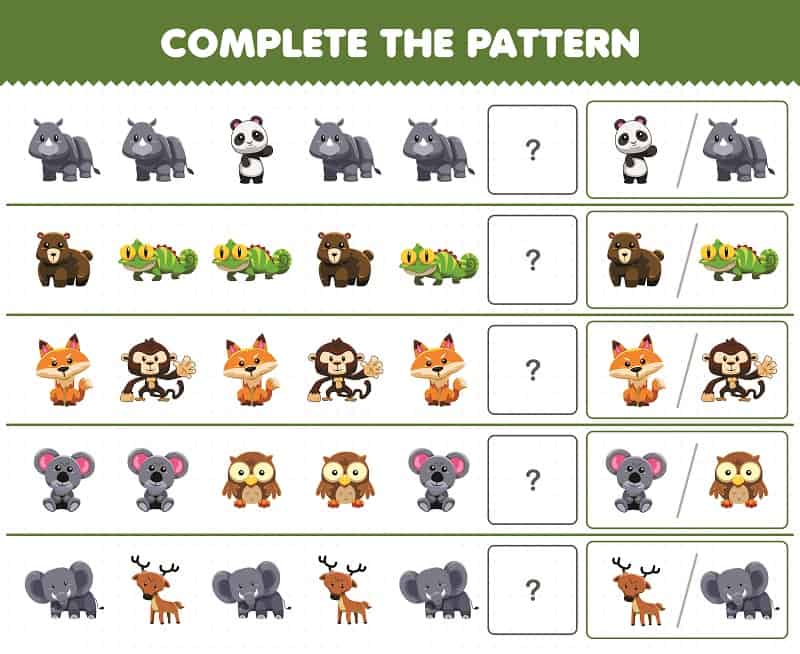
The role of pattern in children’s early mathematical understanding
A pattern is a predictable and regular relationship or sequence[1], usually involving numerical, spatial, or logical relations and which can be expressed as a generalisation[2]. In early childhood, children can notice and learn about patterns that:
- Occur in a single object, as in a striped t-shirt, in an ordered set of objects, such as beads on a string, or between two ordered sets of objects, such as trees on either side of a path.
- Include repeating patterns (such as ABABAB…), spatial structural patterns (as in geometric shapes), and growing patterns (such as 2,4,6,8…).
- Vary in content (colours, shapes, or numbers) and in complexity (for example, repeating patterns can have two, three, or more elements in the repeating unit (ABABAB…, ABBABBABB…, or ABACABACABAC…).
The importance of pattern understanding in early childhood
Pattern understanding refers to the ability to discern the underlying structure of a sequence[3]. Research has found children’s patterning skills and pattern understanding to predict their current and later mathematical competence[4] in number, algebra, and geometry[5], as well as their reading ability and executive function skills[6].
Pattern understanding and mathematical achievement: Mathematics is based on pattern and structure, which is why pattern understanding is so crucial to mathematical achievement. Patterning requires the ability to recognise predictable regularities in shapes, numbers, and measures, to detect sameness and difference, and to make distinctions, classify, and label. This helps children to focus on, and later understand, a range of mathematical structures and relationships.
Children’s pattern understanding at 5 years old is found to predict their mathematical ability at 11 years old[7]. In one study, interventions based on training in pattern understanding were more effective in improving children’s mathematics achievement than interventions based on general mathematics learning[8]. In particular, an understanding of repeated patterns is uniquely associated with higher mathematics achievement[9]. It is thought that children’s ability to abstract and identify the unit of repeat in a repeated pattern leads to higher mathematical achievement both in patterning and other areas of mathematics[10].
Repeating patterns occur frequently in mathematical structures, such as in measurement (the repetition of identical spatial units), and multiplication (the repetition of identical quantities or numbers). Pattern understanding can enhance children’s counting abilities, because counting itself is a predictable, rule-governed sequence. Children with strong pattern understanding are aided in learning patterns in numerical sequences later at school, such as the way in which, when counting in fives, the unit digit alternates between 0 and 5 (5, 10, 15, 20, 25, 30, 35…). Understanding multiplicative structures (multiplication, ratio, proportion, trigonometry) involves understanding ideas such as grouping, partitioning, unitising, and repeating, as well as abilities in visualising mathematical structures such as arrays (a matrix of rows and columns). Visualisation skills are positively related to mathematical achievement[11].
Research has also found connections between patterning and children’s later abilities in algebraic reasoning[12]. Algebraic thinking is an important foundation for advanced studies in mathematics and the sciences, and begins with the understanding of mathematical relationships and patterns. For example, as children discover that a repeating pattern is governed by a rule that the items within the pattern alternate, they also come to understand that the same relation can be applied to other objects and things. They begin to generalise and look for the rules that define patterns, paying less attention to the items in the pattern. This understanding that a relation can be expressed outside of the actual items is the beginning of algebraic thinking. Creating new patterns by applying the repeating pattern rule is a sophisticated cognitive skill involving relational thinking and skills such as encoding, inferring, mapping, and applying relations. Pattern understanding may also contribute to children’s abilities in ‘fluid reasoning’, or the ability to reason and solve problems, without instruction or knowledge, by abstracting information and deducing general principles to apply to new problems in a flexible way[13]. Being able to generalise concepts and ideas from experience facilitates learning in a wide range of areas.
Pattern understanding and reading achievement: There are also (less well-established) connections between patterning and later reading ability[14]. It is theorised that an ability to note the commonalities (or underlying rule) of patterns in early childhood may translate to an ability to abstract the rules governing letter sequences in reading and writing[15].
Pattern understanding and executive function skills: Children with strong pattern understanding are found also to have strong executive function skills, including cognitive flexibility[16] (the ability to switch focus), and working memory[17]. Working memory supports children to remember and process the different items in a pattern, and to keep track of relations when there is a high level of relational complexity between elements in a pattern, while cognitive flexibility may help children to switch their focus between pattern elements. To a lesser extent, children with strong pattern understanding are found to have strong inhibition skills[18] too. Inhibition may help children to inhibit a focus on irrelevant features such as shape or colour or to suppress supplying an incorrect pattern item. Executive function appears to support children to develop higher-level patterning skills that require them to think consciously about the underlying structures of patterns[19]. It should be noted however, that measures of executive function are not well-developed, which may affect the correlations observed.
It is also possible that mathematical thinking such as that involved in patterning may encourage children to use and further develop their executive function skills[20]. For example, as pattern complexity increases (through increasing numbers of elements in a repeating pattern), there are greater demands for working memory. Mathematics skills are found to predict children’s engagement and attention at school[21], and mathematics achievement predicts higher levels of performance in executive function measures[22]. It is likely that there are mutually influencing relations between executive function and mathematical skills, and developing mathematical proficiency and executive function is mutually supportive.
What do children know about pattern?
In early childhood, many young children spontaneously seek out patterns and observe structures and relationships. Young children have been found to develop notions of symmetry through play, and to notice and create symmetrical figures[23]. They are also able to identify, create, and describe a range of repeating patterns[24]. Children’s pattern skills develop as they mature and gain experience.
The first step for most children is to make an exact copy of a model pattern. Next, they move onto being able to extend a model pattern such as ABABAB, continuing the pattern by adding another A, then another B. Research shows that children predominantly use a matching strategy for these problems, that is, they copy the pattern one-to-one[25]. The majority of children aged 3-5 years old can copy a repeating pattern using the same materials, and many of them can continue a pattern[26].
These early skills are important, but they can be performed without a true understanding of the structure of the pattern. More advanced patterning skills include the ability to create a new pattern using the same structure but with different materials. Having been shown an ABABAB pattern with red and blue blocks, children with this skill can make a new ABABAB pattern with green and yellow blocks, or with big and small marbles. It is much harder for pre-schoolers to abstract a pattern to create the same pattern using different materials, and some research suggests less than half of preschoolers can do this[27]. The most challenging patterning skill that children can develop is the ability to isolate and describe the repeating unit in a pattern (1 red block followed by 1 blue block, or the AB in ABABAB), and research finds that very few children can do this[28].
This is likely because abstracting patterns and identifying the pattern unit draws on a deeper understanding of the fundamental pattern structure than duplicating or extending a pattern. To abstract a pattern structure and recognise the unit of repeat in a pattern, children need to identify the relations between different elements in the pattern, for example, that the first element is followed by a second element, which is followed by the first element. Rather than using a visual matching strategy to create a structurally similar pattern, they need to look for the similarity between the relations of elements in the pattern: a relational similarity strategy[29]. Children who learn to use abstract labels for pattern items such as ABABAB are found to be particularly successful with abstracting patterns and identifying pattern units[30].
Can pattern skills be taught?
Research suggests that teaching patterning to young children can provide substantial benefits in terms of pattern understanding, and later achievement in mathematics and reading[31]. Children instructed in pattern understanding have been shown to make considerable progress in learning complex patterns[32], and with skills such as abstracting patterns and recreating them in different media[33]. Providing instructional explanations about patterns has been found to support children to develop better pattern skills, especially if they spontaneously adopt the language used by the teacher[34]. Research shows that with appropriate support (see the strategies below), children can learn pattern abstraction skills in early childhood and benefit from the considerable advantages that pattern understanding has for other learning.
Teaching mathematics in general[35], and specifically pattern instruction that goes beyond the simple copying of model patterns[36], may also improve children’s executive function skills, particularly because learning mathematics makes greater demands on children’s attention, cognitive flexibility, and working memory. This supports them with learning across the curriculum.
Tips for teaching
Early teaching strategies will focus on the visual features of simple patterns. Intentional teaching actions might include:
- Carefully helping children to attend to specific mathematical features, such as the corners on a shape, or the number in a set, which can set up the disposition to direct attention to number, shape, and pattern.
- Introducing children to repeating patterns with strong visual content, such as red blue red blue red blue, or OΔΔOΔΔ.
- Encouraging children to use a one-to-one matching strategy at first to copy a pattern.
- Sometimes hiding models from view so that children have to reproduce patterns from memory, or covering a pattern that children have made and asking them to draw it from memory.
- Talking about patterns. Offer children explanations, and invite them to generate their own explanations about the patterns they observe, both of which have been found to help young children learn about patterns. Can they describe their pattern to you? What kind of pattern is it?
- Asking children to identify missing items in patterns, and identify errors in patterns.
When children are confident with talking about and recreating patterns, they can be encouraged to develop a mental representation of the underlying structure of a pattern, which helps them to notice relational similarity in different repeating patterns. Teachers can support mental representations by:
- Using abstract language and arbitrary labels (such as ‘A’ and ‘B’ or ‘1’ and ‘2’) as well as concrete labels (red, blue) to describe patterns. In research, children who are exposed to abstract labels are able to solve more pattern problems correctly than children exposed to concrete labels[37]. A combination of both concrete and abstract language is found to be more beneficial than one or the other[38] and is likely to support relational thinking.
- Using the same abstract language across different materials, to help children encode the underlying structure (the label ‘A’ or the number ‘1’ can stand for red in the red blue red blue red blue pattern, and for O in the OΔOΔOΔ pattern). This shared label can help children to treat objects similarly, and to think about objects in terms of their relations rather than their perceptual features.
- Encouraging children to compare patterns to notice their relational similarity, despite visual differences. Help children to see that both red blue red blue red blue, and OΔOΔOΔ are ABABAB patterns.
- Inventing names for particular pattern types, for example, call an ABABAB pattern a ‘yabahdah’. Look at a range of patterns and identify which are also a ‘yabahdah’. Children who adopt these labels are found to have better success with abstracting patterns and creating them with different materials[39]. Again, this is because providing a shared verbal label can help children to look beyond similar surface features such as a colour and shape.
- Asking children to make the ‘same ABABAB pattern’ or the same ‘yabahdah’ with different materials (another two colours or two shapes). Four-year-olds are able to generate the same pattern relation with different materials once they are comfortable with the use of abstract labels.
With a good understanding of ways to talk about the structure of repeating patterns, children might be able to focus on and identify the repeating unit in different patterns. Teachers might:
- Invite children to identify similarities and differences between different ABABAB patterns, to get them to focus on the underlying structure and unit of repeat.
- Challenge children to identify the unit of repeat in a pattern by building a tower of blocks such as blue green green blue green green, and then ask them to build the smallest tower possible while keeping the pattern the same (the answer here would be to build a three block tower, using blue green green).
- Ask children to draw or represent their pattern on paper, and then ask them to circle or point to the part that repeats. Ask them how many units of repeat there are in their pattern.
Endnotes
[1] Mulligan, J., Oslington, G., & English, L. (2020). Supporting early mathematical development through a ‘pattern and structure’ intervention program. ZDM Mathematics Education, 52, 663–676. https://doi.org/10.1007/s11858-020-01147-9;
Rittle-Johnson, B., Fyfe, E. R., McLean, L. E. & McEldoon, K. L. (2013). Emerging understanding of patterning in 4-year-olds, Journal of Cognition and Development, 14(3), 376-396. https://doi.org/10.1080/15248372.2012.689897
[2] Mulligan et al., 2020.
[3] Burgoyne, K., Malone, S., Lervag, A., & Hulme, C. (2019). Pattern understanding is a predictor of early reading and arithmetic skills. Early Childhood Research Quarterly, 49, 69-80. https://doi.org/10.1016/j.ecresq.2019.06.006 0885-2006
[4] Pasnak, R., Kidd, J. K., Gadzichowski, K. M., Gallington, D. A., Schmerold, K. L., & West, H. (2015). Abstracting sequences: Reasoning that is a key to academic achievement, The Journal of Genetic Psychology, 176 (3), 171-193. https://doi.org/10.1080/00221325.2015.1024198;
Burgoyne et al., 2019;
Mulligan et al., 2020;
Zippert, E. L., Clayback, K., & Rittle-Johnson, B. (2019). Not just IQ: Patterning predicts preschoolers’ math knowledge beyond fluid reasoning. Journal of Cognition and Development, 20 (5), 752-771. https://doi.org/10.1080/15248372.2019.1658587
[5] Rittle-Johnson, B., Zippert, E. L., & Boice, K. L. (2019). The roles of patterning and spatial skills in early mathematics development. Early Childhood Research Quarterly, 46, 166–178.
[6] Clements, D. H., Sarama, J., Germeroth, C. (2015). Learning executive function and early mathematics: Directions of causal relations. Early Childhood Research Quarterly, 36, 79-90.
[7] Burgoyne et al., 2019.
[8] Kidd, J. K., Pasnak, R., Gadzichowski, K. M., Gallington, D. A., McKnight, P., Boyer, C. E., & Carlson, A. (2014). Instructing first-grade children on patterning improves reading and mathematics. Early Education and Development, 0, 1–18 . https://doi.org/10.1080/10409289.2013.794448 ;
Rittle-Johnson et al., 2019.
[9] Rittle-Johnson et al., 2019.
[10] Miller, M. R., Rittle-Johnson, B ., Loehr, A. M., & Fyfe, E. R. (2016). The influence of relational knowledge and executive function on preschoolers’ repeating pattern knowledge, Journal of Cognition and Development, 17 (1), 85-104. https://doi.org/10.1080/15248372.2015.1023307
[11] Mulligan, J. & Mitchelmore, M. (2009). Awareness of pattern and structure in early mathematical development. Mathematics Education Research Journal, 21 (2), 33-49.
[12] Burgoyne et al., 2019; Mulligan et al., 2020.
[13] Pasnak, R., Schmerold, K. L., Robinson, M. F., Gadzichowski, K. M., Bock, A. M., O’Brien, S. E., Kidd, J K., & Gallington, D. A. (2016). Understanding number sequences leads to understanding mathematics concepts. The Journal of Educational Research, 109 (6), 640-646. https://doi.org/10.1080/00220671.2015.1020911;
Zippert et al., 2019.
[14] Bock, A., Cartwright, K. B., Gonzalez, C., O’Brien, S., Robinson, M. F., Schmerold, K., Shriver, A., & Pasnak, R. (2015). The role of cognitive flexibility in pattern understanding. Journal of Education and Human Development, 4 (1), 19-25. http://dx.doi.org/10.15640/jehd.v4n1a3;
Burgoyne et al., 2019;
Mulligan et al., 2020;
Kidd et al., 2014;
Schmerold, K., Bock, A., Peterson, M., Leaf, B., Vennergrund, K., & Pasnak, R. (2017). The relations between patterning, executive function, and mathematics. The Journal of Psychology, 151 (2), 207-228. https://doi.org/10.1080/00223980.2016.1252708
[15] Burgoyne et al., 2019.
[16] Bock et al., 2015.
[17] Burgoyne et al., 2019; Schmerold et al., 2017.
[18] Burgoyne et al., 2019; Schmerold et al., 2017.
[19] Miller et al., 2016.
[20] Clements et al., 2015.
[21] Clements et al., 2015.
[22] Clements et al., 2015.
[23] Mulligan et al., 2020.
[24] Collins, M. A., & Laksi, E. V. (2015). Preschoolers’ strategies for solving visual pattern tasks. Early Childhood Research Quarterly 32, 204–214.
[25] Collins & Laksi, 2015;
Rittle-Johnson, B., Fyfe, E. R., Loehr, A. M., & Miller, M. R. (2015). Beyond numeracy in preschool: Adding patterns to the equation. Early Childhood Research Quarterly, 31, 101–112.
[26] Collins & Laksi, 2015; Miller et al., 2016.
[27] Miller et al., 2016.
[28] Miller et al., 2016.
[29] Collins & Laksi, 2015.
[30] Fyfe, E. R., McNeil, N. M., & Rittle-Johnson, B. (2015). Easy as ABCABC: Abstract language facilitates performance on a concrete patterning task. Child Development,86 (3), 927–935.
[31] Bock et al., 2015; Kidd et al., 2014; Mulligan et al., 2020.
[32] Pasnak et al., 2015.
[33] Pasnak et al., 2015.
[34] Rittle-Johnson et al., 2015.
[35] Clements et al., 2015.
[36] Miller et al., 2016.
[37] Fyfe et al., 2015.
[38] Fyfe et al., 2015.
[39] Rittle-Johnson et al., 2015.
By Dr Vicki Hargraves