
Games and activities for building executive function in 3-5-year-olds
Executive function supports children to control their thoughts, feelings and behaviours, so it is vital for social and emotional competence, as well as the cognitive control children need for learning[1] [2]. Specifically, executive function skills comprise:
- attention and inhibition: the ability to focus and concentrate, to ignore distractions, and to control impulses and instead choose appropriate behaviours[3]
- working memory: the ability to hold several pieces of information in mind at the same time, in order to think about them, reason and make decisions[4]
- cognitive flexibility: the ability to think flexibly[5], to switch gear and adapt to changing circumstances or demands when necessary, and to apply different rules in different settings[6] [7].
Executive function enables children to maintain attention and avoid getting distracted, to sit still and listen, to remember instructions, and to keep track of what they are doing as they are working. It can help children with skills such as waiting for a turn, cooperating well with others, resisting temptation, and dealing with difficult emotions such as anxiety, frustration or anger without hitting out[8] [9].
Developing strong executive function skills supports children to develop their identities as competent and capable learners[10]. Executive function is related to the development of important learning dispositions[11], such as being able to persevere (self-control), or to think creatively (cognitive flexibility). Research shows that children with high levels of executive function when they start school make faster progress in mathematics and can catch up with peers even if they are initially behind[12], and that higher levels of executive function protect students from the risk of academic failure associated with a poorer socioeconomic background[13]. Outside of schooling, being able to make better decisions and operate effectively in a range of contexts[14] are important life skills. The Dunedin Longitudinal Study found that strong self-regulation skills in early childhood were related to a range of areas of adult wellbeing and success in education, employment, health, and life satisfaction, and associated with a lower frequency of substance abuse or offending[15].
The development of self-regulation and executive function skills is a gradual process which is shaped by children’s experiences. The first important experiences are interactions with adults, which help infants to focus their attention, build their working memory, and manage their reactions to stimuli[16]. Self-regulation is a skill which improves with practice, and the early childhood years are an optimal time for the development of executive function skills, with different kinds of play and many everyday activities and games supporting this process[17] [18]. Younger children will need adult support while learning to regulate their behaviour, manage their attention and complete tasks, but ultimately the aim is for children to self-regulate, so adult support can be gradually withdrawn as children seem ready.
How to support the development of executive function skills
Language is essential in the development of executive function. Language helps children to understand and follow rules and instructions, both supporting them to manage their behaviour and to participate in games and play with others[19]. Language also helps children identify their thoughts and emotions, reflect on them, make plans, and remember information[20]. The development of executive function can be facilitated by adults modelling their thought processes for self-control and self-management out loud, as well as plenty of adult-child talk in which adults support children to reflect on their experiences, to talk about their plans and outcomes, and to evaluate their ongoing progress towards a goal[21]. Bilingualism should be encouraged and supported[22], as access to another language is found to lead to better executive function and self-regulatory skills.
There are many play activities and games that encourage children to pay attention, hold information in memory, and adapt their responses to suit the changing needs of the game or play. Listed below are a range of games and activities based on language and play that are likely to enable children to practise their executive function skills, although their effectiveness has not been specifically evaluated by scientific research[23].
Using language and stories to support executive function
Older children can be encouraged to tell stories or recount events (including in their home languages). Storytelling requires that children hold and work with information in their working memory. With practice, and as their executive function skills develop, they can plan and organise more complex narratives.
- Write down children’s stories, or get children to draw pictures and create their own books. Use this record of the story to revisit it, which will help children to elaborate further on the story or support them to organise the events in a more effective way.
- Get children to act out the stories they have written. This requires children to pay attention, hold the story structure in working memory, and inhibit the impulse to change the story.
- Tell group stories, in which every child adds a small part to the story. This means children have to pay attention to each other, hold in working memory what each person before them said, and adjust their contribution to fit the evolving story, which involves self-control and inhibition.
- Remember to encourage opportunities for storytelling in children’s home languages, as use of other languages is highly supportive of executive function.
Using play to build executive function
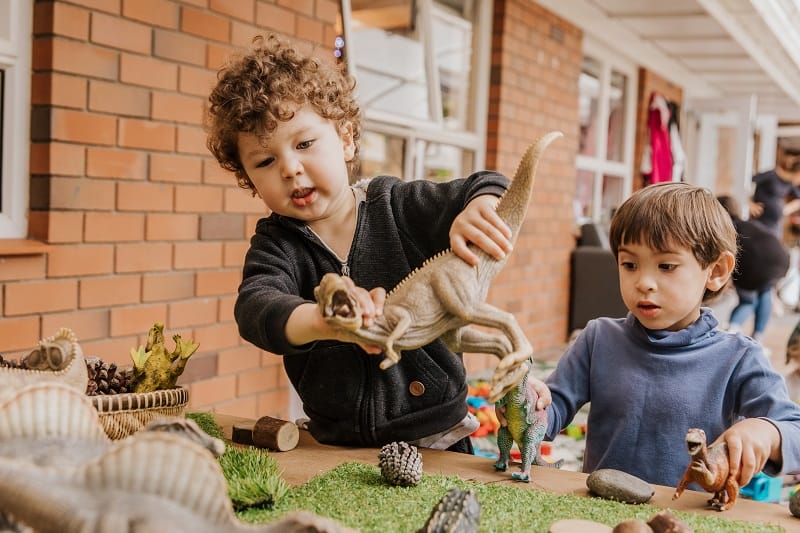
Imaginary play is an important source of executive function skill development. In play, young children invent rules to guide their role in play, and then fit their behaviour to the role and associated rules[24]. For example, a doctor has to talk and act in a certain way. Children will often regulate each other’s play behaviour, reminding them that babies can’t talk, for example, or that sick patients must stay in bed. This regulation of others is an important foundation for developing self-regulation[25]. Imaginative play also supports children in develop cognitive flexibility, when they have to change narratives to incorporate a new player, or when they repurpose an existing item to stand for something else.
- Support high quality imaginative play by providing props and toys, and by reading books, going on trips and watching videos so that children can learn about the appropriate roles for their play theme.
- As children gain imaginative play skills, challenge them further by adapting and re-purposing objects to stand for other objects. For example, a block can be used a phone (rather than a replica phone). Children could also be encouraged to make their own props, requiring them to focus attention, determine what they need, hold this information in working memory while they try out solutions, and adjust their ideas if they don’t work out (cognitive flexibility).
- Encourage children to make plans for their play before starting play. For example, they might decide who they are going to be and what they are going to do in a role play, or what they are going to build in the construction corner. Planning helps children to think before they act, as well as to hold a plan in working memory and to practice inhibitory control as they stick to their plan. You can also use this planning conversation to support children’s oral language and problem-solving skills.
Using songs and games to develop executive function
Games and songs are a powerful way to support children to develop executive function skills, as are physical activities and challenges, as both tend to depend on plenty of focused attention, practice and working memory. Likewise, cooking or any activity in which there is a specific sequence of instructions to follow can help children to practice attention on the sequence of tasks, inhibition while waiting for a turn or the next instruction, and working memory while holding in mind complex instructions.
- Sing songs that repeat and add additional content to earlier parts, which challenges working memory. Also use backward counting songs, like Five Speckled Frogs or songs that involve a long list, like the alphabet song.
- Use lots of music and movement games which challenge children’s executive function skills by requiring that they move in particular ways and synchronise song words or music with their actions. This involves both inhibitory control and working memory. For example, you might get children to move at different speeds depending on which animal name you call out, or play music games like Musical Statues, in which children have to freeze when the music stops (inhibiting their desire to move). Musical statues can be made more challenging by asking children to freeze in particular positions.
- Encourage ball skills and games involving throwing and catching which require children to pay attention to where the ball is. Hopscotch is another good game that encourages children to focus.
- Create obstacle courses, promoting complex movement (such as skipping or balancing) and set challenges for children. To achieve a challenge, children will need to focus their attention, monitor their progress and make adjustments, inhibiting other actions and persisting. Egg and spoon races can be a fun challenge!
- Group games like Tunnel Tag (also known as Stuck in the Mud),in which tagged children have to freeze in place with their legs wide until another player crawls through their legs to release them, help children develop the self-control to stay still. Other games like Grandma’s Footsteps, Sleeping Lions or Duck Duck Goose also help children practice inhibitory control, while a game like Hot Potato, in which children pass around an object as if it is a hot potato and try not to be the one caught holding it when the music stops, help children learn to manage excitement and stay calm.
- Copying games also help children practise executive function skills such as paying attention and committing information to working memory. You might get children to copy a sequence of actions in a Follow the Leader type game, or you might invent clapping patterns for children to echo back to you. You could also create patterns with blocks or beads for children to copy. The game Simon Says is great for practising inhibition. An easier version of this for younger children is to provide two stuffed toys and have the children perform the actions suggested by one of the toys but not the other.
- Card and board games develop executive function skills, and you can introduce new rules to extend children’s executive function. For example, in Bingo, you might have children practise inhibition and working memory by marking their card with the opposite of what is called out.
- Memory games such as Pairs (also known as Memory) encourage children to develop their working memory as they try to remember which cards they have already overturned and where known cards are located. A popular memory game is to place a range of random objects on a tray, and allowing children to try to memorise them, before covering the tray with a blanket and asking children how many they can name.
- Matching and sorting games can be made more challenging. For example, you might ask children to sort cars and bears into two piles, then ask children to sort into colour, so that red cars go with red bears and blue cars with blue bears. This requires children to use their cognitive flexibility in adjusting to changing rules, and to inhibit the desire to follow the previous rule, as well as use their working memory to keep track of what the current rule for sorting or matching is.
- Yoga and meditation exercises help children learn how to reduce their stimulation level and focus their attention.
Endnotes
[1] ENGAGE. (2020). Whānau book.
[2] Ministry of Education. (2019). He māpuna te taimaiti. Author.
[5] Ministry of Education (2019)
[7] Centre on the Developing Child at Harvard University (2014). Enhancing and Practicing Executive Function Skills with Children from Infancy to Adolescence. www.developingchild.harvard.edu
[8] Ministry of Education (2019)
[9] ENGAGE (2020).
[10] Ministry of Education (2019)
[11] Ministry of Education (2019)
[12] Ribner, A. D., Willoughby, M. T., Blair, C. B. & the Family Life Project Key Investigators. (2017). Executive function buffers the association between early math and later academic skills. Frontiers in Psychology, 8 (869). https:doi.org/ 10.3389/fpsyg.2017.00869
[13] Zelazo, P. D., Blair, C. B., & Willoughby, M. T. (2016). Executive function: Implications for education. National Center for Education Research. https://ies.ed.gov/ncer/pubs/20172000/pdf/20172000.pdf
[14] ENGAGE
[15] ENGAGE
[16] Centre on the Developing Child at Harvard University (2014)
[17] ENGAGE
[18] Centre on the Developing Child at Harvard University (2014)
[19] Centre on the Developing Child at Harvard University (2014)
[20] Centre on the Developing Child at Harvard University (2014)
[21] Centre on the Developing Child at Harvard University (2014)
[22] Centre on the Developing Child at Harvard University (2014)
[23] Activities have been taken from ENGAGE (2020) Whānau Book and ENGAGE (2020) School cards, and from the Centre on the Developing Child at Harvard University (2014)
[24] Centre on the Developing Child at Harvard University (2014)
[25] Centre on the Developing Child at Harvard University (2014)
By Dr Vicki Hargraves