

How to engage in teacher inquiry using the spiral of inquiry
Teacher inquiry is a powerful form of teacher learning. Inquiry encourages questioning, exploration and experimentation. It helps teachers to reflect on their practice and turn intuitive judgements about teaching and learning into more structured investigations, systematically and consistently examining the relationship between their actions and children’s learning. Throughout an inquiry teachers make good use of evidence and research in order to stimulate new ways of thinking about teaching and learning, try out new ideas, and evaluate the impact of these changes to practice.
Teacher inquiry requires sustained investigation and action through multiple cycles of inquiry that involve:
• investigating children’s learning
• identifying and focusing on one or two specific areas to improve
• examining the impact of teachers’ actions for children’s learning
• coming up with a ‘hunch’ or a theory about what teacher action might improve children’s learning
• learning from research and from others
• trying out a new or modified practice and checking its effect
• framing a new inquiry, and continuing the cycle
The benefits of teacher inquiry
Inquiry requires deep reflection, questioning of practice, honest self-reflection, openness to new ideas, and being prepared to learn from failures as well as success. It can be a useful form of teacher professional development and inform other processes such as self-review. Teacher inquiry is effective because it is:
- locally-situated as it is developed in teachers’ actual teaching context
- deliberate with clear purposes
- problem-defining as teachers identify a question, challenge or area to investigate and improve
- action-oriented and focused on making and evaluating specific changes to practice
- reflective as it is characterised by deep thought and careful consideration of the relationship between teaching and learning
- iterative, involving several repetitions of key inquiry tasks, in a cycle from collecting evidence, to interpreting evidence, through to taking action, and returning to collecting evidence of its impact
- self-regulated as all actions are determined by the teacher
- collective or individual, involving a team of teachers within a setting, or personal to an individual teacher
- focused on knowledge generation and the advancement of the teacher’s learning and practice
The spiral of inquiry
The ‘spiral of inquiry’ developed by Helen Timperley, Linda Kaser and Judy Halbert is a useful expanded model that extends the focusing, teaching and learning phases of basic inquiry cycles and emphasises the iterative nature of inquiry. This model moves through six interrelated and overlapping stages:
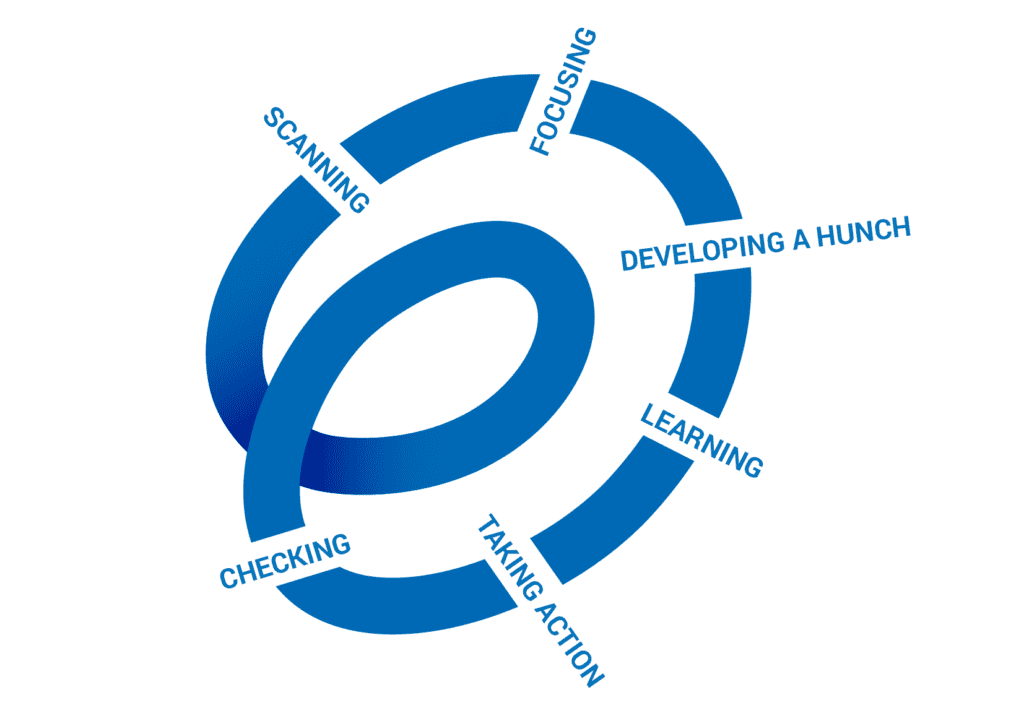
Scanning
What is happening for children?
The scanning phase is about getting an overview of the whole group of children and their areas of strength and need in order to establish a foundation for the focus of the inquiry.
Focusing
Where should you concentrate your energies?
The focusing phase narrows and hones the area of investigation by looking closely at the issues raised during the scanning phase and breaking down larger issues into something more workable.
Developing a hunch
How is my teaching contributing to this situation?
There are two parts to this phase. It begins with an investigation of personal beliefs and assumptions, followed by predictions about the impact that possible changes to practice will have on the area of focus.
Professional learning
How can I learn more about what to actions to take?
This phase involves extending and deepening professional knowledge in order to improve teaching practice and bring about the desired changes to children’s learning.
Taking action
What will you do differently to bring about your desired outcomes?
This phase involves learning about new ways of teaching by trialling new approaches with children, collecting evidence, reflecting on the impact on children, and modifying practice accordingly.
Checking
Have we made enough of a difference?
This phase involves checking the effectiveness of the actions taken in the previous phase by analysing the collected evidence and assessing the impact on children and their learning.
References and further reading
Halbert, J., & Kaser, L. (2013). Spirals of inquiry. BCPVPA Press, Vancouver.
Ministry of Education (2011). Understanding teaching as inquiry. New Zealand Curriculum Update (12), 1-4.
Sinnema, C., & Aitken, G. (2016). Teaching as inquiry. In D. Fraser & M. Hill (Eds.), The professional practice of teaching in New Zealand, pp. 79-97. Melbourne, Australia: Cengage Learning.
Te Kete Ipurangi (n.d.). Inquiry and the key competencies. Retrieved from http://assessment.tki.org.nz/Assessment-in-the-classroom/Teaching-as-inquiry/
Teaching-as-inquiry-practical-tools-for-teachers/Inquiry-and-the-key-competencies
Timperley, H., Kaser, L., & Halbert, J. (2014). A framework for transforming learning in schools: Innovation and the spiral of inquiry (Seminar series 234). Melbourne: Centre for Strategic Education.
Endnotes
1 Timperley, H., Kaser, L., & Halbert, J. (2014). A framework for transforming learning in schools: Innovation and the spiral of inquiry (Seminar series 234). Melbourne: Centre for Strategic Education.