
Executive function in primary school
As children move on from the early childhood years and enter primary school, they develop a stronger grasp of their physical world and become more systematic and logical thinkersi. One set of skills that supports this developmental growth is called executive function. Executive function skills help us answer questions such as:
- Why is it easier for some children to work well with others?
- Why is it harder for children to manage emotions in some situations than in others?
- Why do some children have an easier time accomplishing goals and others struggle to follow through?
What is executive function?
Executive function stems from the coordination of three cognitive processes: cognitive flexibility, working memory and inhibitory control. In primary school, children practise cognitive flexibility skills when they work in groups or teams. For example, a child might need to switch from one idea to another and consider different solutions in order to accomplish a task successfully. Working memory helps a child to hold and remember multiple pieces of information. For example, children in primary school use working memory when they have to remember the multiple steps needed to solve a complex math problem. Finally, inhibitory control allows a child to stop an impulsive response and display a response that is more appropriate for the context. Children use inhibitory control skills when, for example, they feel excited and want to shout out an answer to a question during a class discussion, but wait for their turn to respond instead. These three cognitive processes work together and can be demonstrated in children’s behaviours in many different ways. Executive function matures with brain development and can be strengthened with experience and practice over time. As these skills improve, children can plan and act in ways that make them successful students, empathetic classroom citizens and good friendsi.
How executive function develops
Executive function begins to develop early in life. These skills are influenced by maturation (including brain development) and through the interactions that children have with the people in their lives including caregivers, parents, teachers, after-school care providers, siblings, classmates, and extended family membersii. The foundation for executive function develops in the context of the early attachment relationship that infants develop with their caregivers. Babies who experience warm and supportive interactions with important adults in their lives are more likely to feel safe and secure. This sense of security from trusted caregivers helps children build confidence that allows them to comfortably explore their world, develop independence and practise problem-solving. Secure relationships also lead to strong social emotional development and executive function skills in young children. Children who develop executive function skills early in life are more likely to demonstrate self-control in social and academic environments, especially as children get older and make the transition to more structured learning environments. In primary school, children’s executive function skills are reflected in how they solve problems, stay on task, cooperate with others, and make friends. Importantly, executive function skills are associated with academic achievement, social competencyiii, and personal wellbeing including physical and mental healthiv.
Strengthening executive function skills
Forming warm and responsive relationships with children is important for their executive function development. In particular, providing comfort when children are distressed or need support helps to scaffold executive function skills. Classroom environments that support the development of strong executive function skills have many characteristics in commonii. These include:
- Safe spaces for children to take time to calm down after stressful events
- Encouragement for children to self-monitor their own behaviours
- Clear expectations for children’s behavior
- Organised classroom environments
- Consistent methods of discipline that set boundaries (without being punitive), focus on teaching children about the consequences of their actions, and offer alternatives to inappropriate behaviour
Importantly, executive function skills can be improvediv. The most effective way to bolster executive function skills is to teach them in daily activities, provide children with opportunities to practise them across multiple settings, and offer supportive feedback. The following are especially important for stimulating effective executive function skills in primary school:
- Providing a positive and supportive school climate for every student
- Integrating the opportunity to practise executive function skills in academic content and during social interactions
- Training teachers to model, reinforce, and teach executive function skills in supportive ways
- Promoting effective executive function skills in teachers and after-school staff
- Supporting parents so that they can scaffold their children’s executive function development at home
Strategies for improving executive function skills
Executive function skills can be taught and improved, and primary school teachers serve an important role in helping children develop these skills. There are a number of strategies that teachers and caregivers can use to promote executive function skills in children. These include fostering positive relationships, organising the classroom environment, and providing opportunities to practise skills through games, goal-setting, and self-monitoring. Engaging families in efforts to promote children’s executive function skills can also help children to practise skills across home and school settings.
- Structure the classroom environment to support executive functions skills. Children in primary school are expected to follow daily classroom routines and follow a set of school rules. One way to foster executive function skills is by making sure the classroom is organised and that rules and routines are clearly communicated (for example, post the daily schedule on the wall so that children know what is happening at different times, and offer reminders throughout the day). In addition, ensure that children have the necessary classroom materials for successful learning (such as scissors and sharpened pencils) available in an accessible location.
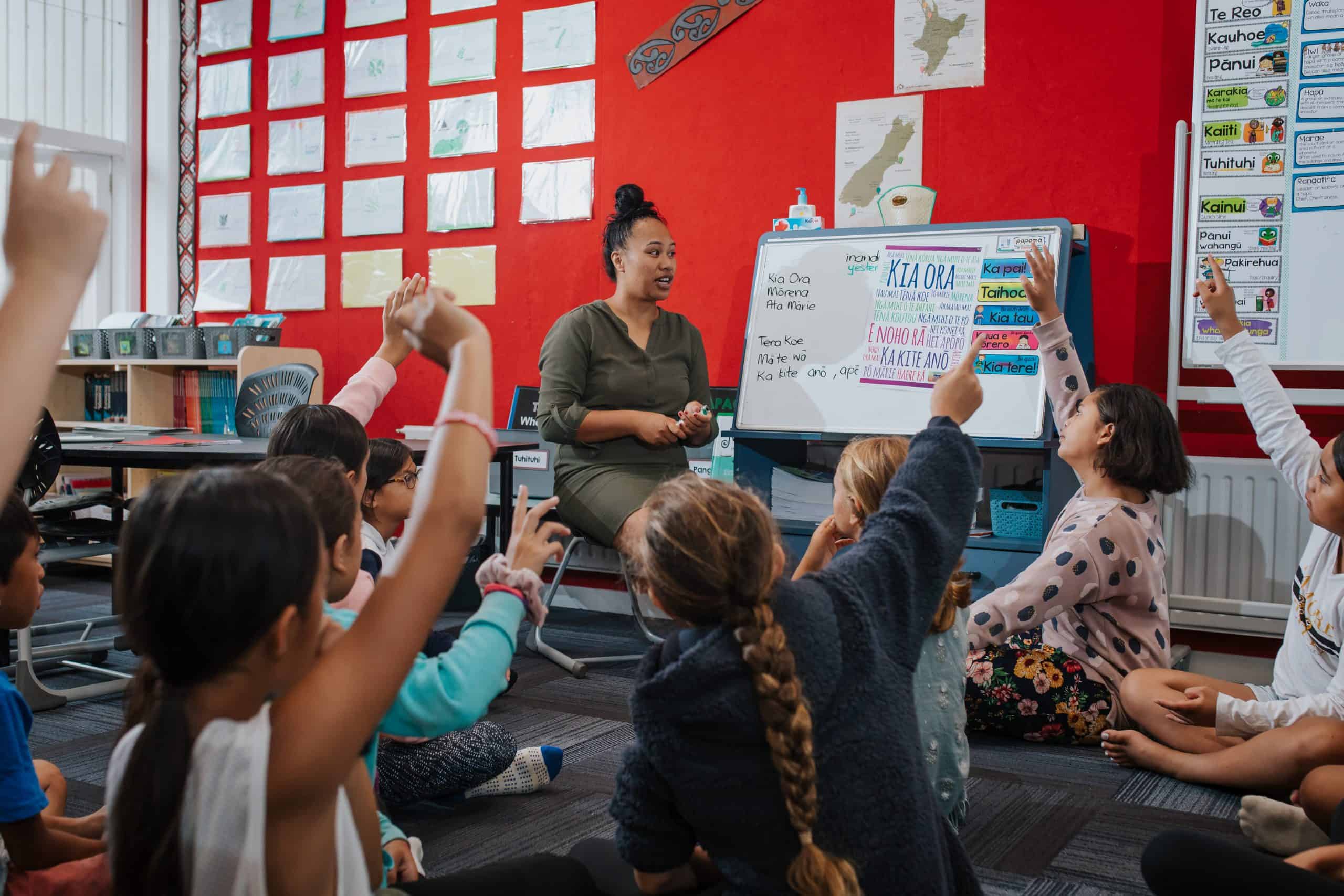
As children navigate the demands of a typical classroom, preparing children for transitions helps them to practise their executive function skills. Let children know what is coming next and set up a cue or signal that lets them know a transition is coming. For example, in younger primary school classrooms, teachers might flicker the classroom lights or use music to signal that a transition to the next activity is coming. They might also use verbal cues, such as chanting ‘1,2,3’ to which children respond with ‘all eyes on you!’ Teachers with older children may rely more on children to notice the cues during more disruptive moments in the classroom, so they can use cues like quietly raising their hand and waiting for children to notice and raise their own hands to signal they are paying attention and ready to regain focus.
Introducing mindfulness into the classroom can be helpful in creating a supportive environment. Embedding quick and easy strategies children can access throughout the day can help children navigate their own executive function skills. Teachers can begin by introducing breathing techniques that children can practise and use in and outside of challenging moments throughout the classroom day. To help younger children begin to understand mindfulness practices, teachers can show a Sesame Street video and practise belly breathing along with Elmo. For older children, teachers can introduce daily journaling as a strategy to help children work through their emotions or reflect on difficult tasks or interactions with peers.
- Foster positive teacher-child relationships. Throughout our lives, relationships serve as a foundation for learning and growth and the teacher-child relationship can be especially helpful in the development of children’s executive function skills. Teachers can foster positive relationships with children in primary school in many ways. For example, many teachers check-in individually with students when possible to see how children are doing and to monitor their progress. Morning meetings and talking with children during individual work time are opportunities to ask how children are feeling, what they are struggling with, and what they might be looking forward to that day. For older children, teachers can ask students about their goal for their day and to report any progress that they have made on projects or other goals. This can turn into a deeper discussion around goal-planning and what steps children might need to take throughout the day to achieve their goals.
- Build children’s autonomy and independencev. For younger children, having opportunities to lead or share their individual ideas is important. One simple way to embed this in the classroom is to hold morning meetings or sharing circles that allow students to share their feelings or respond to a specific question or prompt (for example, ‘How are you feeling about the math test we have tomorrow?’). Brainstorm strategies together for managing feelings that children share (for example, you might ask ‘What is something you could do if you are feeling worried? What could you do to help a friend who is feeling nervous?’). To support autonomy in older children, create situations throughout the day where children need to first rely on their own understanding of a task and then share that understanding in a small peer group. For example, teachers can ask children to work in small groups to solve a math problem or do a science experiment using written directions before having a larger group discussion.
- Continue to explicitly teach executive function skills and allow children multiple opportunities to practise these skills. For younger children, a fun and engaging way to practise children’s executive function skills is through music and movement-based games. The key to introducing these skills through games is to give children multiple opportunities to practicse the basic skill (such as freezing when the music stops) but to enhance each game by increasing the complexity and introducing new cues to further children’s practice of executive function skills. Interventions such as Red Light, Purple Light! vi include a series of music and movement-based games that can easily be introduced into large group settings with few materials. For example, in the Red Light, Purple Light game, when teachers first introduce it, they serve as the ‘stoplight’ and hold up different coloured circles that tell children when to start or to stop an action. As children begin to master a basic variation of the game, teachers can add in levels of complexity by changing the cues or the actions children do (such as hopping on one foot and touching their nose). Teachers can introduce different shapes, numbers, or letters to cue children when actions start and stop. At each level of complexity teachers can also encourage children to serve as the leader or ‘stoplight’.
For children in the older primary years, engage them in self-reflection and self-monitoring practices. For example, ask children to plan an activity they would like to create in the next week. Ask children to write out the materials they will need and what steps they will take to accomplish their project. Then have children monitor and write down their progress each day as they work on the project. Once children complete the project, ask them to reflect on what they did and if it matched the plan they made. Did they need to make any changes? Were the materials enough to complete the project in the way they intended to? Creating and self-reflecting on their experiences will help them tap into executive function skills and complete projects.
To encourage self-monitoring, set-up activities that require children to work towards a long-term goal while asking them to monitor their progress throughout the task. For example, create a classroom reading challenge where children are tasked with reading a certain number of books within a given time period (such as a 40 book challenge over the year). Ask students to be responsible for staying organised and tracking their progress each week. Throughout the challenge, check-in with students and ask them about how things are going. When students experience challenges in completing the project, work together to problem-solve and have other students suggest strategies that have worked for them.
- Use modeling and positive reinforcement of executive function skills. Share aloud the decisions you make throughout the day. Even sharing every day actions can help younger children learn decision-making skills (for example, ‘It looks like it’s raining so I’m going to get my coat so that I don’t get wet’). It is also important to look for ways to model your own executive function skills throughout the day. Talk with children about the importance of being organised when you set up the classroom and routines for the class. In addition to modeling your own executive function skills, it can be helpful to acknowledge when you see children practising these skills.
- Encourage families to be involved in student learning. Working with families to support children’s executive function skills is key. One way to extend their classroom learning at home is by sharing with families the benefit of executive function skills along with resources explaining what these skills are and how they can be practised at home. Invite families to think about ways that they can model their own executive function skills. For example, as they are planning dinner, they can talk through that process with children or even consider asking children to help plan the meal with them. In addition, families can make a weekly schedule together and post it where everyone can see it. If children help develop the schedule, they are more likely to remember what they need to do and can practise planning and being organised. All of these are important for executive function skills.
Children can also bring their learning home by teaching their family members the executive function games they play at school. Teachers can use this as a classroom activity by having children pick their favourite game or activity from school and asking them to create a handout to share with their families about how to play the game or do the activity. For older children, teachers can ask children to identify for their family members how the games help exercise their executive function muscles! Once children have completed their handouts, teachers can compile them and make a booklet to send home with all the ideas they came up with.
Endnotes
___________________________
i Pearson, P. D., &
Duke, N. K. (2002). Comprehension instruction in the primary grades. Comprehension
instruction: Research-based best practices, 247-258.
iiCarlson, S. M. (2009). Social origins of executive function development. In C. Lewis & J. I. M. Carpendale (Eds.), Social interaction and the development of executive function. New Directions in Child and Adolescent Development, 123, 87–97.
iiiMcClelland, M. M., Cameron, C. E., Wanless, S. B., & Murray, A. (2007). Executive function, behavioral self-regulation, and social-emotional competence: Links to school readiness. In O. N. Saracho & B. Spodek (Eds.), Contemporary perspectives on social learning in early childhood education (pp. 113-137). Information Age Publishing Inc.
ivDiamond, A., & Lee, K. (2011). Interventions shown to aid executive function development in children 4 to 12 years old. Science, 333(6045), 959-964. https://doi.org/10.1126/science.1204529
vSosic-Vasic, Z., Keis, O., Lau, M., Spitzer, M., & Streb, J. (2015). The impact of motivation and teachers’ autonomy support on children’s executive functions. Frontiers in Psychology, 6, 146.
viMcClelland, M. M., Tominey, S. L., Schmitt, S. A., Hatfield, B. E., Purpura, D. J., Gonzales, C. R., & Tracy, A.N. (2019). Red Light, Purple Light! Results of an intervention to promote school readiness for children from low-income backgrounds. Frontiers in Psychology, 10, 2365. https://doi.org/10.3389/fpsyg.2019.02365
By Dr Megan McClelland, Dr Shauna Tominey, Alexis Tracy, Dr Alexandra Nancarrow and Jasmine Karing