
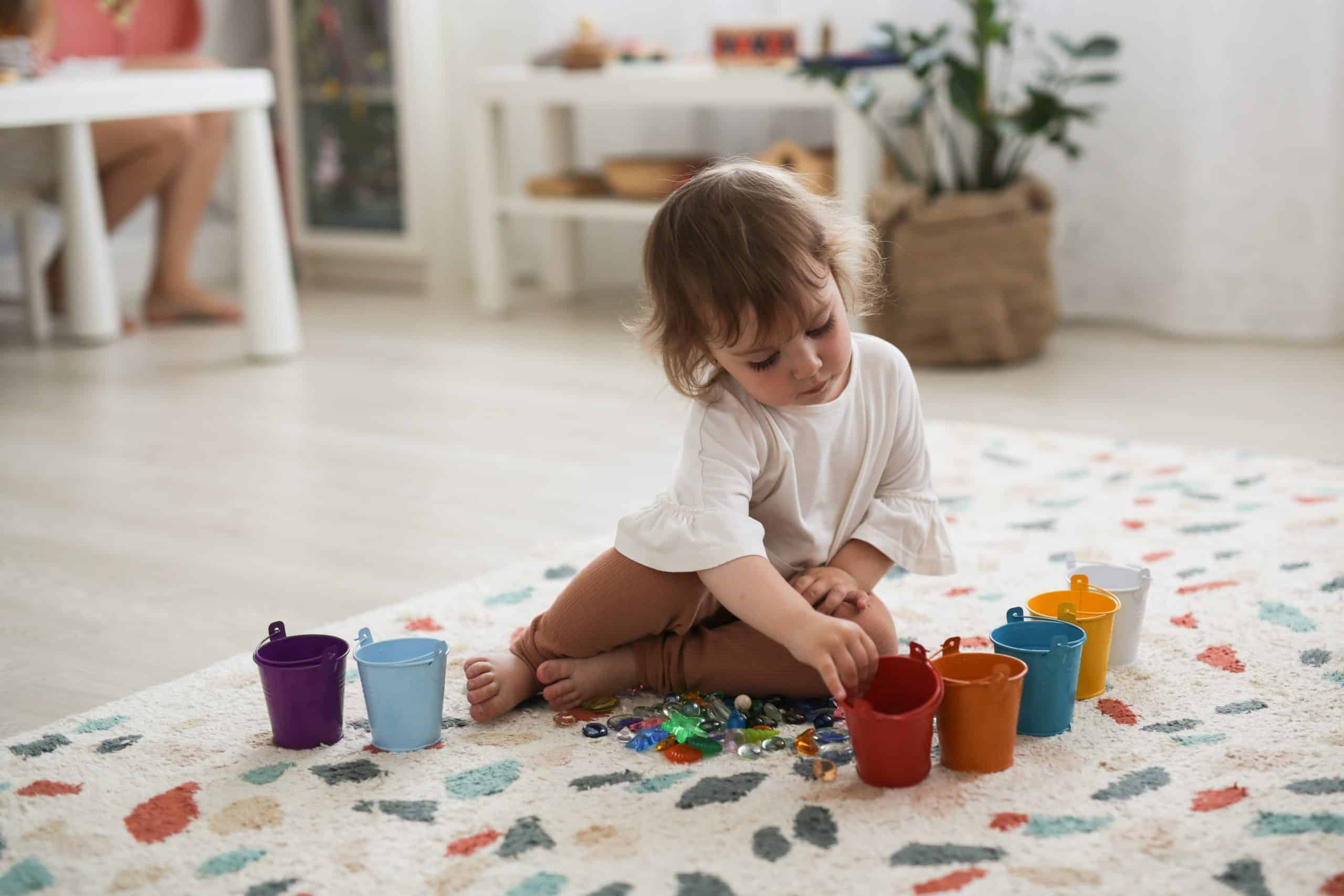
Materials for play: Infants and toddlers
Loose parts are ordinary, everyday, open-ended materials that can be manipulated and used in various ways, moved, carried, shared, combined and taken apart in various configurations and designs. Heuristic play is exploratory play with materials and objects. Children handle, explore and make discoveries about the properties and features of objects, and develop ideas for how they might be used or combined and how they relate to each other. There are no specific directions accompanying the materials and many various outcomes are possible from their use. For example, children might explore a set of balls, pom poms and other spherical objects alongside a range of containers and tubes. Heuristic play is sometimes provided via a ‘Treasure Basket’ for infants who are able to sit but are not otherwise mobile.
Materials are theorised to be highly important in the formation of neural networks in the brains of very young children because they stimulate the senses. Hands-on, practical, sensory and emotional activity with materials are required to switch on neural connections in the brain that underpin thinking and learning. Important early skills such as the ability to focus, sustain attention and identify salient features are activated and practised when children are provided with stimulating open-ended materials. These early skills are the foundation of later learning.
Here are some considerations for using treasure baskets and loose parts with infants and toddlers:
- Choose a good time to introduce materials (such as a calm time when children are well rested, well-fed, and physically comfortable).
- Be responsive and attentive yet unobtrusive, for example, by exchanging smiles or accepting an object a child offers to you. Ensure you are physically comfortable and relaxed which supports infants to feel secure, comfortable and relaxed. Some children may need an encouraging look that says ‘yes, you can stack the cylinders like that’. Share delight and enjoy objects with infants, but try to avoid verbal encouragement and commentary or clapping hands which can be intrusive and disrupt children’s concentration.
- Ensure infants and toddlers can move freely as movement is an important way in which they explore loose parts. Try not to intrude on children’s space, or allow older children to come into the space of infants, and ensure babies are not crowded so that they are not likely to hurt each other accidentally as they attempt to handle larger items.
- Respect children’s choices and decisions (for example, to spend as long as they like looking at the collection before handling anything, or with one particular object). Let infants select from a treasure basket rather than hand them objects or dangle them in front of them. Infants in particular need to warm up first, usually by gazing and visually sizing up objects. When the level of challenge is about right, infants and toddlers will repeat actions. This enables them to master challenges gradually.
- Be extra vigilant about safety by checking items are safe (not sharp and not a choking hazard), and by being physically present and attentive when children are using items. For infants, ensure items can be washed, wiped or disposed of, and clean frequently with soap and water, or in a sterilising solution. Remember that infants at the treasure basket stage will not be able to throw or poke items, which may enable you to include a wider variety of items. Your comfort and confidence with using the objects will be transmitted to the children and convey the message that it is okay for them to explore.
Further reading
Daly, L. & Beloglovsky, M. (2016). Loose parts 2: Inspiring play with infants and toddlers. St. Paul, MN: Redleaf Press.
Forbes, R. (2004). Beginning to play: Young children from birth to three. Maidenhead, UK: Open University Press.
Hughes, A. M. (2010). Developing play for the under 3s: The treasure basket and heuristic play. London: Routledge.
By Dr Vicki Hargraves