

Cooperative learning strategies across the curriculum
The following examples demonstrate how cooperative learning strategies may be used across a number of curriculum areas.
1. Turn to your neighbour
This activity is designed to ensure that all students are actively involved in the learning process.
Task: Students explain theirs answers with reasoning to a classmate, and then they build on each other’s ideas. This provides a way to ensure that all students are active and engaged.
Cooperative procedure: Students create a joint answer as a pair through the following procedure
Step 1:
- Formulate an answer as individuals
- Share answers and reasoning with a partner
- Listen carefully to partner’s explanation
- Create a new answer that is superior to their initial thoughts by building on each other’s thoughts and synthesising their individual ideas
Step 2:
- Each pair joins with another pair and one member of each pair
shares their agreed-upon answer. The second member of each pair listens carefully and adds any information that has been omitted. The second pair follows, providing their explanation. - After the two pairs explain their answers, each pair decides if they wish to revise their answer based on the explanation received from the other pair.
Criteria for success: Each student must be able to explain the answer.
2. Read and explain pairs
This activity is designed to promote interdependence as students work together to build their expertise on an assigned text.
Task: Students work in pairs to elicit the important ideas from a text by discussing and coming to an agreement on the main ideas. Their objective is to establish the meaning of each paragraph and then integrate the paragraph summaries into the overall meaning of the assigned text.
Cooperative procedure: The activity is designed to ensure that each student and partner become experts on the assigned material. It provides an element of interdependence in that the partners are jointly responsible by alternating roles, sharing the reading and sharing the summarising load. The following procedure is used:
- Both students silently read the first paragraph
- Student A summarises the content to Student B in 10 words or less, and then Student B assists in creating a summary sentence; when they agree on their summary sentence, Student B writes the sentence on the summary sheet
- The students identify the question that is answered in the paragraph (for example: How was penicillin discovered?)
- The students move on to the next paragraph and repeat the procedure, alternating between the reading and summarising roles
- After each paragraph is summarised, the students work together to establish the main ideas in the text
- When the summary is completed the students take turn in explaining to each other the main ideas
Criteria for success: Both members in each pair must be able to explain the meaning of the assigned material correctly.
3. Group brainstorming
This process can help to ensure that all members in a group contribute to the process of collecting information.
Task: Students work in groups of four to gather information on a given topic, ensuring that all members of a group have the opportunity to contribute to the process. This activity provides the students the opportunity to record what they know and then to use this record as the basis for negotiating with group members.
Cooperative procedure: Form participants into groups of four. Provide an A3 sheet featuring the diagram shown below or a piece of butcher’s paper to each group, along with four different coloured pens or pencils.
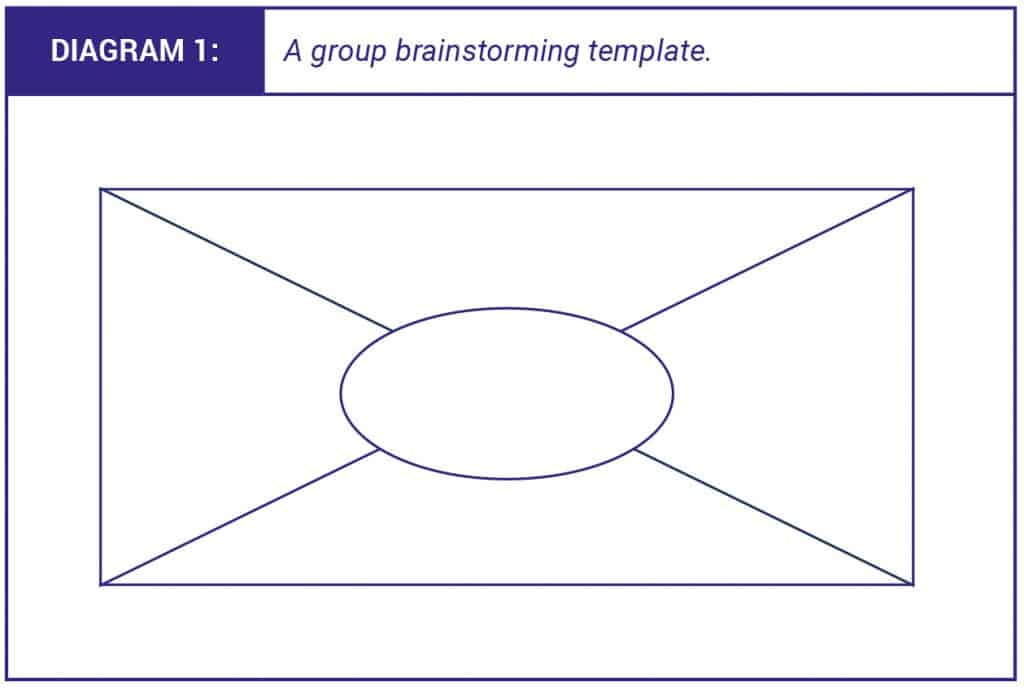
- Pose a question or topic for the brainstorm. For example, you might ask, ‘What are some various kinds of micro-organisms? Why is it important to know about them?’
- Explain that the outer spaces (quadrants) are for members to write their
thoughts about the topic. Set a specific length of time (e.g., 5 minutes) for
the groups to brainstorm and record information or thoughts. - Ask the groups to select the best ideas for the inner oval. The nominated scribe records these. You might stipulate that there should be at least one idea from each member.
- One member from each group reports to the whole class and a master list of the points is made for the whole class.
Criteria for success: Groups are able to negotiate and agree on the key ideas associated with a topic. Each member of each group has contributed at least one idea.
4. Team word webbing
This activity is designed to encourage the development and exchange of important concepts for learning.
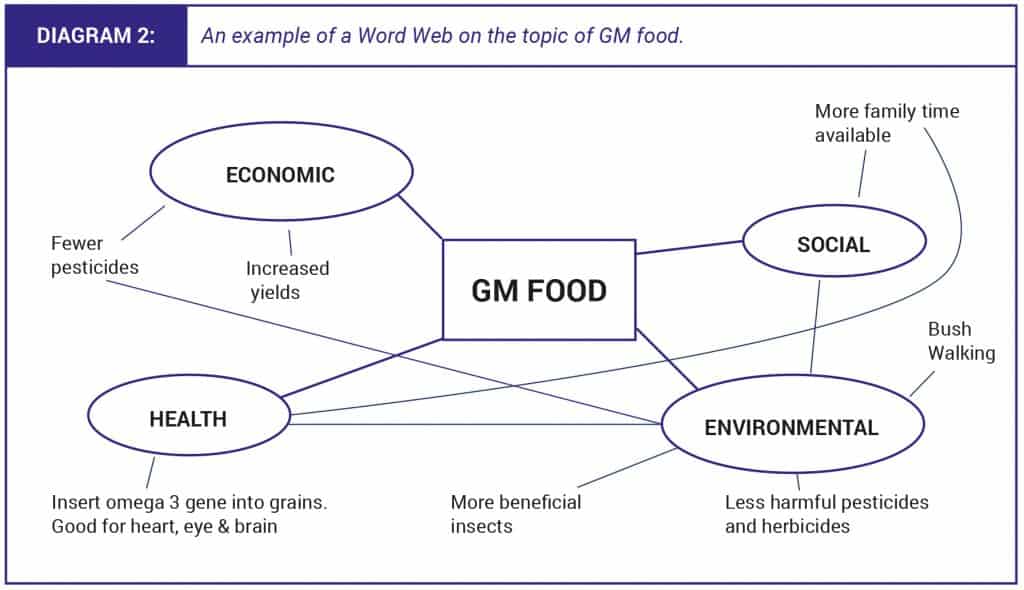
Task: Students work in teams and create Word Webs or other similar tools such as Semantic Maps, Clustering, Chains, Spider Maps and Concept Maps in order to develop and share their understanding and knowledge of key concepts.
Cooperative procedure:
- Give each student a different coloured pen or marker and give each team one piece of butcher paper.
- Have the students write the topic in a rectangle in the centre. Ask the students to do a round of roundtable to determine the core concepts.
- Each student selects one of the sub-topics and writes various ideas that are associated with the sub-topic.
- As a group, the students examine various ideas to see if links can be made across categories.
- A nominated reporter in each group reports on the links made between the various sub-topics. Students are encouraged to comment on the links made.
- Finally, ask the groups to add additional links that were reported by other teams to their Word Web. These Word Webs can now be displayed and further links added as the topic is explored.
Criteria for success: Students understand the key concepts associated with the topic and can see and comment on links between them.
References Gillies, R. M. (2007). Cooperative learning: Integrating theory and practice. Los Angeles: Sage.
By Robyn Gillies