
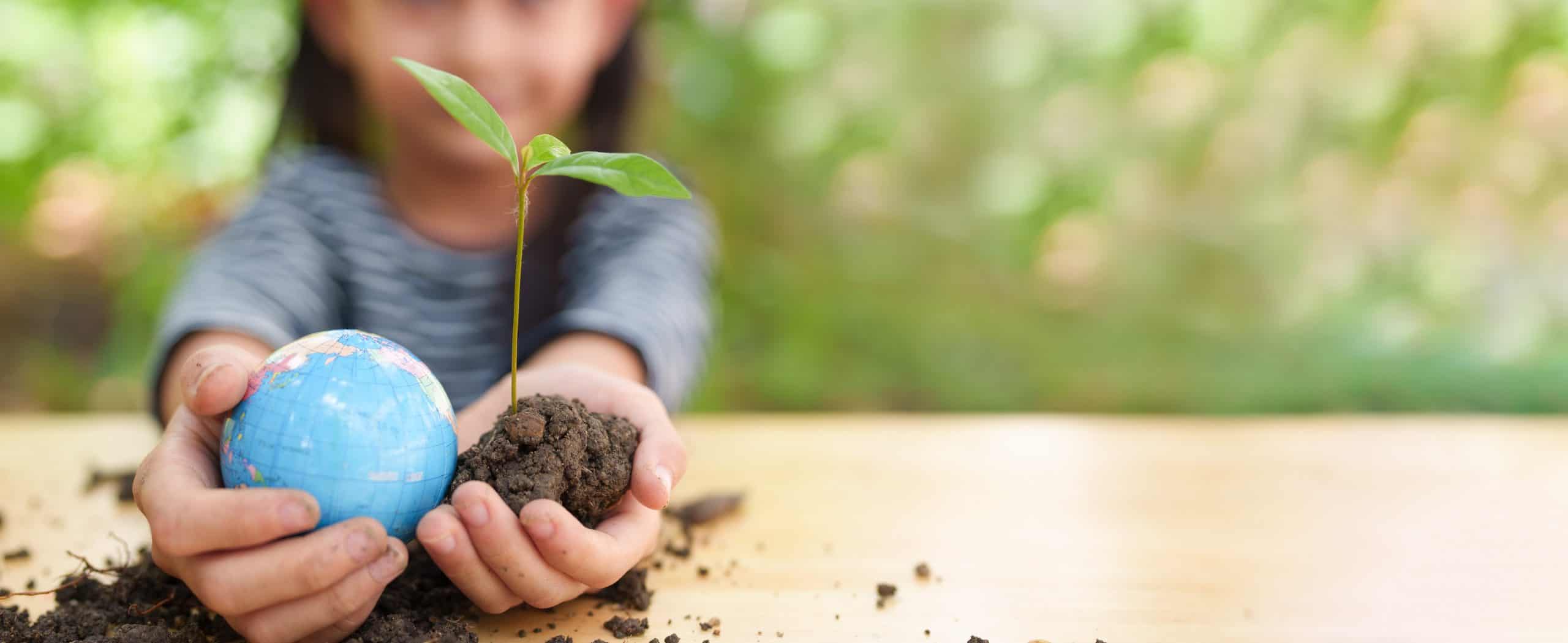
Exploring sustainability practices with children in early childhood
In a webinar, Dr Lacey Peters, Dr Janette Habashi, Dr Victoria Damjanovic, and Dr Ingrid Anderson shared powerful stories of shared inquiry with children that demonstrate children’s natural curiosity, their capacity for empathy, and their potential to become active participants in environmental and social advocacy. Building an image of children as capable of exploring complex topics and making powerful contributions to the world in which they live, they encouraged teachers to extend a sustainability focus beyond environmental justice to (often related) issues of economic and social justice.
The key ideas explored in the webinar were:
Exploring sustainability involves environmental issues, but also concepts of economic sustainability, and social justice. This project was built on Janette’s work with Zeki Learning, a non-profit, educational toy brand that produces ethically-made learning resources, supporting women from the West Bank who have historically experienced a lack of economic opportunities. Some initial aims of the project were to consider how concepts such as fair trade and the sourcing of toys and materials within the early childhood setting might be explored with children. The researchers were interested in discovering children’s understandings and knowledge of consumerism and consumption, what they might know about the people who make toys, and in what ways toy production takes place in socially and economically just circumstances.
Children can understand issues of economic sustainability and social justice and engage in civic action when teachers know how to present these ideas. For example, children might be encouraged to reflect on who is most impacted by environmental issues, or the way in which political and economic circumstances might hinder sustainability practices. One example shared involved a group of children’s inquiry into playground access and food justice in their local area. Teachers helped children map where playgrounds were located in their city and noticed that some neighbourhoods had none at all. This led to further investigations into food deserts (areas with limited access to fresh, healthy food) which were often the same communities that lacked recreational spaces. The children were concerned by this inequality and supported to write a letter to the city council.
Teachers and children are already often engaged in sustainability practices such as the reuse of materials for new purposes, which can be connected to environmental, economic, and social justice concerns. For example, teachers and children may decide to replace a percentage of commercially-produced toys with reused materials. Children hold an instinctive capacity for continuity and to sustain what already exists. To honour this, teachers might value children’s reuse processes, rather than final products. They might invite children to lead sustainability inquiries by asking questions about what to save, what to keep, and what to reuse. At the University of South Florida’s lab school, one sustainability practice related to the reuse of material invited children to think about whether ‘to glue or not to glue’ (because gluing creates a permanence that ends the life cycle of those materials). In this way, the reuse of materials brings together ideas from ecology, creativity, culture, and ethics for children to explore.
It is important to broach complex sustainability topics in ways that are contextual, authentic, and meaningful to children. For example, at Northern Arizona University [NAU]’s Early Learning and Development Centre, a project began when children saw a bird with a piece of trash in its beak on the playground. This observation led to conversations about their own lunchtime habits and how leftover garbage might harm animals. Teachers invited children to collect their own waste for a week, using a kiddie pool as a visual container. As the garbage piled up, the children were able to see the collective impact of their actions, prompting them to advocate for less disposable packaging in their lunches.
Hands-on, visual approaches can make abstract concepts accessible for the children. Simple experiments such as comparing how an apple and a plastic container decompose over time can help children understand the difference between biodegradable and non-biodegradable materials, and consider the implications of this for waste management and environmental sustainability. Children might be supported to consider where garbage goes by building a community map and thinking about where landfill might be placed in their community, opening space for deeper conversations about fairness, privilege, and who is most impacted by waste. It is important to ask open-ended, thoughtful questions and allow children the time and space to grapple with big ideas. Young children can engage deeply with the emotional and ethical dimensions of sustainability, and can communicate powerful messages when given the space and support to do so. For example, as part of the rubbish inquiry at NAU, one child created a mixed-media artwork featuring a bird with a Ziploc bag over its head, communicating a deep understanding of the dangers of pollution.
It can be important to embrace vulnerability and lean into moments of discomfort and uncertainty, recognising that learning alongside children—especially around topics of justice, equity, and sustainability—may be challenging and difficult work. Talking openly with children invites a reciprocal vulnerability, in which, by being open to making mistakes and engaging in honest reflection, teachers model the kind of courageous and hopeful inquiry they want to inspire in children. Acknowledging that they don’t know everything, teachers demonstrate trust that children have a capacity to help understand the world in new ways and to create deeper or more expansive ways of thinking about things.
Community connections and conversations can support deep reflection on issues of sustainability and offer a sense of support which is so important in hard work such as this. Issues related to sustainability are important to many people, and this can provoke collaborations with others not immediately connected to early childhood education.
Sustainability is not only a goal for the future, but a daily practice of imagination and care. When sustainability is seen as ‘one more thing to do’, then sustainability practices are isolated, and context-bound. Instead sustainability might be understood as a natural and fluid process of continually considering how we can help each other, the planet, and its more-than-human inhabitants. Rather than seen as an extra or additional load to the curriculum, sustainability issues can be woven into all sorts of curricular and administrative decisions, and throughout children’s learning experiences. Children’s acts of reuse, in transforming materials, retelling stories, or reimagining systems, are expressions of care, creativity, and hope, and wonderful starting points for reciprocal conversations that create openings and encourage children to help lead the way.
Further resources