
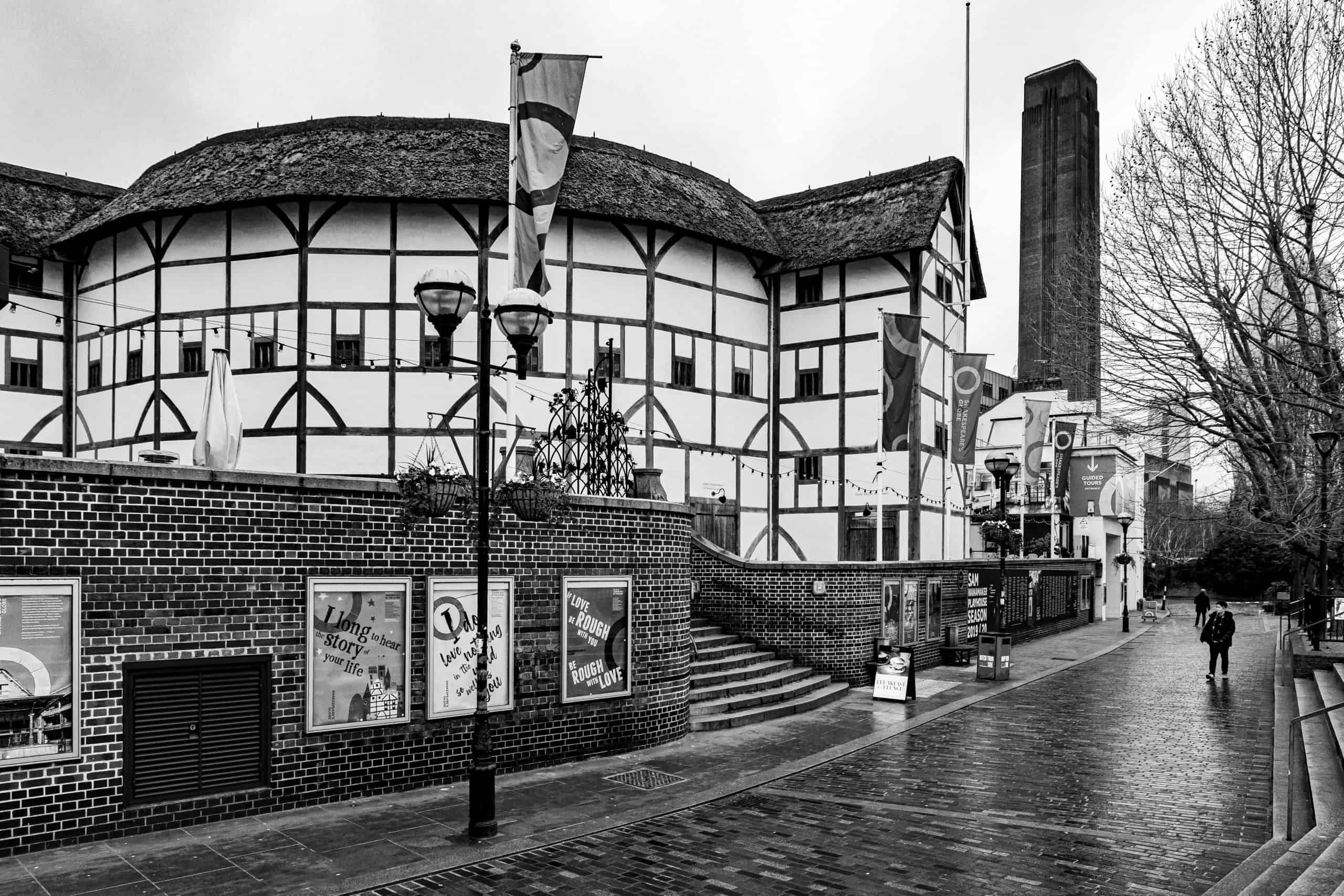
Why (or why not) teach Shakespeare?
Shakespeare has been integral to high school education in many countries since the nineteenth century. In 2010, the Royal Shakespeare Company surveyed forty-three countries and found that Shakespeare was taught in 65 per cent of them, with approximately half of all school students studying his work[1]. The obvious question that follows is: Why? Why is Shakespeare so important?
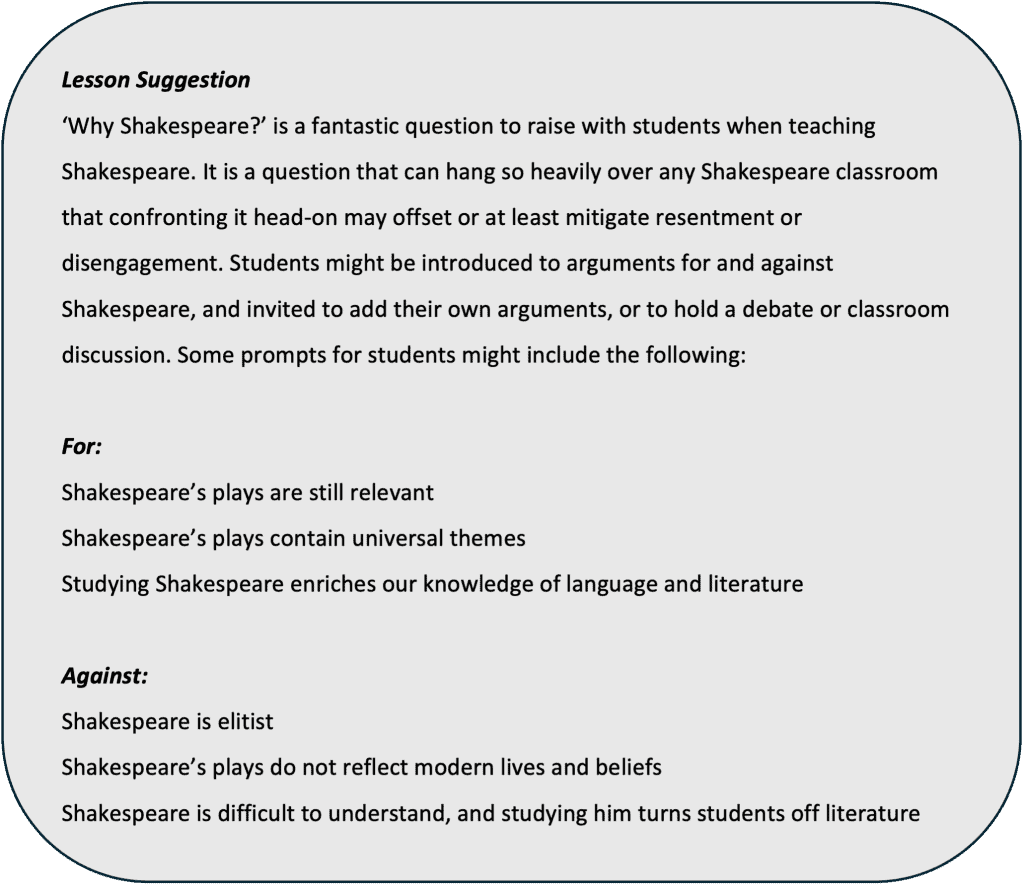
The following discussion will examine current arguments for and against teaching Shakespeare in secondary schools and propose some research-based approaches to teaching his work effectively.
The case against Shakespeare
One of the primary arguments against teaching Shakespeare is that his work is outdated, impenetrable, and no longer representative of contemporary life. Gary Taylor points out that Shakespeare’s language is becoming more and more inaccessible, writing, ‘Shakespeare’s words are disappearing before our eyes; their sound is lost already . . . the code that communicated his meanings becomes unintelligibly obsolete’[2]. Taylor continues, ‘Shakespeare now finds himself needing to be constantly justified against the determined boredom, the soaking resentment, of conscripts’[3]. Shakespeare, in other words, no longer justifies himself. His plays are difficult to decode, and students forced to read them often struggle to see their relevance or to make sense of them. This difficulty often leads to boredom, frustration, and disengagement.
Shakespeare’s plays are also criticised as irrelevant and no longer representative of modern culture and experiences. For example, defending its 2022 decision to withdraw funding from the annual Sheilah Winn Shakespeare Festival, New Zealand’s arts council claimed that the festival was ‘located within a canon of imperialism and missed the opportunity to create a living curriculum and show relevance’[4]. For many today, Shakespeare’s plays are indicative of a historical and cultural past that no longer aligns with contemporary values and lived experiences.
The case for Shakespeare
In contrast, many others argue that Shakespeare’s work explores universal themes and is therefore always relevant. Academics, editors, performers, and educators have long claimed that Shakespeare’s exploration of themes like love, truth, family, betrayal, and justice make his plays relevant to all peoples, all times, and all places. When the Sheilah Winn Shakespeare Festival was defunded, Dawn Sanders – chief executive of the Shakespeare Centre – stated, ‘Creative New Zealand say [the festival] is irrelevant to modern day New Zealand – the opposite is true. . . We’re dealing with what people are thinking, the human psyche, competition, jealousy, misogyny and so many things that are totally relevant’[5]. Sanders, like many others, invoked Shakespeare’s universality and relevance to defend Shakespeare.
The branding of Shakespeare as a universal playwright has roots in the earliest publications of his works. The epigraph for the 1623 First Folio – the first collected edition of Shakespeare’s plays – declared, ‘He was not of an age but for all time!’ This sentiment has persisted ever since. Jan Kott’s influential 1965 book Shakespeare our Contemporary argues that Shakespeare’s vision of history transcends his time and makes his plays relevant today. Harold Bloom’s Shakespeare: The Invention of the Human explores Shakespeare’s unique insight into the human person. According to these theorists, Shakespeare’s access to universal truths about philosophy, history, and humanity give his work richness and accessibility.
The above arguments for and against Shakespeare are compelling, but none of them entirely answers the question of whether and why Shakespeare matters. The world today is certainly strikingly different than Shakespeare’s, but does this mean he does not have value? Must a work reflect the exact values and lived experiences of the reader to be valuable? Conversely, claiming that Shakespeare’s plays explore universal themes is insufficient – almost every work of literature explores universal themes. Shakespeare is not the only playwright who has written about love, truth, and justice. If universal themes are all that makes Shakespeare worthwhile, then surely it would be more beneficial for students to study a more accessible playwright who explores similar ideas.
Recent scholarly writing has brought more nuance to the question ‘Why Shakespeare?’ The following sections outline different reasons for teaching his plays, as well as some examples of how his work can be incorporated effectively into the classroom.
Shakespeare and the birth of modern drama
Shakespeare’s plays were written at an incredibly important point in Western theatre history. He was working during a period often referred to as the Elizabethan Golden Age: a time when theatre as we know it today was being invented in England. Shakespeare’s plays therefore give us insight into this time in history, and into innovations that influenced playwriting for centuries afterwards. Prior to the late sixteenth century, actors would usually travel around or perform in spaces that had not been specifically designed for theatre, such as inns and churches. However, in the 1570s, purpose-built theatres, such as the Rose, the Theatre, and the Globe, began to be built. This shift from roving players to performing in theatres had a huge influence on how plays were written. For example, candles could only be left burning for about half an hour at a time before their wicks had to be trimmed. This meant that, for indoor theatres that were lit by candlelight (such as Blackfriars, where many of Shakespeare’s plays were performed), the action had to pause every half an hour for the trimming of the wicks. Playwrights began working these breaks into their plays, which is why many of Shakespeare’s plays have act breaks, during which the action often shifts in time and place. This five-act structure remained integral to playwriting until well into the modern period.
Shakespeare was also an innovator in developing a more realistic and dramatic form of playwriting. Today we might be used to seeing plays that are highly naturalistic – plays like A Streetcar Named Desire or Who’s Afraid of Virginia Woolf. However, prior to the Elizabethan Golden Age, plays were generally written in a very static, declamatory style. Actors tended to stand onstage and tell the audience how they felt and what they were going to do in a series of speeches that required little of the actor beyond postures and rhetorical hand gestures (an example of this kind of playwriting is a play called Gorboduc, the first English-language play to be written in blank verse).
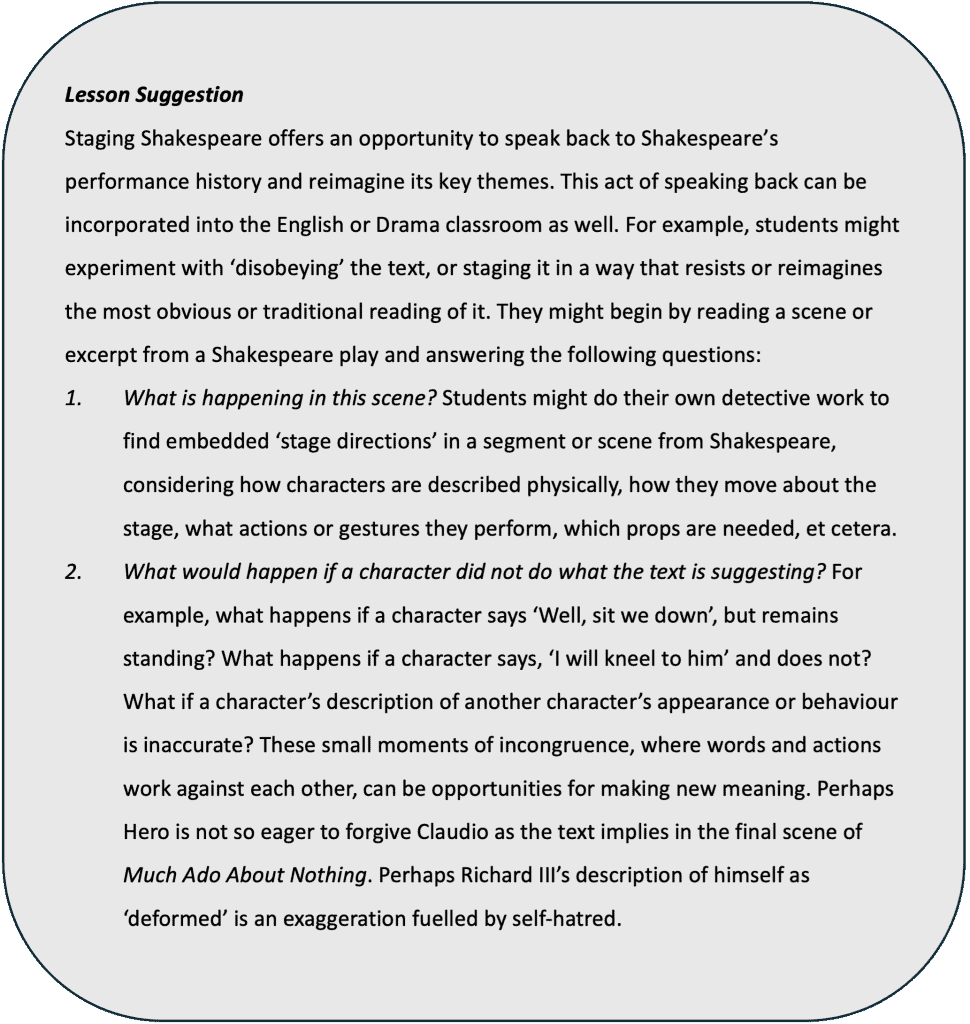
However, Shakespeare was one of the first playwrights to write dramatically; that is, in a way that engaged the actor’s body and moved it more dynamically around the stage. Shakespeare often embedded what Tiffany Stern and Simon Palfrey call ‘prompts for action’ in the dialogue of his plays[6]. These prompts function a bit like stage directions. Lines like ‘Well, sit we down’ (Hamlet 1.1.32), ‘What, dost thou turn away and hide thy face?’ (2 Henry VI 3.2.74), and ‘I will kneel to him’ (The Tempest 2.2.117), indicate not only what the characters are saying, but also what they are doing. Even more subtle language features, like repetition, onomatopoeia, and alliteration, can give indications about a character’s emotional state and temperament. Prompts like these first began to appear in the work of the playwright Thomas Kyd, and Shakespeare refined and mastered the art of ‘mapping gesture-potentiated language onto the body’[7]. This style of writing and performing paved the way for the more naturalistic theatre of the nineteenth and twentieth centuries.
From the perspective of drama history, therefore, Shakespeare’s work sits as a kind of lynchpin between the pre-modern and modern theatre in England. These facts can be a useful way of introducing Shakespeare to a classroom, to explain the importance of Shakespeare to Western culture in an approach that goes beyond the claim that his plays are universal and relevant. One way that students – especially drama students – can explore early modern playwriting and performing practices is by reading an excerpt from Shakespeare and doing some detective work to discover embedded ‘stage directions’ or prompts for action in the dialogue. They might be surprised at how many they find. Students who are confident getting up on their feet in the classroom can experiment with rehearsing a scene and trying to discover and obey as many prompts as possible. They may soon discover that the text is ‘directing’ the on-stage action quite closely.
Shakespeare as a platform for critical thinking
Some scholars argue that Shakespeare matters because Western culture has made him matter. Michael Bristol writes that ‘Shakespeare has made the big time’[8]. Shakespeare’s work has become ubiquitous in education, art, and popular culture: the image of Shakespeare’s face is a logo that most people recognise[9]. As a result of this fame, his works have often been the medium for discussions of important societal questions. Ivo Kamps writes,
Shakespeare is far more important to criticism as a conduit, as a uniquely powerful academic interface, as that part of the academic body through which the most theoretical innovation and political energy course. Shakespeare’s name provides the critic with a forum; it is the occasion for literary criticism[10].
In other words, Shakespeare’s plays have, for the last four hundred years, been a platform for discussions of big questions. Academics, performers, and educators have used Shakespeare’s plays to explore questions of truth, morality, sexuality, gender roles, justice, otherness, and race. These explorations present powerful opportunities to students studying Shakespeare today. Studying Shakespeare’s plays allows them to enter into a four-hundred-year-old conversation. One way that students can participate in such discussions is by studying the performance history of a Shakespeare play. Tracing the history of a play’s performance and analysis can give students insight into the values and beliefs of different cultures and time periods, including their own. The following summary of the character Ophelia from Hamlet provides an illustrative example.
Example: Ophelia
Tracing the performance and critical history of Hamlet is, in one sense, a way of tracing historical understandings of femininity and female mental health. In seventeenth-century stage productions, Ophelia was often depicted as psychologically fragile and weak – a woman with hysterical tendencies. These characteristics were at the time considered to be ‘typical biological and emotional weaknesses of the female sex’[11]. Later, during the eighteenth and nineteenth centuries, Ophelia’s madness was sentimentalised and rendered picturesque[12]. She was romanticised and her emotional fragility became an attraction. In fact, Magda Romanska writes that these depictions of Ophelia ‘set the standard of the nineteenth-century feminine ideal’[13]. We see this idealised, romanticised, and at times eroticised depiction of a fragile Ophelia in films such as Laurence Olivier’s 1948 film, or Sir John Everett Millais’ 1852 painting.
By the mid-twentieth century, however, the tide had begun to turn. With the advent of feminism, Ophelia began to be seen as a subject, rather than an object of male pity or desire. Her madness was interpreted as being more deliberate and infused with anger. Some critics argued that Ophelia’s madness was a ‘protest and rebellion’ in which ‘Ophelia is able to strip off her object position, communicate her anger, frustration, and everything she is forced to deny, and become a subject’[14]. Twentieth-century depictions of Ophelia emphasise her agency and her sexuality. This interpretation has continued into the twenty-first century. In the Royal Shakespeare Company’s 2010 production, Ophelia entered during her ‘mad scene’ wearing a band t-shirt, listening to rock music and aggressively driving a trolley around the stage while screaming her lines.
Some recent productions have depicted Ophelia’s madness as a more realistic and less idealised psychological disintegration. Robert Icke’s 2017 production of Hamlet for the Almedia Theatre in London brought to the forefront a more contemporary depiction of Ophelia’s madness as a form of depressive psychosis: Ophelia was brought on-stage in a wheelchair and punctuated her songs with moments of frantic self-injury. Throughout the production, extra-textual scenes and moments were introduced that highlighted Ophelia’s struggles with her mental health.
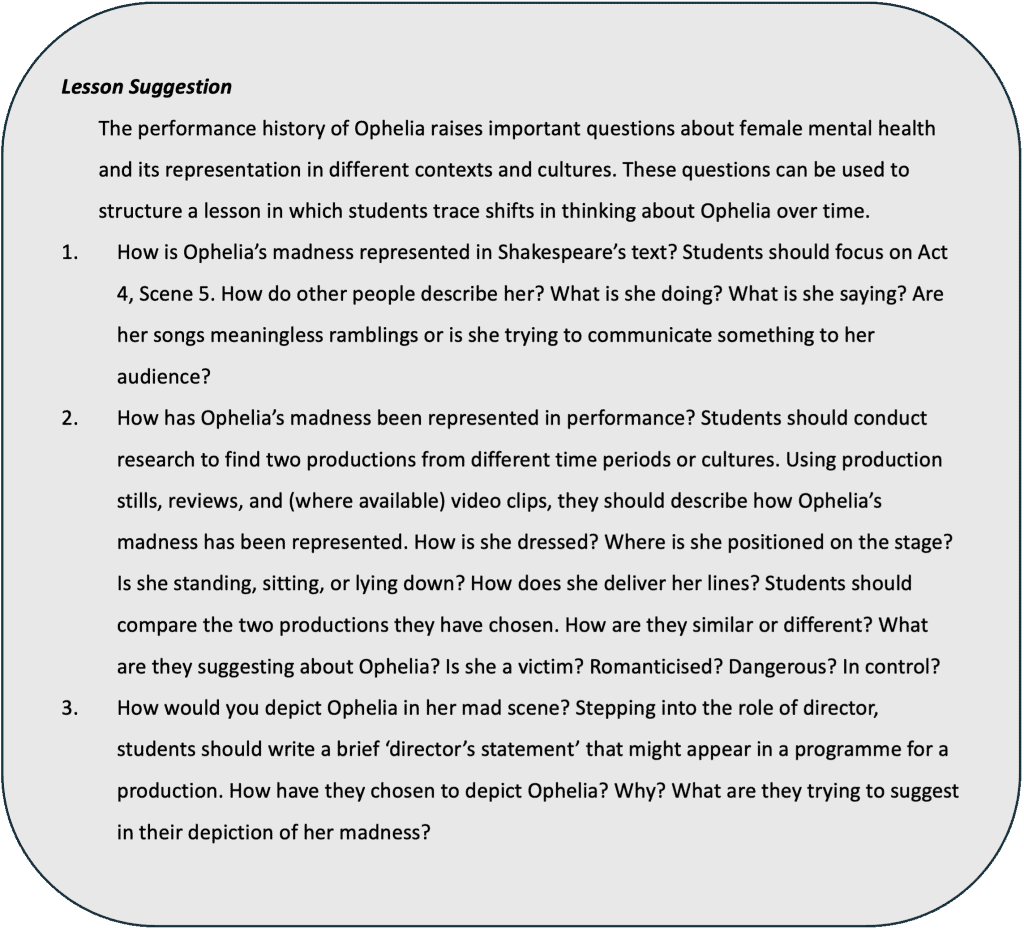
Analysing past productions of Shakespeare can allow students an opportunity to participate in a centuries-long discussion about gender and human psychology. Similar questions can be asked about other prominent Shakespearean characters whose characters have undergone transformation and revision, such as Juliet, Othello, Richard III, and Lady Macbeth.
Shakespeare as a platform for de-colonisation, and revision
The fact that Shakespeare is ‘located within a canon of imperialism’ (as argued by Creative New Zealand) can be seen as both a problem and an opportunity. During the early modern period, concepts of the racial and social ‘other’ were beginning to develop and take shape. Across time, characters like Othello and Richard III have been depicted in ways that we might now recognise as racist or ableist. However, studying, watching, and performing these plays today can create opportunities for de-colonisation and revision.
The Pop-up Globe’s 2017 production of A Midsummer Night’s Dream demonstrates how Shakespeare performances can create spaces for decolonisation. In this performance, the fairies were played by Māori actors who spoke in te reo Māori and wore traditional Māori dress. The four lovers – Lysander, Demetrius, Helena, and Hermia – all wore Jacobean costumes and spoke Shakespeare’s English. The lovers were at the mercy of the fairies throughout the production, helpless against the joyfully brazen tricks of Puck, who leapt about the stage, deceiving the lovers and sharing gleeful exchanges with Oberon in te reo Māori. No subtitles were offered, and audience members who did not speak Māori gleaned meaning from the expressive body language of the actors. At the close of the production, Puck’s line ‘Lord, what fools these mortals be!’ was translated into a single word: ‘Pākehā!’ In the Pop-up Globe – a replica of Shakespeare’s theatre that explicitly evoked England at the early stages of its colonial era – the Māori performers playfully reclaimed one of Great Britain’s most significant cultural icons.
Finding spaces of resistance in Shakespeare can be an important learning experience for students. It unlocks the reality that the students are participants in the meaning-making process, and not simply observers or interpreters. It also engages their critical faculties. Students can start to think not just about what Shakespeare is asking of or telling them, but also about what their own response to those ideas is. This process engages the students in a form of dialogue with Shakespeare that involves both close listening and critical response.
On-your-feet learning and classroom resources
One of the easiest and fastest ways to destroy a young person’s love of Shakespeare is by forcing them to sit down and read the play as though it were a merely literary text. Although reading Shakespeare can be useful and productive, young people encountering his plays for the first time often benefit from a more dynamic approach that brings the difficult language to life. A number of organisations and projects have arisen to help students discover Shakespeare in a dynamic and exciting way in the classroom. The following resources may be useful for primary and secondary schools wanting to incorporate Shakespeare into their classrooms in a more dynamic and engaging way:
- Bell Shakespeare’s Education resources
- The Shakespeare Reloaded project
- Griffiths, H. (2024). Disavowing Authority in the Shakespeare Classroom. Cambridge University Press.
- Semler, L. E., Hansen, C., & Manuel, J., Eds. (2023). Reimagining Shakespeare Education: Teaching and Learning through Collaboration. Cambridge: Cambridge University Press.
By Dr Caitlin West
References
Bloom, H. (1998). Shakespeare: The Invention of the Human. Riverhead Books.
Bristol, M. D. (1996). Big-Time Shakespeare. Routledge.
Corlett, E. (14 October 2022). New Zealand pulls funding for school Shakespeare festival, citing ‘canon of imperialism.’ The Guardian.
French, E. (2006). Selling Shakespeare to Hollywood: The Marketing of Filmed Shakespeare Adaptations from 1989 into the New Millennium. University of Hertfordshire Press.
Kamps, I. (2013). “Alas, poor Shakespeare! I knew him well.” Shakespeare and Appropriation, Routledge, pp. 15-32.
Kott, J. (1967). Shakespeare Our Contemporary. 2nd ed., Methuen Drama.
Palfrey, S, & Stern, T. (2007). Shakespeare in Parts. Oxford University Press.
Romanska, M. (2007). Hamlet, masculinity and nineteenth century nationalism, in Blazan, S. (ed.). Ghosts, Stories, Histories: Ghost Stories and Alternative Histories. Cambridge Scholars Publishing.
Shakespeare, W. Hamlet. Edited by Harold Jenkins, Bloomsbury Publishing, 1982.
—. King Henry VI Part 2. Edited by Ronald Knowles, Bloomsbury Publishing, 1999. Arden Shakespeare Third Series. Drama Online, https://doi.org/10.5040/9781408160343.00000006.
—. The Tempest. Edited by Alden T. Vaughan and Virginia Mason Vaughan, Bloomsbury Publishing, 1999. Arden Shakespeare Third Series. Drama Online, https://doi.org/10.5040/9781408160183.00000045.
Taylor, G. (1989). Reinventing Shakespeare: A Cultural History, from the Restoration to the Present. Weidenfeld and Nicolson.
Teker, G. S. (2006). Empowered by madness: Ophelia in the films of Kozintsev, Zeffirelli, and Branagh. Literature Film Quarterly, 34:2, pp. 113-19.
Tribble, E. (2011). Cognition in the Globe: Attention and Memory in Shakespeare’s Theatre. Palgrave Macmillan.
Endnotes
[1] At the time of writing, New Zealand’s revised Years 7-13 English curriculum which is set to be implemented in early 2026 will re-introduce compulsory Shakespeare for senior students. This underscores his continued – if contested – presence in the New Zealand curriculum.
[2] Taylor, p.378.
[3] Taylor, p.384.
[4] Corlett.
[5] Corlett.
[6] Palfrey & Stern, p.328.
[7] Tribble, p.105.
[8] Bristol, p.3.
[9] French, p.15.
[10] Kamps, p.24.
[11] Teker, p.114.
[12] Teker, p.114.
[13] Romanska, p. 37.
[14] Teker, pp.114-115.