Slow pedagogies in early childhood education
The concept of ‘slow pedagogies’, developed by Dr Alison Clark, recognises that there is always a temporal dimension to everyday life in early childhood settings. The clock is crucial to how early childhood education is understood, organised, and performed, with time often conceptualised as a tool for determining what should happen and how activities should be structured within early childhood settings. The clock makes some things possible and limits other things, demands for some things to be prioritised, and for some things to be done according to a schedule. This perspective recognises the clock as a material object that interacts with and affects the everyday life of humans, agentically producing, enabling, and even excluding practices. The concept of slow pedagogies highlights the way in which time-directed approaches can lead to aspects of quality being subdued in favour of ‘getting it done in time’, and may lead to frenzied, frustrated, and frazzled feelings in children and teachers. The time that is needed to engage in meaningful interactions with young children is not always recognised or valued.
Re-conceptualising time
Slow pedagogies is an approach that highlights the way in which the clock operates on teachers, children, and practices in early childhood settings, and asks teachers to attend to a different sense of time – an approach that appreciates and is led by the rhythms of the person and of the task, so that each person holds their own time, and each task moves to its own rhythm. This is an approach which values the necessity and importance of routine tasks, but aims that the clock is not the principal value driving them. Teachers and children might move at their own pace, and steady, purposeful intentions might be more important than any sense of efficiency. Slowing down as a pedagogy is about letting go of the pressure to always be doing something, to always be productive. Presence is a powerful gift that teachers can offer children, and can lead to exciting discoveries that invigorate learning and teaching.
Slow practices focus on deprioritising established schedules, routines, and patterns of time in favour of holding on to the present moment. Rather than rushing to the next thing, teachers might think about slowing down as a way of expanding or stretching time to value the continuation of a present exploration, interest, or event. There can be valuable impacts on children’s learning when teachers are able to use time for simply being with children and their experiences (rather than doing), for contemplating and diving deep, and even for going off track. Teachers might also reconceptualise time as circular, rather than linear, which involves repeating and revisiting, spiralling deeper, and not being concerned about direction. Circular movements are seen as promoting inventive thinking and creativity, allowing more time for meaning-making with different events, objects, materials, and interactions, because there is no sense that a particular meaning, understanding, or outcome needs to be reached. It is dwelling in possibility and uncertainty that is valued.
Benefits for infants and toddlers
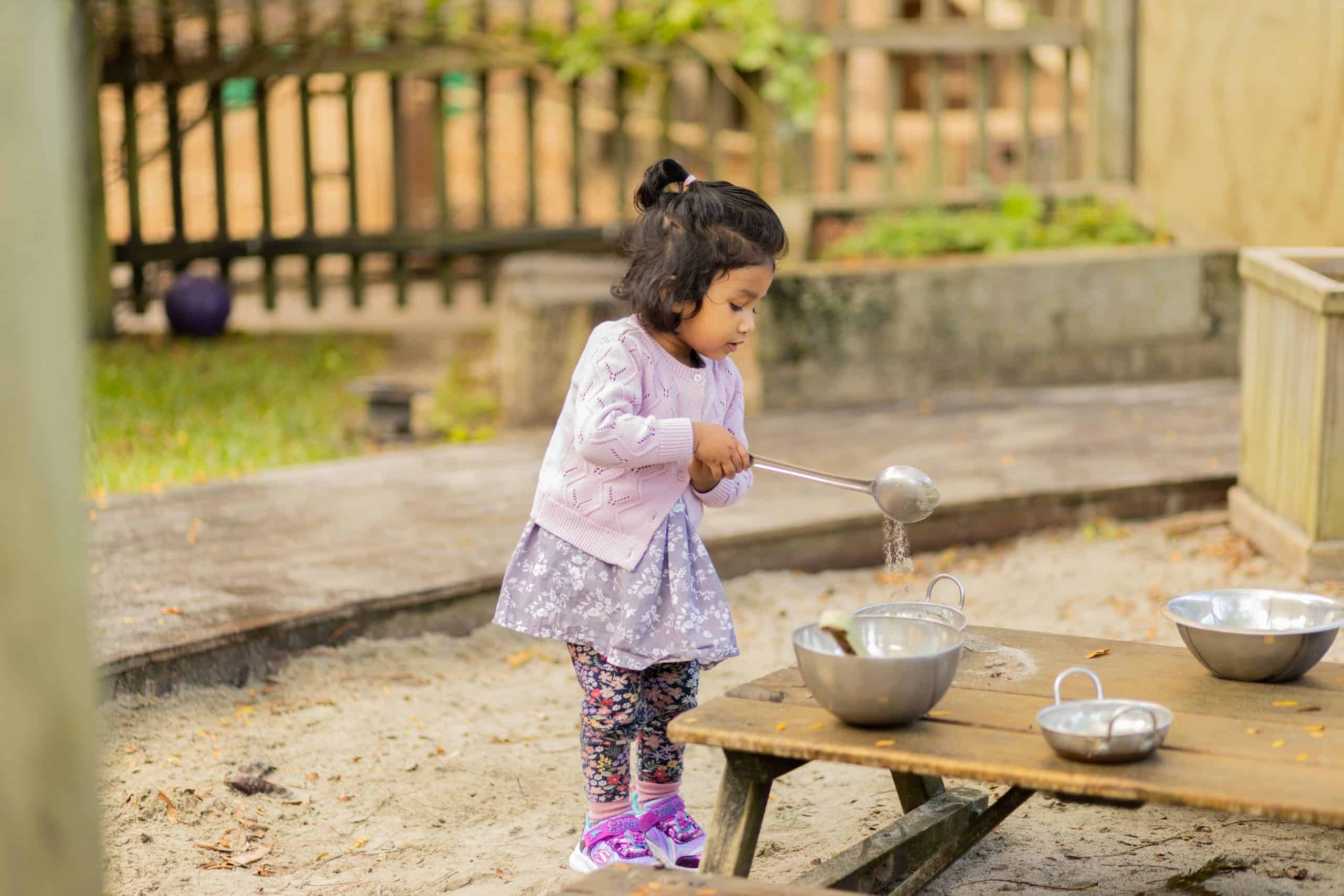
Slow pedagogies support the immersive nature of learning experiences for infants and toddlers, and the deep sensory engagement that is needed to support optimal brain development. Infants and toddlers are likely to take their time as they experience the world. Teachers might not only allow this, but also observe and appreciate it (and maybe even take their lead from it!). Going more slowly is thought to cultivate a deeper attention to things, and to enable teachers and children to become immersed in their experience, focusing only on being present, listening, and observing. For example, consider an infant who is given time to make their own slow progress across the floor to place their bib into the washing basket, and all the opportunities for learning and experiencing that this journey entails.
Infant and toddler wellbeing is promoted through a slowing down of pace that enables teachers to attune to their thoughts, ideas, and feelings. Slow pedagogies enable teachers to develop a watchfulness in which they are imbued with alertness to what is going on for an infant or toddler, and to the ways in which infants’ and toddlers’ bodily actions and rhythms express how they are making sense of the world and developing their identities. As infants’ and toddlers’ communication is primarily non-verbal (albeit sophisticated), slow pedagogies can support teachers to pay careful attention to children’s communicative cues, not to rush them but give them time to communicate, and to be reflective in interpreting the message communicated. It is so important for infants’ and toddlers’ sense of agency, identity, and competence that teachers support their initiatives, and these can be missed in busy early childhood settings when teachers are not able to properly attune to the subtle signals of children.
Slowing down, in its relationship to taking pause or taking a breath, can also be an important strategy for teachers’ emotional wellbeing, which in turn has an enormous impact on infants and toddlers and their ability to draw on the emotional state of the adults around them to co-regulate their own feelings and responses. The importance of positive relationships, emotional security, and wellbeing in infancy for outcomes across the lifetime is well-documented. In other words, while pedagogy plays out in the here and now, it also stretches into the future in terms of its potential for long-lasting impact in children’s lives.
Benefits for older children
One outcome of slow pedagogies for children is described as ‘slow knowledge’, which is generated through deeper exploration and through children and teachers becoming much more attuned to things as they listen and inquire into the world together, linger in experiences, and dwell on ideas and with materials. Slowing down is thought to help teachers and children to be in deep contemplation with others, materials, and place. Slow practices also give teachers and children much-needed time to perceive and interpret each other’s non-verbal and verbal contributions, with which they can establish intersubjectivity and co-construct knowledge. Slowing down, teachers have time for thinking deeply and engaging intentionally with children, with an openness to what might emerge. They are less likely to make quick assumptions, emphasise expected over potential outcomes, or move on too fast. Being open to going off track enables them to explore the unexpected, and offers children high levels of agency in their learning. When teachers slow down, they can offer expanded opportunities for exploration, deepening the value of time spent together and extending the duration of powerful learning and teaching opportunities. They appreciate that the here and now of children’s learning is as important as their long-term outcomes.
Slow pedagogies can be linked to concepts of intentional teaching, when teachers deliberately give time to observing, interacting, or exploring deeply with children, and when pedagogical choices allow children to continue with an activity or interest over much of a day, week, or month. Slow pedagogies also link well with the pedagogy of listening, as an intentional approach to observation, shared inquiry, and co-construction of curriculum.
References
Clark, A. (2023). Slow Knowledge and the Unhurried Child: Time for Slow Pedagogies in Early Childhood Education. Routledge.
Quiñones, G. (2025). Exploring infant-toddler’s wellbeing: Being-with the flow of time and space. In G. Quinones & A. Delaune (Eds.). Wellbeing for Infants and Toddlers in Education and Care (pp.163-176). https://doi.org/10.1007/978-3-031-89376-6_11