
Supporting holistic literacy practices in early childhood education
Given the importance of learning to communicate effectively in ways that support children’s social and emotional wellbeing, in a webinar, Dr Rebecca Hopkins from Auckland University of Technology supported teachers to broaden both their conceptualisation of literacy within early childhood educational settings, and their intentional practices to support children’s literacy skills and understandings.
Literacy is not limited to print-based reading and writing, but to the variety of ways in which people can communicate and comprehend meaning. While literacy is commonly regarded as an ability to read and write involving the understanding and use of alphabets and their relationship with phonemes, the concept of multiliteracies recognises the multiple ways in which we communicate and make meaning. A broader conceptualisation of literacy includes language and communication, physical and embodied literacies, visual literacies, and digital literacies. Literacy is multimodal for young children, meaning that a range of different ways of being literate, including through books, drawing, dance, movement, and singing, all come together very strongly. It is important to retain this holistic perspective on literacies, and revel in the messiness and entanglement of them all!
A broadened conception of literacy practices enables teachers to value and build upon the range of capabilities and competences that children hold for communicating meaning, which aligns with the holistic approach to curriculum that is at the heart of Te Whāriki. As children are engaged in rich literacy practices every day in their homes and early childhood settings, a conception of multiliteracies supports teachers to see and value the whole child and all of their diverse ways of communicating.
Children’s engagement in different literacy practices both provide a foundation for and affect their capacity for learning about reading and writing. For example, children who have very good oral language skills find it easier to learn to read and write. Building on children’s sense of enjoyment in exploring, interpreting, and making meaning in diverse ways can give children the confidence to take into new areas of learning, including reading and writing. This means that understanding children’s literacy practices at home and in the early childhood setting has important implications for the provision of equitable learning opportunities for all children.
Literacy is relational. Children become literate through relationships and through play. Children use language and comprehension skills to understand themselves, to relate to others, and to act in the world, so rich imaginary play is foundational for literacy learning. Literacy practices support children’s friendships, because being able to communicate your feelings and ideas, negotiate play and conflicts, and understand the verbal and non-verbal communications of other children is so important for peer relationships. Co-regulation, having someone to support the regulation of difficult or intense feelings and emotions, is an effective support for social and emotional learning.
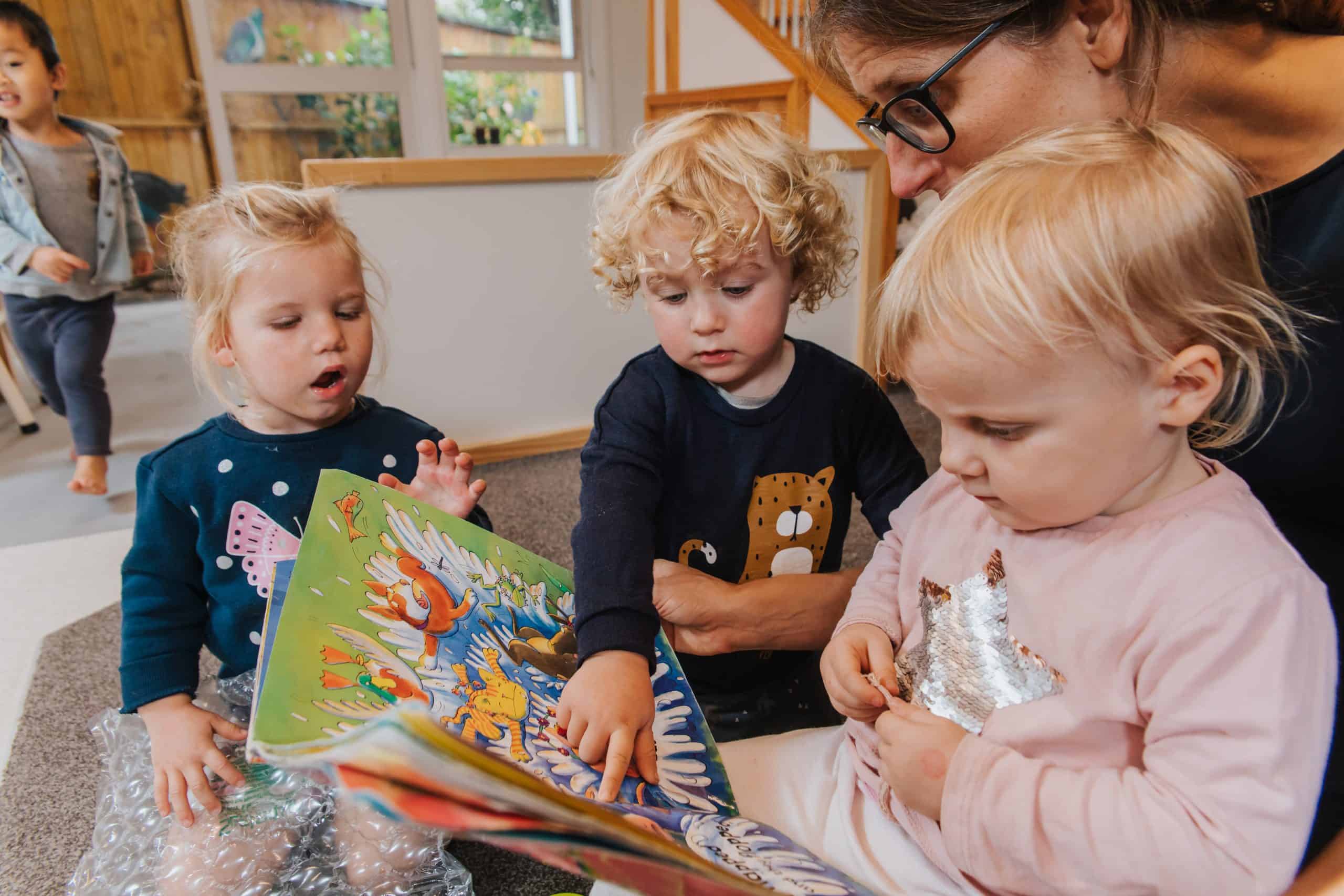
Shared reading is an important activity in early childhood. When children listen to, tell, and read stories they come to understand how a story works, how it is structured (with a beginning, middle, and end, involving some kind of adventure), and they can transfer those skills to their early reading experiences. They can learn about how a book works (in terms of the function of the cover, back of the book, and how the book is sequenced). Most important is that reading is dialogic, which means teachers read with children, developing a dialogue around the events and characters of the story. Rather than simply read ‘at’ children, it is important for teachers to make time for questions and back-and-forth conversations. It isn’t even necessary to read the whole book (although this might be important for some children) as spending time in rich exploration of just one page facilitates a range of literacy learning practices. Teachers can encourage children to develop their visual literacy skills through book reading, as they practise decoding images in the book in relation to the text. Shared reading can also support social and emotional skills, such as with taking turns to turn the page, discussing the different emotions, or reflecting on friendship skills (I Just Ate My Friend by Heidi McKinnon provides a humorous, and yet complex and nuanced, look at friendship, for example).
Storybooks can also prompt a range of literacy activities beyond reading. A story table can display props (perhaps made by children) from favourite stories, with which children can re-enact, or even create new, story events. Outdoors, children can reenact stories such as We’re Going on a Bear Hunt,by Michael Rosen,with large movements.
One powerful technique to support oral language development involves giving the child plenty of time to think about what you are saying and to respond. The practice of serve and return, in which adults and children exchange comments and take turns to contribute to the conversation, is crucial to oral language development. This can mean being comfortable to be silent, and remaining patient and available to hear children’s responses and build upon them to create a dialogue. Quality conversation builds literacy learning. Offering children really descriptive language is important, as the more vocabulary a child has, the more they are able to think in really complex and abstract ways. While structured learning moments can be included, they should be short and frequent, retaining a key focus on fun, engagement, and meaning. Songs and rhymes also help children to attune to the sounds that make up their language.
A range of mark-making activities are important for helping children to get a nice strong grip on a pen or pencil, which is really key for moving into writing later on. Activities such as making cards or notes for other children can support friendships and literacy practices at the same time.
The quality of provision and environments in early childhood settings impacts on children’s engagement with literacy practices. This can mean paying attention to how easily children can access books, both inside and outdoors, the quality and range of books, as well as how representative books are of the identities of the children who attend the setting. The spaces available for reading can also be assessed. The social environment for literacy practices is also significant, with children being much more likely to sit and enjoy books in a reading area if there is an adult present. Outdoor provision is important, especially for children who prefer to be outdoors. Literacy provision here can be broadly conceived and include dancing games, mark-making with chalk, as well as access to books and art activities. Regular review of provision and how it connects to a holistic approach to literacy development that values and extends children’s multiliteracies is very important.
Further resources
McKinnon, H. (2018). I Just Ate My Friend. A & U Children. Watch a reading of the story here.
Rosen, M. (1993). We’re Going on a Bear Hunt. Watch a reading of the story here.
Learn more about supporting children’s early reading enjoyment through at the LitPlus research and professional learning community website.
Boyask, R., Wall, C., Harrington, C., Milne, J., & Couch, D. (2021). Reading for pleasure: For the collective good of Aotearoa New Zealand. National Library of New Zealand. Or read a news article on the report here.
Resources to support literacy development in ECE:
Ministry of Education (n.d.).Talking together – Te kōrerorero: Talk tools Ngā rauemi whakakōrero. The word web (p. 19) and open-ended questions suggestions (p. 26) are helpful and could be a focus for increasing intentional literacy interactions with children.
Ministry of Education. (2025). Kōwhiti Whakapae. Oral language & literacy. (see also the Social & Emotional section for considering multiliteracies.)